Understanding Stars: Their Life Cycle, Classification, and the Energy They Produce
70 likes | 203 Vues
Stars are the fundamental sources of light and energy in the universe, created through a process known as fusion, which combines simple elements into more complex ones. They undergo a life cycle from protostars to main sequence stars, ultimately becoming giants, dwarfs, or even black holes, depending on their initial size. The classification of stars is based on various criteria including size, color, luminosity, temperature, and age, highlighting the vital role they play in the cosmos.


Understanding Stars: Their Life Cycle, Classification, and the Energy They Produce
E N D
Presentation Transcript
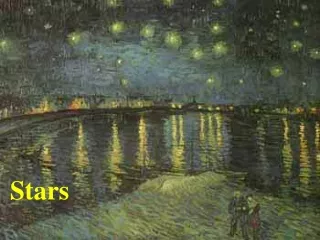
Stars(CN p. 15, Date) I know that stars are the source of all light in the universe, that stars age, and how stars are classified
______ _____? ______ _____? ______ _____? • Stars are the only thing in the universe that make natural energy and light through a process called fusion (combining atoms of simple elements to make more complex elements) • They give off this energy as radiation • Because they are very big, there is a lot of pressure and heat in stars, and they are in a state of matter called plasma • Life Cycle of Stars, stars are born and die: first they are protostars, then main sequence stars (longest period of their lives), finally they become giants, dwarfs, supernovas, neutron stars or black holes, depending on their size • Stars can be classifiedby their • Size • Color • Luminosity/Magnitude (how bright they are) • Temperature • Age
Activity • Interactive HR • http://aspire.cosmic-ray.org/labs/star_life/hr_diagram.html
Summary (p. 15): write 3 sentences, use and highlight stars, energy, classification, fusion)