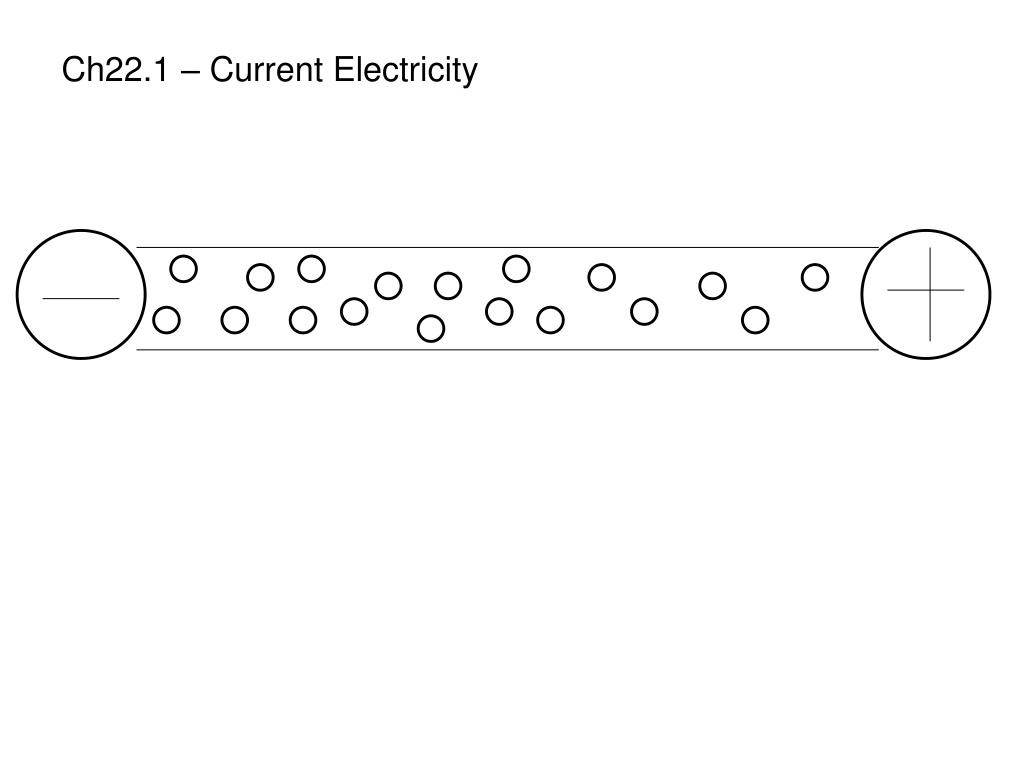
Ch22.1 – Current Electricity. Ch22.1 – Current Electricity. To get a current (a flow of charged particles), need to create a potential difference and sustain it. - batteries, generators. Battery - place any 2 different materials in contact, electrons flow.
Une image / un lien ci-dessous est fourni (tel quel) pour télécharger la présentation
Politique de téléchargement : le contenu du site vous est fourni TEL QUEL pour votre information et votre usage personnel ; il ne peut être vendu, concédé sous licence ni partagé sur d’autres sites sans l’accord de son auteur.Le contenu vous est fourni TEL QUEL, pour votre information et votre usage personnel uniquement.Téléchargez la présentation en cliquant sur ce lien.Lors du téléchargement, si vous ne parvenez pas à télécharger une présentation, l’éditeur a peut-être supprimé le fichier de son serveur.Pendant le téléchargement, si vous ne parvenez pas à obtenir une présentation, le fichier a peut-être été supprimé par l’éditeur.
Ch22.1 – Current Electricity To get a current (a flow of charged particles), need to create a potential difference and sustain it. - batteries, generators Battery - place any 2 different materials in contact, electrons flow
Ex1: what is the potential difference between: Electronic series for several metals 1) Gold and copper? Lithium Potassium Sodium Aluminum Zinc Iron Nickel Tin Lead Hydrogen Copper Mercury Silver Platinum Gold • 3.0V • -2.9V • -2.7V • -1.7V • -.76V • -.44V • -.26V • -.14V • -.13V • 0V • .34V • .8V • .8V • 1.2V • 1.3V 2)Silver and lithium? 3) Iron and potassium? 4) Zinc and copper? 5) Copper and nickel
Ex1: what is the potential difference between: Electronic series for several metals 1) Gold and copper? Lithium Potassium Sodium Aluminum Zinc Iron Nickel Tin Lead Hydrogen Copper Mercury Silver Platinum Gold • 3.0V • -2.9V • -2.7V • -1.7V • -.76V • -.44V • -.26V • -.14V • -.13V • 0V • .34V • .8V • .8V • 1.2V • 1.3V (1.3V) – (.34V) = .96V 2)Silver and lithium? (.8V) – (-3.0V) = 3.8V 3) Iron and potassium? (-.44V) –(-2.9V) = 2.46V 4) Zinc and copper? (.34V) – (-.76V) = 1.10V 5) Copper and nickel (.34V) – (-.26V) = .6V
Current (I) - rate at which charge flows q Coulombs Amps = I = sec t Ex2: The belt on the Van de Graaf generator carries 20µC of charge to the sphere when it rotates in 2 seconds. Determine the current. Ex3: The starter motor in a car draws 180A of current from the battery in about 2 seconds. How much charge is flowing thru the circuit?
Resistance (R) – resists the flow of current. Symbol: - usually made of semi conductive materials, like carbon - resistors are small usually, so use a color code to ID Color Code Ex4) What is the resistance of: Red, green, blue, gold Ex5) brown, black brown, gold Ex6) Color stripes for 4000Ω +/-10% 0 1 2 3 4 5 6 7 8 9 +/- 5% +/- 10% Black Brown Red Orange Yellow Green Blue Violet Gray White Gold Silver Ch22 HW #1
Resistance (R) – resists the flow of current. Symbol: - usually made of semi conductive materials, like carbon - resistors are small usually, so use a color code to ID Ex4) What is the resistance of: Red, green, blue, gold 25 x 106Ω +/-5% Ex5) brown, black brown, gold 10 x 101Ω +/-10% Ex6) Color stripes for 4000Ω +/-10% Yellow, black, red, silver Color Code 0 1 2 3 4 5 6 7 8 9 +/- 5% +/- 10% Black Brown Red Orange Yellow Green Blue Violet Gray White Gold Silver Ch22 HW #1
Lab22.1 Batteries - Lab due tomorrow - Ch22 HW#1 due at beginning of period
Ch22 HW#1 1 – 10 • 1. What is the potential for a wet cell battery made with nickel and zinc? • 2. What is the potential for a wet cell battery made with • Al and mercury? • 3. What is the potential for a wet cell battery made with • Pt and Cu? • 4. What is the potential for a wet cell battery made with sodium and tin?
Ch22 HW#1 1 – 10 • 1. What is the potential for a wet cell battery made with nickel and zinc? • -.76 – (-.26) = .5V • 2. What is the potential for a wet cell battery made with • Al and mercury? • -1.7 – (.80) = 2.5V • 3. What is the potential for a wet cell battery made with • Pt and Cu? • 4. What is the potential for a wet cell battery made with sodium and tin?
Ch22 HW#1 1 – 10 • 1. What is the potential for a wet cell battery made with nickel and zinc? • -.76 – (-.26) = .5V • 2. What is the potential for a wet cell battery made with • Al and mercury? • -1.7 – (.80) = 2.5V • 3. What is the potential for a wet cell battery made with • Pt and Cu? • .34 – (1.2) = .86V • 4. What is the potential for a wet cell battery made with sodium and tin? • -.14 – (-2.7) = 2.56V
5. What is the current when 25 C of charge pass by a point in 10 seconds? • 6. What is the current when 4.5 C pass by a point • in 3.2 seconds? • 7. What is the resistor with the colors: • gray, green, red, silver? • 8. What is the resistor with the colors: • red, green, brown, gold? • 9. Write the color band for a 1000, +/- 5% resistor. • 10. Write the color band for a 300,000, +/-10% resistor.
5. What is the current when 25 C of charge pass by a point in 10 seconds? • I = q/t = 25C/10s = 2.5A • 6. What is the current when 4.5 C pass by a point • in 3.2 seconds? • 7. What is the resistor with the colors: • gray, green, red, silver? • 8. What is the resistor with the colors: • red, green, brown, gold? • 9. Write the color band for a 1000, +/- 5% resistor. • 10. Write the color band for a 300,000, +/-10% resistor.
5. What is the current when 25 C of charge pass by a point in 10 seconds? • I = q/t = 25C/10s = 2.5A • 6. What is the current when 4.5 C pass by a point • in 3.2 seconds? • I = q/t = 4.5x10⁻⁶C/3.2s = 1.4x10⁻⁶A • 7. What is the resistor with the colors: • gray, green, red, silver? • 8. What is the resistor with the colors: • red, green, brown, gold? • 9. Write the color band for a 1000, +/- 5% resistor. • 10. Write the color band for a 300,000, +/-10% resistor.
5. What is the current when 25 C of charge pass by a point in 10 seconds? • I = q/t = 25C/10s = 2.5A • 6. What is the current when 4.5 C pass by a point • in 3.2 seconds? • I = q/t = 4.5x10⁻⁶C/3.2s = 1.4x10⁻⁶A • 7. What is the resistor with the colors: • gray, green, red, silver? • 85x102Ω ± 10% • 8. What is the resistor with the colors: • red, green, brown, gold? • 9. Write the color band for a 1000, +/- 5% resistor. • 10. Write the color band for a 300,000, +/-10% resistor.
5. What is the current when 25 C of charge pass by a point in 10 seconds? • I = q/t = 25C/10s = 2.5A • 6. What is the current when 4.5 C pass by a point • in 3.2 seconds? • I = q/t = 4.5x10⁻⁶C/3.2s = 1.4x10⁻⁶A • 7. What is the resistor with the colors: • gray, green, red, silver? • 85x102Ω ± 10% • 8. What is the resistor with the colors: • red, green, brown, gold? • 25 x 101Ω ± 5% • 9. Write the color band for a 1000, +/- 5% resistor. • 10. Write the color band for a 300,000, +/-10% resistor.
5. What is the current when 25 C of charge pass by a point in 10 seconds? • I = q/t = 25C/10s = 2.5A • 6. What is the current when 4.5 C pass by a point • in 3.2 seconds? • I = q/t = 4.5x10⁻⁶C/3.2s = 1.4x10⁻⁶A • 7. What is the resistor with the colors: • gray, green, red, silver? • 85x102Ω ± 10% • 8. What is the resistor with the colors: • red, green, brown, gold? • 25 x 101Ω ± 5% • 9. Write the color band for a 1000, +/- 5% resistor. • brown, black, red, gold • 10. Write the color band for a 300,000, +/-10% resistor.
5. What is the current when 25 C of charge pass by a point in 10 seconds? • I = q/t = 25C/10s = 2.5A • 6. What is the current when 4.5 C pass by a point • in 3.2 seconds? • I = q/t = 4.5x10⁻⁶C/3.2s = 1.4x10⁻⁶A • 7. What is the resistor with the colors: • gray, green, red, silver? • 85x102Ω ± 10% • 8. What is the resistor with the colors: • red, green, brown, gold? • 25 x 101Ω ± 5% • 9. Write the color band for a 1000, +/- 5% resistor. • brown, black, red, gold • 10. Write the color band for a 300,000, +/-10% resistor. • orange, black, yellow, silver
Ch22.1Equivalent resistance When resistors are in series (one attached to next, etc), just add them up. Req = R1 + R2 +… Ex1) What is the equivalent resistance? 2Ω 3Ω 1Ω 2Ω 3Ω 4Ω 4Ω 4Ω 4Ω
Ch22.1Equivalent resistance When resistors are in series (one attached to next, etc), just add them up. Req = R1 + R2 +… Ex1) What is the equivalent resistance? 2Ω 3Ω = 5Ω 1Ω 2Ω 3Ω = 6Ω = 16Ω 4Ω 4Ω 4Ω 4Ω
Ohm’s Law - voltage, current, & resistance are related by: V= I.R Ex4) A 12V battery is attached to 100Ω resistor. What current passes through the circuit? 12V 100Ω Ex5) A 20V battery pushes 2A thru a circuit. What kind of resistance does it feel? I = 2A ? 20V Ch22 HW#2 11-20
Ch22 HW#2 11 – 20 • For 11 – 14, what is the equivalent resistance of: • 11. Two 10 resistors in series. • 10 10 • 12. Two 10 resistors in parallel. 10 • 10 • 13. A 10 , 25 , and a 35 resistor in series. • 10 25 35 • 14. A 300 and a 150 resistor in parallel. • 300 • 150
Ch22 HW#2 11 – 20 • For 11 – 14, what is the equivalent resistance of: • 11. Two 10 resistors in series. • 10 10 = 20 • 12. Two 10 resistors in parallel. 10 • = 5 • 10 • 13. A 10 , 25 , and a 35 resistor in series. • 10 25 35 • 14. A 300 and a 150 resistor in parallel. • 300 • 150
Ch22 HW#2 11 – 20 • For 11 – 14, what is the equivalent resistance of: • 11. Two 10 resistors in series. • 10 10 = 20 • 12. Two 10 resistors in parallel. 10 • = 5 • 10 • 13. A 10 , 25 , and a 35 resistor in series. • 10 25 35 = 70 • 14. A 300 and a 150 resistor in parallel. • 300 • = 100 • 150
18. A 9 V battery feels a resistance of 18 in the circuit it is attached to. • How much current will it produce? • 19. A 1.5 V D-Cell battery produces 0.75 A when in a circuit. • How much resistance is in this circuit? • 20. A 100 resistor has 1.1 A passing through it. What kind of voltage might cause this? 9V 18Ω I = .75A ? 1.5V I=1.1A R=100 V=?
18. A 9 V battery feels a resistance of 18 in the circuit it is attached to. • How much current will it produce? • 19. A 1.5 V D-Cell battery produces 0.75 A when in a circuit. • How much resistance is in this circuit? • 20. A 100 resistor has 1.1 A passing through it. What kind of voltage might cause this? 9V 18Ω I = .75A ? 1.5V I=1.1A R=100 V=?
18. A 9 V battery feels a resistance of 18 in the circuit it is attached to. • How much current will it produce? • 19. A 1.5 V D-Cell battery produces 0.75 A when in a circuit. • How much resistance is in this circuit? • 20. A 100 resistor has 1.1 A passing through it. What kind of voltage might cause this? 9V 18Ω I = .75A ? 1.5V I=1.1A R=100 V=?
18. A 9 V battery feels a resistance of 18 in the circuit it is attached to. • How much current will it produce? • 19. A 1.5 V D-Cell battery produces 0.75 A when in a circuit. • How much resistance is in this circuit? • 20. A 100 resistor has 1.1 A passing through it. What kind of voltage might cause this? • V = I.R = (1.1A)(100Ω) • = 110V 9V 18Ω I = .75A ? 1.5V I=1.1A R=100 V=?
Current - in a series circuit, current stays the same through out circuit. - in a parallel circuit, current splits up to the branches. Ex3) How much does each ammeter read? 5Ω 1) Req : 5+4 = 9 3V 4Ω V 3V Req 9Ω I = = = .33A A