Understanding Equilibrium and Activity Coefficients in Aqueous Solutions
This text delves into the concept of equilibrium, particularly focusing on the equilibrium constant (K or Keq) in the context of reactions involving calcium carbonate (CaCO3). It discusses the significance of activity and activity coefficients in determining ion interactions in solutions. The importance of understanding how temperature, ionic strength, and concentration influence these coefficients is emphasized, along with various methods for calculating them including the Debye-Hückel and Davies models. The interplay between non-ideal mixtures and the behavior of dissolved ions is also explored.

Understanding Equilibrium and Activity Coefficients in Aqueous Solutions
E N D
Presentation Transcript
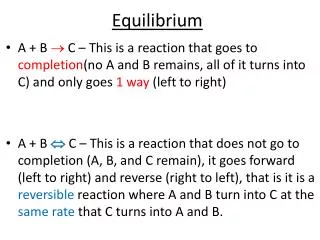
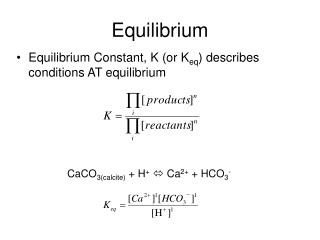
Equilibrium • Equilibrium Constant, K (or Keq) describes conditions AT equilibrium CaCO3(calcite) + H+ Ca2+ + HCO3-
Activity • Sometimes called ‘effective concentration’, which is misleading and reflects a poor understanding of the property… • Think of more of the effect the rest of a solution has on how easily two ions come together..
Activity • For solids or liquid solutions: ai=Xigi • For gases: ai=Pigi = fi • For aqueous solutions: ai=migi Xi=mole fraction of component i Pi = partial pressure of component i mi = molal concentration of component i
Activity Coefficients • Where do they come from?? • The standard state for dissolved ions is actually an infinitely dilute solution… • Activity of phases - gases, minerals, and bulk liquids (H2O) are usually pretty close to 1 in waters • Dissolved molecules/ ions have activity coefficients that change with concentration (ions are curved lines relating concentration and activity coefficients, molecules usually more linear relation)
Application to ions in solution • Ions in solutions are obviously nonideal mixtures! ai = gimi • The activity coefficient, gi, is found via some empirical foundations • Dependent on the other ions in water…
Dissolved species gi • First must define the ionic strength (I) of the solution the ion is in: Where mi is the molar concentration of species i and zi is the charge of species I
Activity Coefficients • Debye-Huckel approximation (valid for I: • Where A and B are constants (depending on T, see table 10.3 in your book), and a is a measure of the effective diameter of the ion (table 10.4)
Different ways to calculate gi • Limiting law • Debye-Huckel • Davies • TJ, SIT models • Pitzer, HKW models
Neutral species • Setchnow equation: • Logan=ksI For activity coefficient (see table 4-2 for selected coefficients)