Une image / un lien ci-dessous est fourni (tel quel) pour télécharger la présentation
Politique de téléchargement : le contenu du site vous est fourni TEL QUEL pour votre information et votre usage personnel ; il ne peut être vendu, concédé sous licence ni partagé sur d’autres sites sans l’accord de son auteur.Le contenu vous est fourni TEL QUEL, pour votre information et votre usage personnel uniquement.Téléchargez la présentation en cliquant sur ce lien.Lors du téléchargement, si vous ne parvenez pas à télécharger une présentation, l’éditeur a peut-être supprimé le fichier de son serveur.Pendant le téléchargement, si vous ne parvenez pas à obtenir une présentation, le fichier a peut-être été supprimé par l’éditeur.
F I N
Plus de contenu associé
Transcription de la présentation
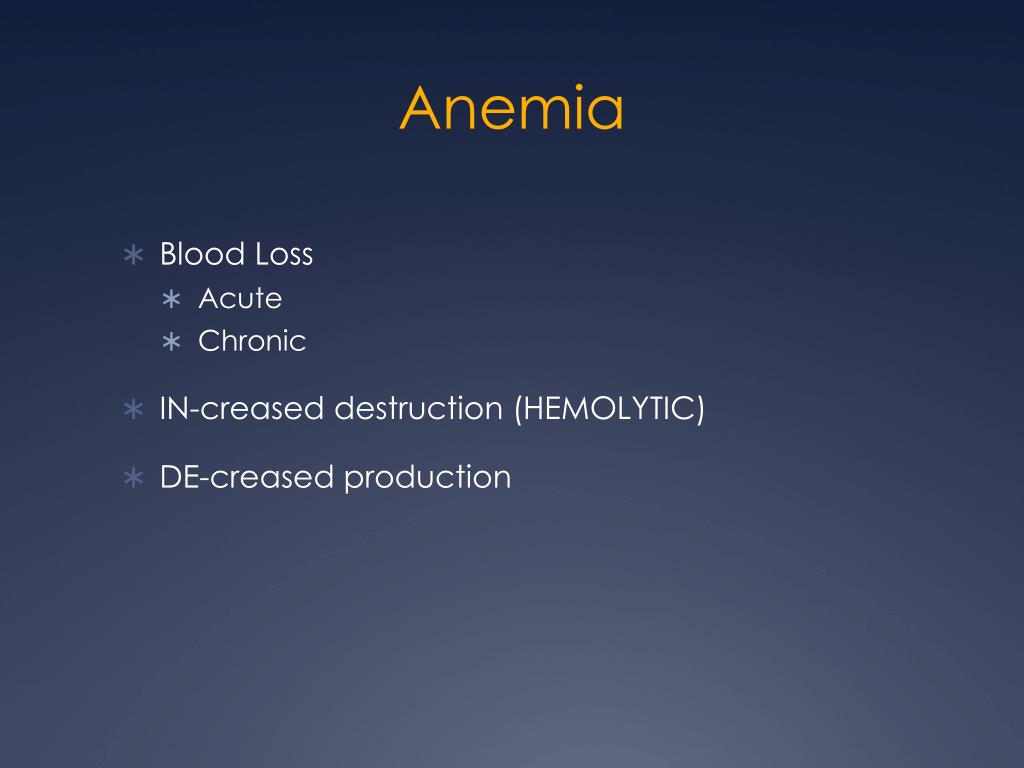
Anemia • Blood Loss • Acute • Chronic • IN-creased destruction (HEMOLYTIC) • DE-creased production
Features of All Anemias • Pallor, where? • Tiredness • Weakness • Dyspnea, why? • Palpitations • Heart Failure (high output), why?
Blood Loss • Acute • Trauma • Chronic • Lesions of gastrointestinal tract, gynecologic disturbances. The features of chronic blood loss anemia are the same as iron deficiency anemia, and is defined as a situation in which the production cannot keep up with the loss.
Impaired Production • Disturbance of proliferation and differentiation of stem cells: aplastic anemias, pure RBC aplasia, renal failure • Disturbance of proliferation and maturation of erythroblasts • Defective DNA synthesis: (Megaloblastic) • Defective heme synthesis: (Fe) • Deficient globin synthesis: (Thalassemias)
Sickle Cell Disease • Classic hemoglobinopathy • Normal HGB is α2 β2: β-chain defects (Val->Glu) • Reduced hemoglobin “sickles” in homozygous • 8% of American blacks are heterozygous
Clinical features of HGB-S disease • Severe anemia • Jaundice • PAIN (pain CRISIS) • Vaso-occlusive disease: EVEREWHERE, but clinically significant bone, spleen (autosplenectomy) • Infections: Pneumococcus, Hem. Influ., Salmonella osteomyelitis
THALASSEMIAS • A WIDE VARIETY of diseases involving GLOBIN synthesis, COMPLEX genetics • Alpha or beta chains deficient synthesis involved • Often termed MAJOR or MINOR, depending on severity, silent carriers and “traits” are seen • HEMOLYSIS is uniformly a feature, a microcytic anemia • A “crew cut” skull x-ray appearance may be seen
Paroxysmal Nocturnal Hemoglobinuria (PNH) • ACQUIRED, NOT INHERITED like all the previous hemolytic anemias were • ACQUIRED mutations in phosphatidylinositol glycan A (PIGA) • It is “P” and “N” only 25% of the time GlycosylphosPhatidylInositol
Immunohemolytic Anemia • All of these have the presence of antibodies and/or compliment present on RBC surfaces • NOT all are AUTOimmune, some are caused by drugs
Coombs Test • DIRECT: Patient’s CELLS are tested for surface Ab’s • INDIRECT: Patient’s SERUM is tested for Ab’s.
NON-Hemolytic Anemias:i.e., DE-creased Production • “Megaloblastic” Anemias • B12 Deficiency (Pernicious Anemia) • Folate Deficiency • Iron Deficiency • Anemia of Chronic Disease • Aplastic Anemia • “Pure” Red Cell Aplasia • OTHER forms of Marrow Failure
MEGALOBLASTIC ANEMIAS • Differentiating megaloblasts (marrow) from macrocytes (peripheral smear, MCV>94) • Impaired DNA synthesis • For all practical purposes, also called the anemias of B12 and FOLATE deficiency • Often VERY hyperplastic/hypercellular marrow
Ileal resection, ileitis • Competitive parasitic uptake • Fish tapeworm in • Fish tapeworm infestation • Bacterial overgrowth in blind loops and diverticula of bowel • Increased requirement • Pregnancy, hyperthyroidism, disseminated cancer
Vit-B12 Physiology • Oral ingestion • Combines with INTRINSIC FACTOR in the gastric mucosa • Absorbed in the terminal ileum • DEFECTS at ANY of these sites can produce a MEGALOBLASTIC anemia
Please remember that ALL megaloblastic anemias are also MACROCYTIC (MCV>94 or MCV~100), and that not only are the RBC’s BIG and hyperplastic/hypercellular, but so are the neutrophils, and neutrophilic precursors in the bone marrow too, and even more so, HYPERSEGMENTED!!!
APLASTIC ANEMIAS • ALMOST ALWAYS involve platelet and WBC suppression as well • Some are idiopathic, but MOST are related to drugs, radiation • FANCONI’s ANEMIA is the only one that is inherited, and NOT acquired • Act at STEM CELL level, except for “pure” red cell aplasia
MYELOPHTHISIC ANEMIAS • Are anemias caused by metastatic tumor cells replacing the bone marrow extensively
Fe Deficiency Anemia • Due to increased loss or decreased ingestion, almost always, in USA, nowadays, increased loss is the reason • Microcytic (low MCV), Hypochromic (low MCHC) • THE ONLY WAY WE CAN LOSE IRON IS BY LOSING BLOOD, because FE is recycled!
+++ ++ Fe Fe Regulation of iron absorption Gut lumen Heme Fe DMT1 Enterocyte Ferritin ++ +++ Fe Fe MTP1 Enterocyte precursor Plasma transferrin Transferrin Receptor HFE Hepcidin
Gastrointestinal absorption 1 mg/day Functional iron Blood, marrow, myoglobin 2 grams Storage iron Liver, RES 1 gram Plasma transferrin 2 mg Daily physiologic loss 1 mg
Clinical Fe-Defic-Anemia • Adult men: GI Blood Loss • PRE menopausal women: menorrhagia • POST menopausal women: GI Blood Loss
2 BEST lab tests: • Serum Ferritin • Prussian blue hemosiderin stain of marrow (also called an “iron” stain)
Treatment of iron def anemia • Oral iron is the preferred initial treatment • Recommended daily dose is 150-200mg/day of elemental iron • 325 mg of ferrous sulfate contains 65 mg of elemental iron • One table three times a day • Administer iron on an empty stomach with half a glass of OJ or 250mg ascorbic acid
Safety of intravenous iron Sodium ferric gluconate in sucrose (Ferrlecit) Available in Europe > 30 years 2.7 x 10⁶ doses/year in Germany + Italy in 1995 Iron dextran (Imferon until 1992, InFed since 1992) 3 x 10⁶ doses/year in US in 1996 Faich, Strobos. Am J Kidney Dis 1999: 33(3):464-70
Safety of intravenous iron Reported severe adverse reactions (1976 - 1996): SFGS 3.3 severe allergic reactions/106 doses, no fatalities ID 8.7 severe allergic reactions/106 doses, 31 fatalities Faich, Strobos. Am J Kidney Dis 1999: 33(3):464-70
Safety of intravenous iron Other theoretical risks: iron overload sepsis acceleration of atherosclerosis Faich, Strobos. Am J Kidney Dis 1999: 33(3):464-70
Medicare warning :( Recombinant human erythropoietin is approved only for treatment of anemia caused by renal failure or by cancer treatment and for certain hematologic malignancies. Sodium ferric gluconate in sucrose is approved only for treatment of anemia in patients on hemodialysis and for patients who have had a severe reaction to iron dextran.
Connexion au compte
Connectez-vous pour publier votre contenu sur SlideServe.