Ocean plants
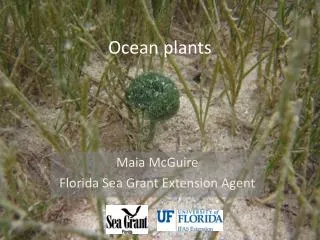
Ocean plants. Maia McGuire Florida Sea Grant Extension Agent. Terminology. Aquatic Estuarine Freshwater Marine Emergent Floating Submerged. Phytoplankton Algae Seagrass SAV (submerged aquatic vegetation) True plant. Phytoplankton.

Ocean plants
E N D
Presentation Transcript
Ocean plants Maia McGuire Florida Sea Grant Extension Agent
Terminology • Aquatic • Estuarine • Freshwater • Marine • Emergent • Floating • Submerged • Phytoplankton • Algae • Seagrass • SAV (submerged aquatic vegetation) • True plant
Phytoplankton • Mostly single-celled, photosynthetic, microscopic plants • DIATOMS are the most abundant type of phytoplankton—they have a silica “housing” • DINOFLAGELLATES often produce toxins (and red tides!); some bioluminesce
Activity • Design and construct a plankter
Algae blooms • Usually a response to increased nutrient levels • Phytoplankton reproduce by dividing, creating high concentrations (“blooms”) • Nutrient loading can be natural (upwelling) or related to runoff from land
Red tide • Bloom of a type of dinoflagellate • Algae release a chemical that goes into the water and also into the air • Causes respiratory difficulties to humans • Toxic to fish and sometimes to marine mammals
Red tide (cont.) • Blooms form offshore in Gulf of Mexico • Can bloom in any month of the year • Blooms can last for weeks to months; may be lengthened by runoff from land (?)
Multi-cellular plants… • Algae • Not considered true plants—no roots, flowers, vascular system • Often called “seaweed” • Often use holdfasts to attach to the substrate • Different groups of algae contain different types of chlorophyll • Green algae, brown algae, red algae
Reproduction in algae • Sexual reproduction involves production of spores, which produce a gametophyte, which produces gametes
Green algae • Contain chlorophyll a and b • Examples: sea lettuce (Ulvalactuca), dead man’s fingers (Codium fragile)
Brown algae • Contain chlorophyll a and c • Includes Sargassum seaweed
Red algae • Contain chlorophyll a • Source of agar, carrageenan (used in many food products • Few have common names • Often finely branching
Calcareous red algae • Often found on coral reefs—help “cement” the reef surface
Activity • Pressing seaweed
Seagrasses • Fully submerged marine plants; true angiosperms • True roots, vascular system, flowers • Reproduce asexually using rhizomes • 6-7 species; 3 common • Turtle grass, Shoal grass, Manatee grass • Star grass, Paddle grass, Johnson’s seagrass, • Widgeon grass (freshwater grass with high salinity tolerance)
Thalassia testudinumTurtle grass • Largest and most robust of Florida’s seagrasses • Flat, wide (4-12 mm) leaf blades (10-35 cm in length) • 2-5 leaves per shoot • Forms extensive meadows
Halodule wrightiiShoal grass • Early colonizer of disturbed areas or areas too deep or shallow for other seagrasses • Tolerates wide range of T, S • Leaves flat (1-3 mm wide), 10-20 cm long • Tips of leaves have 2-3 points
Syringodium filiformeManatee grass • Leaves are round (like spaghetti); 1-1.5 mm in diameter; length varies but can reach 50 cm • Commonly found mixed with other seagrasses or in small monospecific patches
Halophilaengelmanni, H. decipiens, H. johnsonii • Relatively sparsely distributed • Paddle-shaped leaf blades • Johnson’s seagrass is listed as a threatened species
Ruppia maritimaWidgeon grass • Often found alongside Halodule in areas of lower salinity • Important food for waterfowl • Primarily a freshwater plant
Seagrass distribution Thalassia testudinum Halodule wrightii Syringodium filiforme Halophila decipiens Halophila johnsonii Halophila engelmanii
Seagrass biology • Growth • Thalassia blades can grow as much as 1 cm/day • Growth is slowed by cooler temperatures • Extremes in temperatures (hot or cold) can kill leaf blades • Optimal temperature range 20-30° C • Optimal salinity range 24-35 ppt • Extensive seagrass beds not found deeper than 10-15 m (light and pressure are both factors)
Zonation • Halodule grows in shallowest water and has highest tolerance to exposure • Thalassia is most dominant; forms large meadows in waters up to 10-12 m deep • Syringodium forms meadows in deep water (up to 15 m) • Halodule and Halophila can grow in even deeper water, but sparsely
Productivity • Highly productive ecosystems • Important food source, for grazers and as detritus
Seagrasses provide habitat • Many species of fish • Molluscs (e.g. scallops, snails) • Shrimp, crabs and other crustaceans • Worms
Threats to seagrasses • Physical damage • Dredging, prop scars/blowouts • Eutrophication • Salinity stress • Temperature stress
Mangroves • Emergent plants • Very salt-tolerant • Have adaptations to deal with salt and wave action • Occur in zones • Three species in Florida
Red mangrove • Rhizophora mangle • Has prop roots to stabilize tree
Black mangrove • Avicenniagerminans • Has “pneumatophores” (breathing roots) • Salty leaves
White mangrove • Lagunculariaracemosa
Ocean stewardship • Read “A new home for an old friend” to teach kids that aquarium plants should not be dumped into ponds or the ocean • http://www.usc.edu/org/seagrant/caulerpa/index.html