Download
1 / 59
590 likes | 700 Vues
This chapter explores the emergence of absolutism in 17th-century Europe, focusing on key figures such as Louis XIV of France, Ivan the Terrible, and Peter the Great of Russia. It discusses the consolidation of power, the impact of the Edict of Nantes, the influence of Cardinal Richelieu, and the disastrous wars that marked Louis XIV's reign. It also examines the Romanov dynasty in Russia and its contributions to the state's transformation. Finally, the struggles between monarchy and parliament in England under James I and Charles I reveal the complexities of governance during this period.

E N D
AKS 42:Absolutism and Enlightenment Chapter 21 – PAGES 589-617 Chapter 22.2 & 22.3 – PAGES 629-639
FranceBackground: • Henry of Navarre (Henry IV) • 1st king of Bourbon Dyn. • Converted to Catholicism • Devoted reign to rebuilding France & its prosperity • Edict of Nantes • Issued by Henry • Huguenots could live in peace in France & set up their own houses of worship in certain cities
FranceBackground: • Cardinal Richelieu • No walls in Protest. cities • Weakened power of nobles by ordering them to take down their castles & by ↑ power of gov’t agents
“I am the state.” - Louis XIV FranceLouis XIV (14th) Comes to Power (4 yrs old ): • France suffered from riots by nobles – Louis’ life threatened at times • Louis never forgot fear/anger – vowed to be so strong nobles could never threaten him again So distinguished
FranceLouis XIV Comes to Power: • Jean Baptiste Colbert: • Made France economic power • Followed mercantilism – make France self-sufficient • Expanded & protected French industry. • Encouraged migration to Canada (fur trade)
FranceSun King’s Grand Style: • Controls Nobility • Nobles expected to be at Palace at Versailles – if not, incomes & social status ↓ • Made nobility totally dependent on Louis • Patron of the Arts • Pop. opera & ballet • Supported writers • Promoted art that glorified monarchy & supported absolute rule
FranceDisastrous Wars and Legacy: • Expansion • Wanted to expand – succeeded at first • Countries banned together to match France’s strength – balance of power
FranceDisastrous Wars and Legacy: • War of Spanish Succession (1701-1714) • Charles II of Spain died – throne went to Louis’ grandson – Spain & France now ruled by French Bourbon kings • Treaty that ended war allowed Louis’ grandson to stay in power as long as thrones of Spain & France not united • Big winner - Great Britain: • Took Gibraltar • ↑ involvement in slave trade
FranceDisastrous Wars and Legacy: • Death and Legacy: • People rejoiced at news of Louis’ death • Pos.: • Military leader of Europe • Ranked above all others in art, lit., statesmanship • Neg.: • War & construction of Palace at Versailles = massive debt • Tax burden by poor & Louis’ abuse of power would plague his heirs & set stage for revolution
RussiaThe First Czar: Wow, he’s ugly • Ivan the Terrible • 1st to call himself “czar” • 1547-1560 – “good period” – won victories, added lands, code of laws, ruled justly • Terror • 1560-1584 – “bad period” – Ivan accused boyars (nobles) of poisoning his wife, Anastasia • Using secret police – executed boyars, their families, & peasants who worked their land • 1581 – killed oldest son – left only weak son to rule
RussiaThe First Czar: • Romanovs: • Ivan’s son died – period of turmoil w/ no leader • 1613 – leaders from Russian cities met to choose next czar – chose Michael Romanov • Begins Romanov Dynasty (1613-1917) Mikey!!!
RussiaCzar Peter the Great: • Russia Different Than Europe: • Had looked to Constantinople for leadership • Mongols & geog. barriers had cut Russia off from Ren. & Age of Expl. • Relig. Diff. – Russia was E. Orthodox; W. Euro. mostly Cath. or Protest. • Russia viewed them as heretics
RussiaCzar Peter the Great: • Peter Visits West: • Believed future depended on having warm-water port • 1697 – “Grand Embassy” – long visit to W. Europe • Goal: learn about Euro. customs and manuf. techniques
RussiaPeter Rules Absolutely: “For you know yourself that, though a thing be good and necessary, our people will not do it unless forced to.” - Czar Peter the Great • Reforms: • Brought Russian Orthodox Church under state control • ↓ power of great landowners • Modernized army by hiring Euro. officers who drilled soldiers in Euro. tactics w/ Euro. weapons • Paid for army w/ heavy taxes
RussiaPeter Rules Absolutely: • Westernization: • Intro. potatoes • Started 1st newspaper • ↑ women’s status • Ordered nobles to adopt W. fashion • Advanced Edu. - *believed this was key to Russia’s progress
RussiaPeter Rules Absolutely: • St. Petersburg: • Wanted a seaport easier to travel to the W • Fought Sweden for land on Baltic Sea • Had St. Petersburg built on a piece of swampy land • Estimated 25,000 – 100,000 people died in the effort to build it
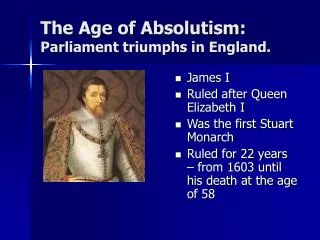
EnglandDefying Parliament: • James I (1603-1625): • Struggled w/ Parliament over $ • Agreed to new trans. of Bible
EnglandDefying Parliament: Charlie! • Charles I (1625-1649): • Forced to sign Petition of Right: • Not imprison subjects w/o due cause • Not levy taxes w/o Parl.’s consent • Not house soldiers in private homes • Not impose martial law during peacetime • Set forth idea that law was higher than king
EnglandEnglish Civil War (1642-1649): • Background/Causes: • Parl. passed laws to limit royal power – king outraged – arrested Parl. leaders – mob began to form • Loyal to Charles – Royalists/Cavaliers • Puritan supporters of Parl. – Roundheads
EnglandEnglish Civil War (1642-1649): • Result: • Roundheads win • Oliver Cromwell: • Roundhead General • Tried, beheaded Charles for treason - 1649 • Est. commonwealth (repub. form of gov’t)
SpainSpanish Empire: “His smile and his dagger were very close.” - Phillip’s court historian • Philip II: • Seized Portugal (no heir) – now had empire that circled the globe • Emp. gave him lots of wealth • Duty = defend Cath.
SpainDefeat of Spanish Armada: • Background: • Philip launched Armada in attempt to punish Protest. Eng. & Queen Eliz. I, who supported Protest. subj. who rebelled against Philip
SpainDefeat of Spanish Armada: • What Happened: • Spanish Armada defeated • Impact: • Seriously weakened Spain
SpainSpanish Art and Literature: • El Greco (“the Greek”): • Showed deep Cath. faith of Spain • Velasquez: • Court painter for Philip IV of Spain • Cervantes: • Don Quixote de la Mancha (1605) • Birth of modern European novel
SpainEmpire Weakens: • Inflation: • 2 causes: • Spain’s pop. ↑ • Silver bullion flooded marked value ↓ • Taxes: • Spain’s nobles don’t pay; burden on lower classes never dev. middle class • Bankruptcy: • Finance wars = Spanish kings borrowed $ • Philip declared Spain bankrupt 3 times
SpainDutch Revolt and Dutch Prosper: • 1579 – 7 N. provinces of Protest. Netherlands – united, declared ind. from Spain • Art: • Rembrandt – painted portraits of wealthy middle-class merchants • Trade: • Stability of gov’t concentration on econ. growth • Dutch E. India Co. – dominated Asian spice trade
PrussiaThirty Years’ War (1618-1648) • Causes: • Lutheran & Cath. princes tried to gain followers • Split in 2 leagues • Spark: • Ferdinand II (HRE) closed some Protest. churches, Protest. in Bohemia revolted
PrussiaThirty Years’ War (1618-1648) • Hapsburg Wins: • 1st 12 yrs • Haps. armies crushed troops hired by Protest. princes • Hapsburg Losses: • Protest. drove Haps. armies out of N. Germany
PrussiaThirty Years’ War (1618-1648) • Peace (Treaty) of Westphalia: • Weakened Spain & Austria (Haps.) • Strengthened France • German princes ind. of HRE • Ended relig. wars • New method of peace negot.
PrussiaThirty Years’ War (1618-1648) • Results: • Trade & agric. disrupted • Germany’s econ. ruined • Treaty recognized Euro. as a group of ind. states • Beginning of modern state system
AustriaGrows Stronger: • Austrian Haps. reconquered Bohemia – wiped out Protest. • Cent. gov’t; created standing army
AustriaMaria Theresa: • Charles VI convinced leaders of Europe to sign agreement Maria heir to all Haps. territories • Faced yrs of war – main enemy: Prussia
PrussiaRise: • Army of 80,000 men paid for w/ perm. taxation • Weakened rep. assemblies of their territories • Became rigidly controlled, militaristic soc.
PrussiaFrederick the Great: “…the fundamental role of governments is the principle of extending their territories.” - Frederick the Great • Military policies, softened some laws • Encouraged relig. toleration, legal reform • Ruler should be a father to his people
PrussiaWar of Austrian Succession (1740-1748) • Over Silesia (bordered Prussia) • Hungary & Britain helped Maria Theresa – stopped Prussian aggression • Prussia became major Euro. power
PrussiaSeven Years’ War (1756-1763) • Fought in Euro., India, & N.Am. • No change in territory in Euro. • British real victors • France lost colonies in N.Am. • Britain gained sole econ. domination in India