Une image / un lien ci-dessous est fourni (tel quel) pour télécharger la présentation
Politique de téléchargement : le contenu du site vous est fourni TEL QUEL pour votre information et votre usage personnel ; il ne peut être vendu, concédé sous licence ni partagé sur d’autres sites sans l’accord de son auteur.Le contenu vous est fourni TEL QUEL, pour votre information et votre usage personnel uniquement.Téléchargez la présentation en cliquant sur ce lien.Lors du téléchargement, si vous ne parvenez pas à télécharger une présentation, l’éditeur a peut-être supprimé le fichier de son serveur.Pendant le téléchargement, si vous ne parvenez pas à obtenir une présentation, le fichier a peut-être été supprimé par l’éditeur.
F I N
Plus de contenu associé
Transcription de la présentation
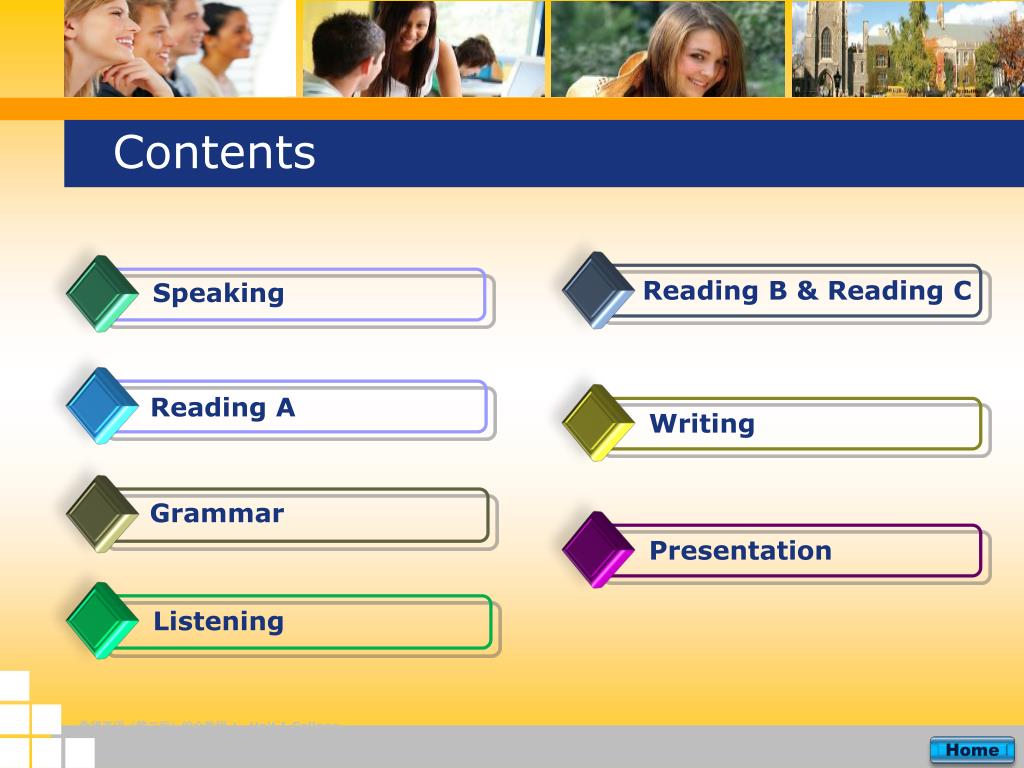
Contents Home Reading B & Reading C Speaking Grammar Listening Writing Presentation Reading A 希望英语(第二版)综合教程 1 Unit 1 College
Unit 1 College 希望英语 (第二版) 综合教程 1 希望英语 (第二版) 综合教程 1 Unit 1 College 外语教学与研究出版社
Speaking Next > Home < Back Speaking Task 1 Task 2 Task 3
S-Task 1 < Back Next > Home Speaking Task 1 Look at the pictures on Page 2 and list words or phrases about them. Then share your work with others. Suggested Words: library campus school bus hike backpack trekking pole teaching building tutor/teacher S-Task 1
S-Task 2 < Back Next > Home Speaking Task 2 Use the following sentence patterns and the words or phrases from Task 1 to describe the pictures on Page 2 to your classmates. A. In… you can see… B. There is/are… in… Sample Sentences: In this picture, you can see a professor tutoring a student in the teaching building. There is a teacher and his student in this picture. There are some students hiking in the mountain in this picture.
S-Task 3 < Back Next > Home Speaking Task 3 Work in pairs. Take turns asking your partner the following questions and make notes. Organize your notes and report to the class using the given paragraph as a model. Model Report Tom is a college freshman. He studies computers because he wants to start his own Web company in the future. He enjoys what he studies, but he is having some problems with his roommates. He hopes he can get over the problems soon. • Why do you come to college? • How do you like your college life? • What are the problems of living on campus? • What do you want to get from attending college?
Reading A Next > Home < Back Reading A Task 6 Task 1 Task 2 Text Task 7 Task 3 Task 8 Task 4 Task 9 Task 5
A-Task 1-1 < Back Next > Home Reading A Task 1 Try to work out the meanings of the highlighted words with the help of other words. The first one has been done for you. 1. I must make adjustmentsto my watch. It’s slow. changes; corrections 2. If students don’t like the food in the college cafeteria, they can go to the restaurants nearby. a restaurant, bar, etc. where people collect their own food and drink, often in a factory, college, etc.
A-Task 1-1 < Back Next > Home Reading A Task 1 3. The television interferes with his studying. He cannot concentrate. 4. Excessive beer drinking will cause stomach problems. 5. Philip works as a school counselor to give advice and help to college students. make hard for something to happen, prevent something from happening greater than what is normal or necessary; too much a person who gives advice to people who need it
A-Task 2-Text-1 < Back Next > Home Reading A Task 2 Text 声音 翻译 Going to College There are things you’ve never dealt with before: living away from home, dealing with roommates, washing your own clothes…, but with a little preparation, you can build enough confidence to tackle any stress that comesyour way.
A-Task 2-Text-2 < Back Next > Home Reading A Task 2 Text 声音 翻译 Living away from home tends tobe the toughest adjustment for first-year students. You’ve had a job descriptionthat clearly tells you your role within your family all your life. Whichever role youfulfilled at home, when you’re gone, you’re not sure where you fit in. It may seem like your family is doing fine without you, and you may feel sad about these changes. adjustment, role, changes
A-Task 2-Text-3 < Back Next > Home Reading A Task 2 Text 声音 翻译 You may also feel homesick in your first weeks and months. The first thing you should know is that homesickness is very common. In fact, just about everyone experiences it at some point in his or her life. But you still may feel lonely or left out. homesickness, lonely
A-Task 2-Text-4 < Back Next > Home Reading A Task 2 Text 声音 翻译 Some students turn toalcohol, heavy partying, excessive sleep or smoking to deal with these sorts of problems. However, too much partying can result ina lot more problems and can seriously interfere withyour ability to keep up with all your assignments, papers and exams, and that will only make matters worse. problems, interfere with
alcohol: [‘ælkəhɔl]酒; 酒精; 含酒精的饮料 ability: [ə’biliti]能力; 力量 able adj. be able to keep up with :跟上, 不落人之后 assignment: [ə’sainmənt] (分派的)任务,作业 assign vt. 分配; 交给 bad : worse worst糟糕的,差的;拙劣的,劣质的
A-Task 2-Text-5 < Back Next > Home Reading A Task 2 Text 翻译 声音 Try to identify your feelings and fears, and talk about what you’re going through. The sooner you deal with these issues, the sooner you’ll feel better. If you are homesick, it can help to call, write, or e-mail your parents, other family members, and friends from home to let them know how you’re doing and to tell them you miss them. identify, talk
the sooner…the sooner ---The harder he tried, the less progress he seemed to make. ----the sooner the better 尽早;越早越好 let sb do sth ---My boss let me leave early. 我老板允许我早些离开。
A-Task 2-Text-6 < Back Next > Home Reading A Task 2 Text 声音 翻译 Who else can you talk to? First of all, that person sharing the dorm room with you. Roommates are great built-in buddies, and as first-year students themselves, they’re probably experiencing many of the same fears and worries that you’re dealing with. buddies, same fears
first of all :首先;最初;最重要的是 share with:与…分享〔合用〕 roommate :室友,住在同室的人 eg. classmate, schoolmate built-in: [‘bɪlt’ɪn]是…的组成部分的; 嵌入式的; 内置的 buddy: [‘bʌdi]同伴, 伙伴
A-Task 2-Text-7 < Back Next > Home Reading A Task 2 Text 声音 翻译 But what ifyou don’t get along with your roommate?
get along with:进展,与…和睦相处 ---How are you getting along with your English studies? 你的英语学得怎样? ---He is good-tempered; he gets along with everyone. 他脾气好, 和谁都处得来。
A-Task 2-Text-8 < Back Next > Home Reading A Task 2 Text 声音 翻译 Your roommate might be as unlike you as the cafeteria’s mystery meat is from your mom’s pot roast. In some cases, that’s a good thing; opposites sometimes attract. And a different point of view may be what you need. But if you just don’t get along, there’s no reason to be mad. You’ll still have to spend the year together, so try to respect your differences. opposites, differences
cafeteria: [,kæfi’tiəriə]自助餐馆;自助食堂 mystery : [‘mistəri]神秘的事物;难以理解的事物;谜 roast : [rəust] vt. & vi.烤; 烘; 焙 n.烤肉 opposite: [‘ɔpəzit] n.对立面, 对立物, 相反的人[事物] attract : [ə’trækt]具有吸引力 respect : [ris’pekt]尊敬, 尊重 diferent adj. diference n. in some cases: 在某些时候 point of view:观点
A-Task 2-Text-9 < Back Next > Home Reading A Task 2 Text 声音 翻译 It can help to find someone you do feel understands you. On a campus with plenty of people of your age, chances are great you’ll find someone to talk to. And if you can’t wait for that, make a stop at the school counseling center. All universities have one, and first-year fears are something the counselors know well. find, talk to
A-Trans-8 < Back Reading A 室友也许与你差别很大,就如同食堂里叫 不出名字的肉与妈妈做的炖肉味道完全不同一 样。某些时候,这倒是件好事。相异有时相吸。不同的视角也许正是你所需要的。但如果真的 合不来,也不必生气,毕竟还得共度大学时光,所以要尽量去尊重你们之间的差异。
A-Trans-9 < Back Reading A 找一个你确实感觉能理解你的人会有益处。校园里同龄人很多,找到一个与你谈得来的人 并不困难。如果等不及,你就去学校心理咨询 中心。所有大学都设有心理咨询中心,那里的 顾问对新生的这些焦虑十分了解。
tackle < Back Reading A Task 2 Text tackle v.to dealwith 处理,解决,应付 e.g.Thequestionwassodifficultthatthestudents didn’tknowhowtotackleit. translation 我晚饭后开始做作业。 I’ll tackle my homework after supper.
stress < Back Reading A Task 2 Text stress n.pressure caused by difficulties in life压力,困难 e.g.He’s under stress because his wife is very ill. translation 我们当中并非所有人都能应付现代生活的紧张。 Not all of us can cope with the stresses of modern life.
tendto < Back Reading A Task 2 Text tend to to be likely to往往会,易于 e.g.Janet tends to get very angry if you annoy her. translation 年青人都趋于以自我为中心。 Young people tend to be self-centeredness.
jobdescription < Back Reading A Task 2 Text job description [dis’kripʃən] A job description is a list of the general tasks, or functions, and responsibilities of a position. Typically, it also includes to whom the position reports, specifications such as the qualifications needed by the person in the job, salary range for the position, etc.工作描述,工作说明,职责说明describe e.g.A typical job description will contain the job title, to whom the person is responsible, their main duties, followed by a more detailed list of tasks.
Whichever… < Back Reading A Task 2 Text Whichever role you fulfilled at home, ... Here“whichever”canbesubstitutedby“nomatter which”. e.g.Whichever he chooses, they won’t be pleased. translation 不管他选哪个,都会导致误会。 Whichever he picks, it will result in misunderstanding.
fulfill < Back Reading A Task 2 Text fulfill v.to do,perform; tomaketrue; tocarryout满足,实现履行 e.g.I have fulfilled many of my youthful ambitions. translation 我们必须履行自己的诺言。 We must fulfill our promises.
fit in/into < Back Reading A Task 2 Text fit in/into (ofaperson)tobesociallycompatiblewithother membersofagroup 合适,适合 e.g.You can’t bring outsiders into a place like this; they wouldn’t fit in. 局外人, 圈外人 translation 他们工作努力,相处融洽。 They work hard and fit in well.
leave out < Back Reading A Task 2 Text leave out toomit; toneglect toput in,consider, etc. 忽略,漏掉 e.g.You’ve left out the article “the” in this sentence. be/feel left out tofeelasifyouarenotacceptedorwelcomeina socialgroup受冷落 e.g.Alltheothers intheroomseemedtoknow eachotherandIbegantofeelleft out.
turnto < Back Reading A Task 2 Text turn to somebody/something to trytogethelp,advice orsympathyfromsomeoneor bydoingsomething求助于 e.g.Nobody seems to understand the poem so I don’t know who to turn to. translation 你随时可以来找我帮忙。 You can always turn to me for help.
excessive < Back Reading A Task 2 Text excessive [ik’sesiv] a.toomuch,toogreat过多的,过分的,过度的 e.g.She takes an excessive interest in clothes. translation 他是一个酒徒。 He is an excessive drinker.
result in < Back Reading A Task 2 Text result in tocausetohappen导致,造成 e.g.Fifty percent of road accidents result in head injuries. translation 他的懒惰导致了他的失败。 His laziness resulted in his failure.
interferewith < Back Reading A Task 2 Text interfere with [,intə’fiə] to preventsomethingfromsucceeding orfromhappening inthewaythatwasplanned 干扰,打搅 e.g.Anxiety can interfere with children’s performance at school. translation 这柱子碍眼。 The pillar interferes with the sight.
identify < Back Reading A Task 2 Text identify[ai’dentifai] v. toprove,showorrecognizewhoor whata particularpersonorthingis发现,认出 e.g.I identified the coat at once—it was my brother’s. translation 灯光太暗(dim),我没法认出她。 The light was too dim for me to identify her.
Connexion au compte
Connectez-vous pour publier votre contenu sur SlideServe.