Download
1 / 14
140 likes | 266 Vues
This document outlines methods for accurately forecasting thunderstorms (TS) in Terminal Aerodrome Forecasts (TAFs) at the NWS WFO and CWSU Chicago. It includes definitions for CB and VCTS, emphasizes the importance of understanding various forcing mechanisms (e.g., cold fronts, warm fronts, MCSs), and provides a systematic approach to assessing storm coverage, duration, and timing. Additionally, it highlights essential guidelines for communication within the WFO, including amendments, confidence levels, and updates as storm events approach.

E N D
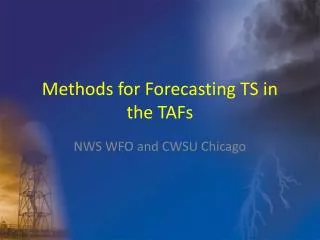
Methods for Forecasting TS in the TAFs NWS WFO and CWSU Chicago
Definitions • CB • Only used with TS/VCTS • VCTS • prevailing TS in the 5-10 mile donut around the terminal • used when coverage is scattered/or storms skirting by and there is uncertainty that the terminal will be directly affected
Steps • What is the forcing mechanism? • How much coverage is typical? • How long does TS usually last with this type of setup? • How confident are you that TS will occur? (what mitigating factors are there?) • What is the most likely time window for occurrence?
What is the forcing mechanism? • Cold fronts • Warm fronts (overrunning, LLJ…) • Stationary fronts • MCS’s • Upper cold pool/trough/daytime heating
How confident are you that TS will occur? • Forcing mechanism • Magnitude of forcing • Magnitude of instability/moisture • Magnitude of inhibition • Timing consistency
What is the most likely time window for occurrence? • Apply the typical duration of thunder to the time window that you think is most likely • Timing uncertainty can be conveyed in AFD • Timing adjustments made with AMD’s • Can establish a trend/show confidence
How soon to include thunder? • Anytime…but consider: • Confidence dependent (see previous slide) • Think about the typical conditions associated with the forcing mechanisms • May not have enough confidence to add TS beyond 6-10 hours • Highlight low confidence and/or low probability in AFD’s and briefing calls
TEMPO and PROB30 • Confidence and mode dependent • What to do with PROB30 at the 9 hr mark? • can establish a trend • show confidence
Cigs and Vsby • Cigs • MVFR or VFR • Multiple MCS’s – progressively lower w/ each (3500ft 1st round, 2500ft 2nd, 1500ft 3rd) (8/23 event) • Vsby • Mainly MVFR/VFR but <= IFR for short periods
Important Guidelines • Amend when needed • don’t wait til the next 2/3 hr update • Add detail as the event nears, especially if storms are on the scope • narrow time window • carry prevailing TS • Wind gusts? Hail? **Wind details following convection
Important Guidelines • Communicate • WFO/CWSU • within the WFO • Brief the facilities • Heads up in the morning • Heads up 1 to 2 hours prior to arrival (TRACON boundary is beyond the airport) • Heads up if timing changes within the first 3 hours