Download
1 / 20
200 likes | 330 Vues
Acute Lymphoblastic Leukemia (ALL) is a type of cancer characterized by the clonal proliferation of blast cells in the blood, bone marrow, and other organs. Arising from single B or T lymphocyte progenitors, it presents with varied clinical features including bleeding, fever, and hepatomegaly. Diagnosis includes blood tests, bone marrow morphology, and immunophenotyping. Treatment strategies are tailored based on risk classification and immunophenotype, aiming for remission induction. Prognosis varies, with complete remission rates between 80-99% depending on age and risk factors.

E N D
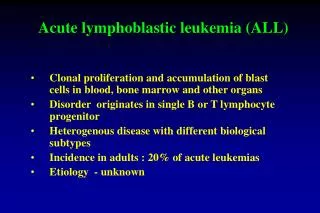
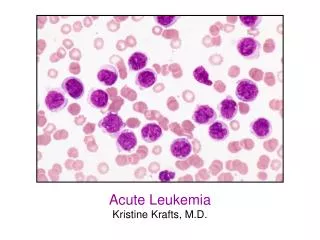
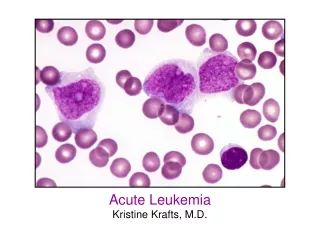
Acute lymphoblastic leukemia (ALL) Clonal proliferation and accumulation of blast cells in blood, bone marrow and other organs Disorder originates in single B or T lymphocyte progenitor Heterogenous disease with different biological subtypes Incidence in adults : 20% of acute leukemias Etiology - unknown
Acute leukemias - clinical features 1. Bleeding 2. Fever/infection 3. Bone/joint pain 4. Hepatomegaly 5. Splenomegaly 6. Lymphadenopathy 7. CNS involvement
Acute leukemias - laboratory findings (1) 1. Blood examination - anemia, - thrombocytopenia, - variable leukocyte count, usually increased, - blood morphology: presence of blast cells 2. Bone marrow morphology - presence of blast cells, - suppression of normal hematopoiesis
Acute leukemias - Laboratory findings (2) 3. Cytochemical stains 4. Immunophenotyping 5. Cytogenetics 6. Molecular studies
Morphologic subtypes of acute lymphoblastic leukemias (FAB classification) Subtype Morphology Occurrence (%) L1 Small round blasts 75 clumped chromatin L2 Pleomorphic larger blasts20 clefted nuclei, fine chromatin L3 Large blasts, nucleoli,5 vacuolated cytoplasm
Acute lymphoblastic leukemias - reactivity with special stains Subtype Peroxidase or Non-specific Periodic Sudan black esterase acid-Schiff L1 - - +++ L2 - - +++ L3 - - +++
Immunologic classification of acute lymphoblastic leukemias B- lineage (80%) Markers Pro-B CD19(+),Tdt(+),CD10(-),CyIg(-), Common CD19(+),Tdt(+),CD10(+),CyIg(-), Pre-B CD19(+),Tdt(+),CD10(+),CyIg(+),SmIg(-) Mature-B CD19(+),Tdt(+),CD10(±),CyIg(±),SmIg(+) T-lineage (20%) Pre-T CD7(+), CD2(-), Tdt(+), Mature-T CD7(+), CD2(+), Tdt(+),
Chromosomal/molecular abnormalities with prognostic significance in ALL Better prognosis - normal koryotype - hyperdiploidy Poor prognosis - t (8; 14) - t (4; 11) Very poor prognosis - t (9; 22); BCR/ABL (+)
Risk classification in ALL 1. Standard risk 2. High risk 3. Very high risk
High-risk ALL 1. Pre - T 2. Pro - B 3. Age > 35 years, 4. WBC > 30 G/L in B-ALL > 100 G/L in T-ALL 5. No remission after 4 weeks of induction therapy
Very high-risk ALL Chromosome Philadelphia - positive or BCR/ABL (+)
In ALL the choice of treatment-strategy depends on: 1. Risk qualification 2. Immunophenotype of leukemic cells - T lineage, - early B lineage, - mature B lineage, 3.Age and biological condition 4. Goal of treatment
Remission induction therapy in ALL 1. Antineoplastic treatment a/Drugs: prednisone, vincristine, asparginase, cyclophosphamide duanorubicin/adriablastin/epirubicin, cytosine arabinoside, b/Treatment duration: 4-8 weeks c/ No of courses: 1- 2 2. CNS prophylaxis 3. Supportive care 4. Treatment of complications
Post-remission therapy in standard-risk ALL 1. Chemotherapy a/. Maintenance therapy: 6-mercaptopurine, methotrexate - for 2-3 years. b/. Intensification treatment periodically repeated: daunorubicin/adriablastin, prednisone, vincristine, cyclophosphamide. 2. CNS prophylaxis
Post-remission therapy in high-risk ALL 1. Intensification treatment: amsacrine, mitoxantrone, idarubicine, high dose cytosine arabinoside, high dose methotrexate, high dose cyclophosphamide. 2.Hematopoietic stem cell transplantation - high-dose therapy - reduced intencity conditioning
Post-remission therapy in very high-risk ALL - High-dose therapy( reduced-intencity ?) + allogeneic stem cell transplantation
Treatment results in ALL • Adults • Complete remission (CR) 80-85% • Leukemia-free survival (LFS) 30-40% • Children • Complete remission (CR) 95-99% • Leukemia-free survival (LFS) 70-80%
AutoHSCT in ALL • Treatment related mortality (TRM) 2-8% • CR1 • LFS 42% (15-65%) • RI ( relapse incidence) 51% • CR2 • LFS 24% (20-25%) • RI 60%
AlloHSCT in ALL • Sibling donor CR1 >CR2 relapsed/refractory LFS 51% (21-80) 34% (13-42) 20% (12-33) RI 26% (9-50) 47% (40-69) 71% (59-76) TRM 29% (12-42) • Matched unrelated donor LFS 39% (38-42) RI 22% (19-23) TRM 48%