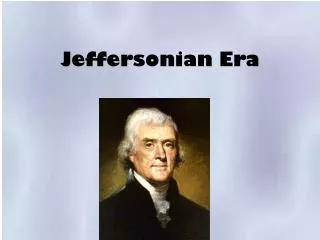
Jeffersonian Era
200 likes | 338 Vues
The Election of 1800 marked a pivotal moment in U.S. history, featuring a fierce battle between Thomas Jefferson and Aaron Burr, representing the Democratic-Republicans, against John Adams and Charles Pinckney of the Federalists. Jefferson's victory, marred by a tie with Burr, led to a decision by the House of Representatives, resulting in the pivotal 12th Amendment establishing separate ballots for president and vice president. The era witnessed significant events, including the Louisiana Purchase and Marbury v. Madison, shaping the nation's political landscape.


Jeffersonian Era
E N D
Presentation Transcript
Election of 1800 • Battle b/w: (all ran for president—2nd highest votes becomes vice-president) • Jefferson and Aaron Burr (D-R) • President Adams and Charles Pinckney (F) • Electoral College: Jefferson defeated Adams, but tied with Burr • House of Representatives to decide—deadlocked • Hamilton moved to support Jefferson
Results of Election of 1800 • 12 Amendment: electors cast separate ballots for president and vice-president (either run for president or v-p) • Famous duel b/w Burr and Hamilton
Hamilton wrote unflattering remarks about Burr. Burr challenged Hamilton to a duel. July 2, 1804—duel Drew to see who would fire 1st—Hamilton won Hamilton fired into sky Burr shot Hamilton in stomach He died next day Burr charged w/ murder—fled
“Every difference of opinion is not a difference of principle. We are all [Democratic-]Republicans; we are all Federalists.”Jefferson’s inaugural address
Southern Politics • Dreamed of nation of indep. farmers • Limited central gov.: served merely to protect indiv. liberties of Constitution • 1st to use Washington, D.C. as capital • Muddy streets & few buildings; most left when Congress was not in session D.C. 1814
Early Map of D.C.—not accurate b/c most this was not built at the time; didn’t realize how difficult it would be to build it
Jefferson as Pres. • Simplicity—sometimes appeared too casually dressed • Walked to inauguration • Tried to shrink gov. & cut costs • Reduced size of army • Eliminated internal taxes
Louisiana Purchase • James Monroe sent to buy territory from France • Napoleon had just been defeated in Santo Domingo (Haiti) & wanted to sell Louisiana Territory • 1803—Nap. sold entire territory to U.S. for $15 million • Had to accept offer without consulting gov. • Senate ratified purchase • More than doubled U.S.
Lewis & Clark • 1804—48 men left St. Louis for Pacific • Returned 2 yrs. later w/: • scientific info. about plants & animals • Knowledge of Native American tribes • Sacajawea served as interpreter & guide (16 yrs. old)
John Marshall & Supreme Court • Pres. Adams appointed Marshall, Federalist, as chief justice • 30 yrs. on Court—strengthening power of Supreme Court & federal gov.
Cause of Marbury v. Madison • Judiciary Act of 1801—early 1801 • Created 16 new federal judges • “Midnight judges”= Adams filled these spots last day as president • William Marbury = “midnight judge” who never received his official papers • James Madison—Jefferson’s Sec. of State—duty to deliver papers
Marbury v. Madison • One of most import. decisions ever!!! • Marbury sued S. of S. Madison to force delivery of papers • Chief Justice Marshall refused to rule on the request—said unconstitutional b/c Constit. did not empower Supreme Court to issues the orders • Judicial Review = ability of Supreme Court to declare an act of Congress unconstitutional