Understanding Exponential Functions in Grades 11 and 12 Mathematics
150 likes | 438 Vues
This resource outlines essential properties and expectations for students learning exponential functions in grades 11 and 12. Students will evaluate and simplify expressions with exponents, connect numeric, graphical, and algebraic representations, and solve real-world applications. Key concepts include properties of exponential functions such as domain, range, and asymptotes. The curriculum encourages the use of technology to graph functions and explore transformations. Additionally, it introduces related topics like exponential decay and prepares students for logarithmic functions.


Understanding Exponential Functions in Grades 11 and 12 Mathematics
E N D
Presentation Transcript
Properties of Exponential Functions In Grade 11 and 12 College/University Math
The 3 Overall Expectations Simply put, the grade 11/12 curriculum asks that the students be able to… • Evaluate and simply expressions containing exponents • Make the connection between the numeric, graphical, and algebraic representations (Graph them! Transform them!) • Solve real-world applications involving exponential functions.
How to Get Started… Here are some functions that the students should be familiar with after learning Trigonometric functions… Hint: this picture is a warmup of what’s to come!
This way.. • This way, students can simply algebraic expressions containing integer and rational exponents… • Examples: simplify the following two • 41/2 x 4 ½ = • X3 / X1/2= • (X6y3)1/3=
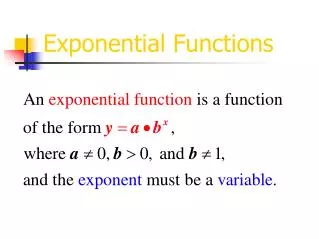
So then, Introducing Exponential Functions! • They involve exponents Examples: y=2x y=3x y=bx • Start off with f(x) = bx • x is the exponent • b is the base Students should be able to graph with calculators, paper and pencils, and graphing technology based on a table of values.
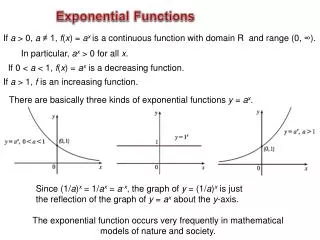
Then looking at a basic exponential function, students need to… 1.4 – determine the key properties relating to domain and range, intercepts, increasing/decreasing intervals, and asymptotes. f(x)=2x
And the properties are… • Domain: • Range: • Intercepts: • Increasing/Decreasing Interval: • Asymptotes: The set of real numbers Set of positive real numbers Dependant on the a value of f(x)=abx Increase if b>1, Decrease if b<1 Horizontal asymptote on x=0
f(x)=ex • Although there is no instruction to teach the function f(x)=ex, it would be useful to introduce the base e. • The numerical value of e is approximately 2.71828183 • Later on, this will be expanded in logarithmic functions.
The transformations! • Students are to investigate, using technology, the roles of the parameters a, k, c, and d in functions of the form f(x) = a ek (x - c) + d, and compare it to the graph of f(x)=ax It may be helpful for the visual learners to use this interactive script online to see the patterns. (However, this pattern rebounds off the original graph of f(x)=ex) http://archives.math.utk.edu/visual.calculus/0/shifting.5/index.html
Approximation Activity Get into groups and, using your body, demonstrate the two graphs below and then describe the transformation involved from f(x)=3x to f(x)=0.3x-2-5
Exponential Decay – Computers continued… Neatly sketch a graph of the data from the table on the previous page. When choosing your scale for the horizontal axis, consider question 4 below. After you have plotted the points, draw a smooth curve through them. • Using the graph, comment on the shape of the curve. Use words such as the following in your description: increasing, decreasing, quickly, slowly. • Use your graph to predict the number of students per computer in the year 2006. • Is the answer from question #4 surprising? Why or why not?
Moving Further into the Realms of Functions… LOGARITHMS!