Download
1 / 21
220 likes | 457 Vues
Chapter 9 explores the critical early years of the United States under George Washington's leadership. As the first president inaugurated in 1789, Washington set essential precedents for the executive branch and established the first presidential cabinet, which included key figures like Thomas Jefferson and Alexander Hamilton. The chapter also delves into the creation of the federal judiciary, particularly the Judiciary Act of 1789, and discusses Hamilton's financial plan to address war debts, raise government revenues through tariffs, and establish a national bank. The contrasting interpretations of the Constitution between Federalists and Democratic-Republicans are highlighted, illustrating the foundation of American political parties.

E N D
Launching a New Republic Chapter 9
Reading • Workbook ( Blue book) Page 93 DEVELOPMENT OF GOVERNMENT
Constitution • Constitution = Plan of government • 3 branches • Congress ( Legislative branch) use plan to organize the new government. • Executive branch • Judicial branch
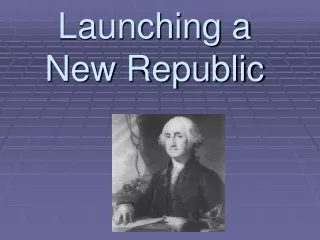
Washington takes OfficeExecutive Branch • 1stPresident • Inaugurated (sworn in as President) • Every action Washington does is setting a precedent (example) that would become the standard
Washington leads a new nation • Washington elected unanimously by electoral college to be 1st President • Precedents • Cabinet – advisors (Executive branch) • Judiciary Act – Judicial branch ( federal courts) • Neutrality
Executive BranchCabinet • Congress & President created departments to help the President • The_________ appoints the HEAD of the department President’s cabinet • Appointments must be approved by ________ • Helped solve issues and problems • Set an example for future Presidents
Executive Branch • 1st President: Washington • Vice-President: John Adams • Cabinet • Secretary of War: Defense of the nation • Henry Knox • Secretary of State: Relations with foreign nations • Thomas Jefferson • Secretary of Treasury: Money & budget • Alexander Hamilton - Attorney General : Edmund Randolph ( legal advice) • Why having a cabinet is important? ( Own words)
Cabinet Then… and now! 1789 Now a day 15 departments HW: Visit the website of the executive branch of our national government, www.whitehouse.gov or Wikipedia(Cabinet of the United States) Find a list of the 15 cabinet positions and the functions of each ( department) Explain which department you think is the most necessary or important and why. • 4 departments • Department of State • Department of Treasury • Department of War • Attorney general
Judicial BranchSetting up Courts • Setting Up The Courts • The writers – the Constitution had left many matters to be decided by Congress. • Congress made the Federal Judiciary Act of 1789: • Supreme court had 6 members ( 1 chief of Justice + 5 justices) • Provided for less powerful federal courts ( 2 additional to Supreme Court • Federal District Court • Court of Appeals • Named John Jay the Chief Justice Had a Supreme Court, but they needed justices
Economic Problems • War debts • U.S. had borrowed millions (Internal & External) • 1789 – National Debt was $52 million! • Secretary of Treasury – Alexander Hamilton needed to come up with a financial plan
Reading • Workbook ( Blue book) Page 94 Economics
Hamilton’s Financial Plan • 1. Payoff war debts • 2. Raise Government Revenues (taxes) • 3. Create a National Bank
1. Paying off all war debts • Sectionalism ( Sectional differences) • Northern VS Southern states • South most already paid their debts / asked to help pay for Northern states debts • Compromise: South will support plan and will help, but National Capital will be move more South • From NY to Washington DC ( between Virginia & Maryland)
2. Raising government revenues • Secretary of Treasury – In charge of finances • profit through tariffs • Tariffs – Taxes on imported goods • Placed high taxes on foreign goods • Two purposes for taxes • Raise money for gov’t • Encourage growth for the American Industry • Wanted people to buy American goods
3. National Bank • Hamilton wanted a National Bank(Strong National Government) • Safe place to keep money • Give loans to businesses and government • Paper money Currency for the nation • Thought it was “necessary & proper” to carry out the government duties
Reading • Workbook ( Blue book) Page 94 Interpreting the Constitution
Opposed the National Bank • James Madison & Thomas Jefferson • Didn’t think we needed a National Bank • Constitution didn’t give power to the government to set up a National Bank
Interpreting the Constitution • Different interpretations of the Constitution caused disagreements • Strict Interpretation – Thomas Jefferson & James Madison • Loose Interpretation- Alexander Hamilton • Showed signs of different views and ideas of how country should be ran
Strict vs. Loose Strict Construction Only what is written in the Constitution Loose Construction Flexible/ open to interpretation Alexander Hamilton Elastic Clause “Necessary & Proper” Thought the National Bank was Necessary to carry out government duties • Jefferson/ Madison • Constitution did not give the power to set up a National Bank • Government only has powers Constitution CLEARLY says • Didn’t want to give the National government too much power
Process Process: Interpreting the ConstitutionStrict vs. LooseFederalists vs. Democratic- Republicans • Strict Interpretation: • Who was for it? _____________________________________________________________________________________________ • What was their interpretation? __________________________________________________________________________________________________________________________________________________________________________________________________ • Loose Interpretation: • Who was for it? _____________________________________________________________________________________________ • What was their interpretation? __________________________________________________________________________________________________________________________________________________________________________________________________ Are you for a strict or loose interpretation of the Constitution? Why? • ____________________________________________________________________________________________________________________________________________________________________________________________________________________________________________________________________________________________________________________________________________________________________________________________________________________________________________________________________________