The Early 20th Century: Key Developments Before World War I
This overview highlights significant events and cultural changes in the early 20th century, leading up to World War I. Under President Theodore Roosevelt, the government faced labor strikes, created the National Forest System, and established the FDA to address food safety. Innovations like the airplane, polygraph, and pop-up toaster emerged, while art movements such as Impressionism and American Realism flourished. With newspapers as the primary news source and the rise of comics, these elements shaped American society and values during this transformative period.

The Early 20th Century: Key Developments Before World War I
E N D
Presentation Transcript
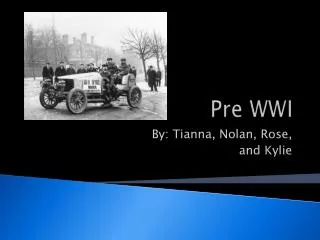
Pre WWI By: Tianna, Nolan, Rose, and Kylie
Government • At the turn of the century the president was Theodore Roosevelt. He was considered to be a good president and popular with the people. • Coal strikes (as well as other labor strikes) were common. Unions vs. corporations were fairly common around the country. Government usually sided with corporations. • Naturalists and preservationists wanted to protect nature, so Roosevelt had the national Forest System put in place (that’s where we get our national parks from).
Government (continued) • Dangerous food and medicine were being made, so the FDA came around to help the problem. • After a while of avoiding the war, America entered WWI. • Wilson was the other president during the this time. However, he was not very popular.
Science • At the turn of the century a variety of inventions helped shape the time period. Many are used today and changed the course of history. • Of the most significant inventions, the first airplane was invented by the Wright Brothers in 1903. • In 1902, the first designs of lie detectors/polygraphs were invented by James Mockepzie. • Neon light was first created around this time. • Toward the end of this area and WWI, the pop up toaster was invented By Charles Stritz.
Art • Early in the 1900s the art movements were Impressionism and American Realism • American Impressionism is a style of painting characterized by loose brushwork and vivid colors • Realism in the visual arts and literature is the general attempt to depict subjects as they are considered to exist in third person objective reality
Other Culture • Newspapers were big as a source of getting information (no TV/news channels) • Some of these are the New York Times and New York Post. These are the only two newspapers still around today under the same name. • Radio was not really common at this time, but it was, however, first being used. In 1907 Eugenia H. Farrar was the first singer to be broadcasted. • Fashion included “nice” clothes that often had long, elegant lines. People dressed very formally compared to modern dress.
Other Culture (continued) • Another form of reading was comics, a relatively new medium of writing. “Yellow Kid” was one of the first comics published. • Family values were very important to the American people in the early 20th century. • People were also fascinated by airplanes, a new invention. Plane shows were just starting to be viewed. • Fun Fact: Nickelodeon was created in 1905. (Not the TV network but the first indoor space devoted to showing motion pictures. They charged a nickel to get in.)
Media Clip • http://archive.org/details/the-great-trainrobbery • (an early movie and it was silent)