Efficient Wind Turbine Simulation and Control for Enhanced Energy Utilization
Our project focuses on improving a wind turbine system by utilizing a computer-controlled motor coupled with a generator to efficiently harness wind energy for powering AC loads. The new system offers a user-friendly interface via LabVIEW and integrates real-time wind data analysis. The project addresses the limitations of traditional battery-dependent systems, implementing a battery backup while optimizing wind energy utilization. The setup includes precise voltage regulation, consistent output, and comprehensive measurement capabilities, ensuring effective power generation and management.


Efficient Wind Turbine Simulation and Control for Enhanced Energy Utilization
E N D
Presentation Transcript
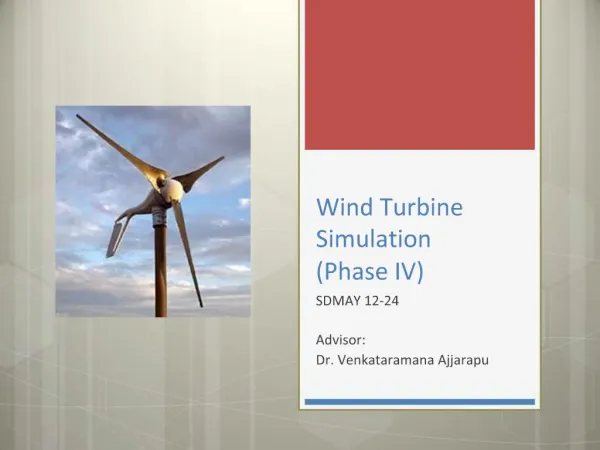
Wind Turbine Simulation(Phase IV) SDMAY 12-24 Advisor: Dr. VenkataramanaAjjarapu
SDMAY 12-24 Group Members • Brian Alexander (Computer Engineering) • Lon Bromolson (Electrical Engineering) • Jarid Strike (Electrical Engineering) • Chase Schaben (Electrical Engineering)
SDMAY 12-24 Project Description • Computer controlled motor is coupled with generator from wind turbine • Turbine power is used to drive inverter w/ AC load • Measurements are taken using DAQ USB-6008, and imported into LabVIEW
SDMAY 12-24 Problem Statement • Existing system: • Load primarily uses batteries • System does not efficiently use wind energy • Weak motor • Model for new system: • Wind turbine primarily powers load • Batteries are used as backup • PC provides user-friendly interface
SDMAY 12-24 • Functional Requirements • Turbine voltage is rectified and converted to provide consistent 24V output • Inverter will provide AC voltage to 2 light bulbs • The turbine can generate a 300W continuous output • The anemometer and wind vane will transmit wind profiles from locations on campus • The motor will simulate outdoor wind speed • The wind turbine will supply the battery bank when the voltage is below 24V • The turbine will not exceed power ratings on load
SDMAY 12-24 • Non-Functional Requirements • The final project will include a user’s manual • The project will be documented through technical manual and in-depth schematics • Technology Requirements • LabVIEWinterface must accurately calculate variables and display them for the user to see • Wind data must be read and input into LabVIEWin real-time • All sensor and control equipment must be connected with LabVIEW
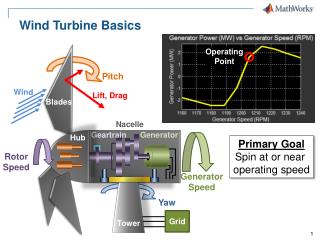
SDMAY 12-24 LabVIEW Interface • Control wind speed simulation motor • Read measurements from: • Wireless real wind data (Serial Input) • RPM (Digital Input via NI USB-6008) • CT sensors (Analog Input via NI USB-6008) • Voltage Divider (Analog Input via NI USB-6008) • Obtain plots that can be analyzed using Excel. • Wind(mph) vs. Power (W), etc.
SDMAY 12-24 LabVIEW Interface • Available Outputs: • Motor voltage • PWM generator • Available Inputs: • Wind speed measured by anemometer • Motor RPM measured by Hall sensor • Turbine current measured by current transducer and USB-6008 • Inverter current measured by current transducer and USB-6008 • Battery voltage measured by USB-6008
SDMAY 12-24 Motor Control • Existing motor could not provide consistent high-speed output without overloading/overheating • We are replacing this 370W induction motor with new 1.5 HP (1.1 kW) induction motor • This will require a new bracket to mount the motor Figure from Wikipedia “File:VFD System.png”
SDMAY 12-24 Load/Battery/Turbine Solution • Rectify three-phase output of generator • Up/Down convert voltage level to 24 V • Control energy storage
SDMAY 12-24 VFD Motor Rectifier / Boost-Buck Generator Load Coupling RPM Sensor PWM Generator
SDMAY 12-24 Measurement From 3-phase Generator
SDMAY 12-24 MATLAB Model for Rectifier/Buck-Boost Circuit
SDMAY 12-24 Schematic for PWM generator
SDMAY 12-24 Test Plan • Run system for a long period (few days or few weeks) while simulating actual wind speed conditions • Measure power generation of wind turbine over time • Measure battery voltage over time
SDMAY 12-24 Estimated Cost $175 – 1.5 HP Motor $40 – Coupling $45 – Mounting brackets $20 – Other electrical components $280 – Total $500 – Budget
SDMAY 12-24 Planned Tasks • Order new motor and couple to generator • Develop power management circuitry • Finish simulation • Build circuit • Test circuit • Run full system test • Finalize LabVIEW interface and write user’s manual • Finalize all documentation and website
SDMAY 12-24 Any Questions??