
SlideServe
Menu
Préférences
© SlideServe · v2026

Kruger National Park Case Analysis

jamal avatar
19 diapositives · 810 Views · Jul 17, 2014

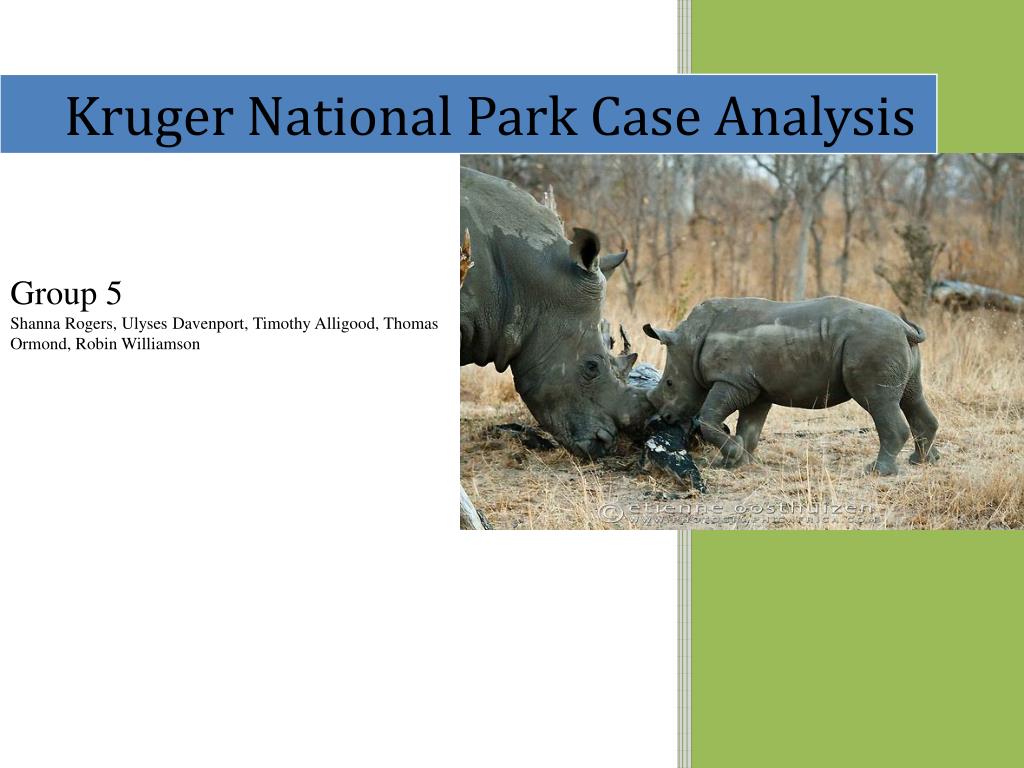
Kruger National Park Case Analysis . Group 5 Shanna Rogers, Ulyses Davenport, Timothy Alligood , Thomas Ormond, Robin Williamson. Executive Summary . Kruger National Park is a leading conservation group toward the conservation of rhinos
Kruger National Park Case Analysis - slide 1
01 / 19Kruger National Park Case Analysis
1 / 17

Télécharger la présentation

Kruger National Park Case Analysis
Une image / un lien ci-dessous est fourni (tel quel) pour télécharger la présentation

Politique de téléchargement : le contenu du site vous est fourni TEL QUEL pour votre information et votre usage personnel ; il ne peut être vendu, concédé sous licence ni partagé sur d’autres sites sans l’accord de son auteur.Le contenu vous est fourni TEL QUEL, pour votre information et votre usage personnel uniquement. Téléchargez la présentation en cliquant sur ce lien. Lors du téléchargement, si vous ne parvenez pas à télécharger une présentation, l’éditeur a peut-être supprimé le fichier de son serveur.Pendant le téléchargement, si vous ne parvenez pas à obtenir une présentation, le fichier a peut-être été supprimé par l’éditeur.

F I N

Plus de contenu associé

Transcription de la présentation
  1. Kruger National Park Case Analysis Group 5 Shanna Rogers, Ulyses Davenport, Timothy Alligood, Thomas Ormond, Robin Williamson

  2. Executive Summary • Kruger National Park is a leading conservation group toward the conservation of rhinos • Kruger is losing funding and a poaching increase is eminent • Over 50 rhinos were poached in Kruger in 2009 and over 100 in South Africa

  3. Define the Problem • Kruger National Park, established in 1989, works to repopulate the black and white rhino populations throughout South Africa and the world • Over 10,000 white rhinos and 500 Black rhinos live on their land • Poaching has become a big problem to their funds and their rhinos lives

  4. Define the Problem • Kruger is selling rhinos at auction to unknown dealers and cannot establish their whereabouts or what will happen to the rhino after sold • Asian and Indian populations are under a rouse and believe the Rhino horn can be used to cure illness, mainly cancer – leading to more poaching

  5. Ethical dilemmas/Overall strategy • Ethical Dilemma(s): • The increased poaching of rhinos on Kruger land, the loss of funding from the government, • Overall Strategy/Vision: • Selling rhinos for conservation and preservation to accumulate lost funding. They have an overall vision to protect and repopulate the rhinos and other animals on their land

  6. Impact if Not Addressed • Overall, if Kruger park does not do something about their ethical dilemmas, it will inevitably lead to an overall loss of funding, more poaching on their land, and the inability to help repopulate and conserve the animals that live in Kruger Park

  7. SWOT Analysis • Strengths: • Professional Staff • Strong domestic tourism market • Good infrastructure and equipment • Weaknesses: • Park Security • Communication their message • Decreased funding • Weak protection of animals from poachers

  8. SWOT Analysis • Opportunities • Could enhance the breeding of the rhinos • Expand revenue by going into new markets such as weddings or honeymoons • Go after international funding for development • Threats • Poaching • Local economica downturn/struggles • Increased costs in food and fuel, which would lead to increase in the park’s expenses • Trade Regulation

  9. Establish Contributing Factors • Poaching on Kruger National Park land • Lack of communication of values, goals, ideals, and problems faced by Kruger • Loss of funding from the government • Unknown destination of sold rhinos and their fates

  10. Possible Solutions • Poaching: • Harvest the horns: • Pros: Painless, less motivation for poachers, sells bring in funding, horns grow back • Cons: Cost of trained individuals, expense per animal • Black Rhino Range Expansion Project • Pros: Less invasive, additional breeding land, provides funding • Cons: Funds only for relocation of rhinos

  11. Possible Solutions • Lack of communication: • Marketing: • Pros: Awareness, low-cost • Cons: Audio- only • Telethon • Pros: Raise awareness, raise money • Cons: Pre-telethon expenses

  12. Possible Solutions • Loss of Funding: • Government contracts • Pros: Recoup lost funding, WWF • Cons: Government control • Hunts on Kruger National Park land • Pros: Excellent income, viewed ethical by SANParks • Cons: Animals still die, does not solve problem

  13. Possible Solutions • Selling of rhino and their unknown fate • Contracts for purchasers • Pros: Protection/reservation of animals • Cons: Breach of contract may be very hard to prove • RFID chips • Pros: Rhino horns can be traced, no harm • Cons: Very costly and time consuming

  14. Recommended Solutions • Poaching: • Harvest rhino horns and control selling of them • Lack of Communication: • Hire a marketing team of professionals

  15. Recommended Solutions • Sale of rhinos: • Contracts to those who purchase rhinos (contract including RFID chip) • Loss of Funding: • Look for more government and national funding grants

  16. Execution of Solutions • Harvesting horns: • Follow implementation of private conservationist John Hume • Build a “corral” type fence of 1,000 acres and 7ft high • Fence could also be used for reproduction of rhinos • Train existing crew on rhino dehorning and hire more crew as needed

  17. Execution of Solutions • Hire marketing team: • Partner with Save the Rhino foundation • Enlist an up and coming celebrity • Purchase SARAD Software and hire AllianceMediato get message out to public

  18. Execution of Solutions • Sale of Rhinos • Draft a contract for each buyer to sign with stipulations that must be met • Require each rhino be tagged with RFID chips • Run background checks on each purchaser

  19. Execution of Solutions • Government contracts and funding • Try to convince and partner with government over sale of rhino horns • Sponsorship and donations from private and public companies/donors