Chemical Bonds: Understanding Molecular Interactions and Reactions
This review discusses the essential role of chemical bonds in holding atoms together within molecules. It explains how chemical reactions involve the breaking of original bonds and the formation of new ones. The text highlights the process of bond-breaking and bond-making, using the example of hydrogen and chlorine gases reacting to form a new substance. Students are encouraged to actively engage in group activities to simulate this process of chemical bonding and reaction, enhancing their understanding of molecular chemistry concepts.


Chemical Bonds: Understanding Molecular Interactions and Reactions
E N D
Presentation Transcript
Bonds: Holding Molecules Together November 27, 2012
Review • A chemical bond is a force that holds two atoms together in a molecule. • In order for a chemical reaction to take place, the original bonds must break and new ones must form.
Breaking & Making Bonds • Chemical bonds in starting substance must break. • If molecules bump into each other with enough energy, the bonds will break. • What happens next? • The atoms will then rearrange and new bonds form to make the new substance.
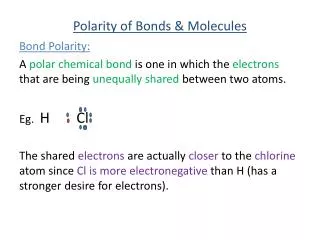
New Bonds, New Substances • What happens when hydrogen and chlorine are combined? • A chlorine gas molecule is diatomic. • A hydrogen gas molecule is diatomic. • When the two different molecules react the bonds between the two diatomic molecules break. • What is the new substance that is created?
Class Activity • While working in groups, student will imitate the breaking of bonds of two diatomic molecules and show the creation of a new substance.