Understanding Emotions: Paths to Self-Knowledge and Self-Perception
180 likes | 288 Vues
Explore the intricate relationship between emotions and self-awareness. Understanding how emotions inform our self-perception can enhance our self-knowledge. Dive into concepts like self-perception theory, introspection, social comparisons, and cultural influences on identity. Learn how various factors, such as physiological responses and social contexts, shape our emotional experiences. By unraveling the complexities of emotional arousal and attribution, we gain insight into ourselves and how we relate to the world around us.


Understanding Emotions: Paths to Self-Knowledge and Self-Perception
E N D
Presentation Transcript
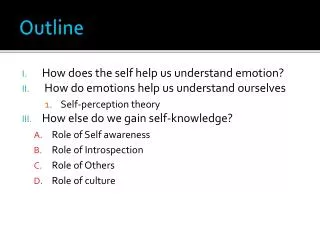
Outline • How does the self help us understand emotion? • How do emotions help us understand ourselves • Self-perception theory • How else do we gain self-knowledge? • Role of Self awareness • Role of Introspection • Role of Others • Role of culture
Self Observation & Emotion How might emotions be created? • Schacter & Singer 2 factor theory of emotion – know Study • Experience arousal • I’m feeling something – what is it? • Seek attribution for it, attribution determines emotion • The context suggests that I should be experiencing _____.
Implications of 2 factor theory • Can misattribute arousal to wrong source • Bridge study • View arousal from bridge as signal that one is attracted to a woman.
Can reduce emotional reaction • Reduce emotional reaction by attributing arousal to nonemotional source • In Schacter & Singer if told effects of drug, study did not work • If reminded of bridge, study should not work
Self Observation and emotion • Facial feedback hypothesis – facial expressions can trigger corresponding changes in emotional experience • Why works • Physiological explanation – • Smiling decreases brain temp = pleasant • Frowning increases it = unpleasant • Self perception theory – ‘I’m smiling, I must like the cartoons”
Self-Perception theory Bem’s Self-perception theory: when own attitudes are uncertain and ambiguous, we observe out own behavior and infer our attitudes from it. • Behavior -> self knowledge • In essence, making an attribution for our own behavior
Self Focus • Time spent thinking about one’s self has increased • Archival analysis of song lyrics • Use of first person singular pronouns
How do we come to know ourselves: The role of Self Awareness Figure 5.3Self-Awareness Theory: The Consequences of Self-Focused AttentionWhen people focus on themselves, they compare their behavior to their internal standards.(Adapted from Carver & Scheier, 1981) Note: Self awareness can be positive if one experienced a success and think about accomplishments
How do we come to know ourselves: Role of Introspection • Introspection: looking inward to examine your own thoughts, feelings, and motives • Surprisingly, this process can lead us astray • Often do not know why we do the things we do. • Ex 1: nylon demo • Ex 2: art study
Nylon demo Top 2 choices 14 picked 1 or 2 28 (twice as much) picked 3 or 4 Might conclude: 3 and 4 better than 1 and 2 Why? – when asked said silky, smooth, etc Reality – introspective reasoning was incorrect, picked not b/c more silky but b/c last.
Is listing pros and cons helpful? • Art appreciation Study • Time1: • List reasons or not for picking Art or animal poster • Time2: Do you still like poster? • Those who listed reasons liked poster less than those who did not • Reason generated attitude change
Why could listing reasons be harmful? • Due to introspection sometimes leading us astray: Why? • Often don’t know what thinking • Only get subset of knowledge • based on causal theories • could be incorrect • Noise and film study – theory about noise incorrect • Factual knowledge is weighted too heavily relative to affective info and misguides decisions. • Thus, listing pro/cons most likely to lead to incorrect affective judgments
How do we come to know ourselves: Role of other • Social comparison theory • When do you compare? • When no objective standard, uncertain about performance • With whom do you compare? • Automatically – with anyone around • Not all equal – pick appropriate depending on goals • Similar to self – most informative • Accuracy motive • Upward comparison – compare to better person • Improvement motive • Downward comparison – compare to worse others • Enhancement motive
How do we come to know ourselves: Role of culture • Independent: defining self in terms of one’s own thoughts, feelings, and actions • I am: honest, tall, shy • Interdependent: defining self in terms of one’s relationships to other people; • I am: a Smith, a sister,
Self Self Mom Mom Dad Dad Friend Friend Interdependent Collectivistic Independent Individualistic