Understanding Conditional Probability: Independent and Dependent Events Explained
Conditional probability measures the likelihood of an event occurring given that another event has already occurred, represented as P(B|A) for the probability of B given A. This concept applies to both independent events, where the occurrence of one does not affect the other, and dependent events, where it does. Through examples like drawing cards without replacement and calculating probabilities based on genetic traits, we can understand how these probabilities are computed. Explore key principles including the multiplication rule for independent and dependent events.

Understanding Conditional Probability: Independent and Dependent Events Explained
E N D
Presentation Transcript
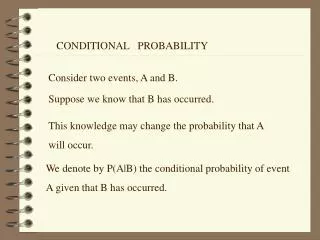
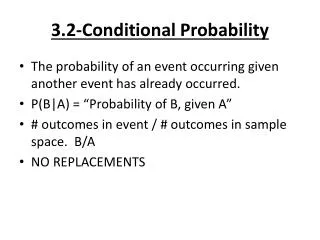
3.2-Conditional Probability • The probability of an event occurring given another event has already occurred. • P(B|A) = “Probability of B, given A” • # outcomes in event / # outcomes in sample space. B/A • NO REPLACEMENTS
Examples • 2 cards are selected WITHOUT replacement. What is the probability the second is a queen given the first is a king? • From table on p. 115, what is probability the child has a high IQ given it has the gene? • Do the TRY IT YOURSELF 1 on p. 115
Examples • 2 cards are selected WITHOUT replacement. What is the probability the second is a queen given the first is a king? 4 queens, 51 cards left so 4/51 = 0.078 • From table on p. 115, what is probability the child has a high IQ given it has the gene? • Do the TRY IT YOURSELF 1 on p. 115
Examples • 2 cards are selected WITHOUT replacement. What is the probability the second is a queen given the first is a king? 4 queens, 51 cards left so 4/51 = 0.078 • From table on p. 115, what is probability the child has a high IQ given it has the gene? 33 high IQ with gene out of 72 with gene so 33/72 = 0.458 • Do the TRY IT YOURSELF 1 on p. 115
TRY IT YOURSELF 1 • 1a) # of outcomes of event (no gene) = 30 # of outcomes of ss (total kids)= 102 b) P(no gene) = 30/102 = 0.294 • 2 a) # of outcomes of event ( no gene normal IQ) = 11 # of outcomes of ss (total with normal IQ) = 50 b) P(no gene|normal IQ) = 11/50 = 0.22
Independent & Dependent Events • Independent Events • Occurrence of one event does NOT affect the other • P(B|A) = P(B) OR P(A|B)=P(A) • Dependent Events • Occurrence of one event DOES affect the other • Non-replacing • Sample space changes each time
Examples: Independent or Dependent? What is the probability? • Selecting a king and then a queen (no replacement)? • Tossing a coin heads, then rolling a 6 on a 6 sided die? • Practicing the piano and then becoming a concert pianist? • Do TRY IT YOURSELF 2 p. 116
Examples: Independent or Dependent? What is the probability? • Selecting a king and then a queen (no replacement)? Dependent P(B|A) = 4/51, P(B) = 4/52 )not same • Tossing a coin heads, then rolling a 6 on a 6 sided die? • Practicing the piano and then becoming a concert pianist? • Do TRY IT YOURSELF 2 p. 116
Examples: Independent or Dependent? What is the probability? • Selecting a king and then a queen (no replacement)? Dependent P(B|A) = 4/51, P(B) = 4/52 )not same • Tossing a coin heads, then rolling a 6 on a 6 sided die? Independent : P(B|A)=1/6, P(B) = 1/6 same • Practicing the piano and then becoming a concert pianist? • Do TRY IT YOURSELF 2 p. 116
Examples: Independent or Dependent? What is the probability? • Selecting a king and then a queen (no replacement)? Dependent P(B|A) = 4/51, P(B) = 4/52 )not same • Tossing a coin heads, then rolling a 6 on a 6 sided die? Independent : P(B|A)=1/6, P(B) = 1/6 same • Practicing the piano and then becoming a concert pianist? Dependent: practicing affects chances of it • Do TRY IT YOURSELF 2 p. 116
TRY IT YOURSELF 2 • 1. • A) No • B)Independent • C) making it through first has no affect on second • 2. • A) Yes • B) Dependent • C) Studies show exercise lowers resting heart rate
Multiplication Rule: P(A AND B) • The probability that 2 events A and B will occur in sequence is: • Dependent: P(A and B) = P(A) · P(B|A) • Independent: P(A and B) = P(A) · P(B) • AND • Can be extended for any number of events • IF P(B) = P(B|A), then A and B are independent and simpler rule of multiplication can be used.
Examples: • 2 cards are selected without replacement. What is the probability of a king AND then a queen? • A coin is tossed AND a die is rolled. What is the probability of getting a head AND rolling a 6? • Do TRY IT YOURSELF 3 p. 117
Examples: • 2 cards are selected without replacement. What is the probability of a king AND then a queen? dependent P(K and Q)=P(K)·P(Q|K)=4/52 ·4/51=0.006 • A coin is tossed AND a die is rolled. What is the probability of getting a head AND rolling a 6? • Do TRY IT YOURSELF 3 p. 117
Examples: • 2 cards are selected without replacement. What is the probability of a king AND then a queen? dependent P(K and Q)=P(K)·P(Q|K)=4/52 ·4/51=0.006 • A coin is tossed AND a die is rolled. What is the probability of getting a head AND rolling a 6? independent P(H and 6) = P(H)·P(6)=1/2 · 1/6 = 1/12=.083 • Do TRY IT YOURSELF 3 p. 117
TRY IT YOURSELF 3 • 1. A = swim thru first B= swim thru 2nd • A) independent • B) P(A and B) = P(A)·P(B) = (0.85)(0.85) = 0.7225 • 2. A=no gene B=normal IQ • A) Dependent • B) P(A and B) = P(A)·P(B|A) = 30/102·11/30 = .108
Examples: Find the probabilities • A coin is tossed AND a die is rolled. What is the probability of a head AND then a 2? • Probability of 1 salmon getting through a dam is 0.85. What is the probability of 3 getting through the dam? • Probability that none of the salmon get through? • Probability that at least one gets through? • Do TRY IT YOURSELF 4 on p. 118
Examples: Find the probabilities • A coin is tossed AND a die is rolled. What is the probability of a head AND then a 2? independent: P(A)·P(B)=1/2·1/6 = 1/12=0.083 • Probability of 1 salmon getting through a dam is 0.85. What is the probability of 3 getting through the dam? • Probability that none of the salmon get through? • Probability that at least one gets through? • Do TRY IT YOURSELF 4 on p. 118
Examples: Find the probabilities • A coin is tossed AND a die is rolled. What is the probability of a head AND then a 2? independent: P(A)·P(B)=1/2·1/6 = 1/12=0.083 • Probability of 1 salmon getting through a dam is 0.85. What is the probability of 3 getting through the dam? Independent (.85)(.85)(.85)=0.614 • Probability that none of the salmon get through? • Probability that at least one gets through? • Do TRY IT YOURSELF 4 on p. 118
Examples: Find the probabilities • A coin is tossed AND a die is rolled. What is the probability of a head AND then a 2? independent: P(A)·P(B)=1/2·1/6 = 1/12=0.083 • Probability of 1 salmon getting through a dam is 0.85. What is the probability of 3 getting through the dam? Independent (.85)(.85)(.85)=0.614 • Probability that none of the salmon get through? failure = 1-.85 = .15 so P(none)=(.15)(.15)(.15)= 0.003 • Probability that at least one gets through? • Do TRY IT YOURSELF 4 on p. 118
Examples: Find the probabilities • A coin is tossed AND a die is rolled. What is the probability of a head AND then a 2? independent: P(A)·P(B)=1/2·1/6 = 1/12=0.083 • Probability of 1 salmon getting through a dam is 0.85. What is the probability of 3 getting through the dam? Independent (.85)(.85)(.85)=0.614 • Probability that none of the salmon get through? failure = 1-.85 = .15 so P(none)=(.15)(.15)(.15)= 0.003 • Probability that at least one gets through? Complement to None ( 1 or more) 1-P(none) = 1-.003 = 0.997 • Do TRY IT YOURSELF 4 on p. 118
TRY IT YOURSELF 4 • 1. • A) event • B) P(3 successes)=(.9)(.9)(.9)=0.729 • 2. • A) complement • B) P(at least 1) = 1 – P(none) P(fail) = 1-.9 = .1 P(3 fail (none))= (.1)(.1)(.1)=.001 P(at least 1) = 1-.001 = 0.999
Assignment (Due Wed.) • 3.2 p. 119 # 1-20