Download

1 / 26
260 likes | 384 Vues
Ancient Greece's geography played a crucial role in shaping its civilization. The mountainous terrain and numerous islands limited arable land while providing strategic locations for trade via the Aegean and Ionian Seas. The resulting warring city-states led to the emergence of various government forms, including direct democracy in Athens and oligarchy in Sparta. Notable figures like King Philip II and Alexander the Great rose to power in this context, unifying Greece and expanding its territory through military conquests. Understanding this interplay reveals the foundations of Greek heritage.

E N D
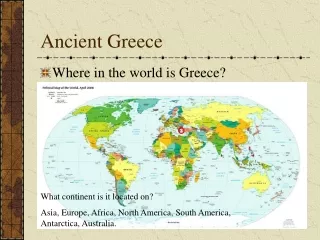
___. Geography • ___ . Location • ___. Peninsula jutting out into Mediterranean • ___. 2,000 islands in Aegean & Ionian Seas • ___. Seas • ___. These seaways linked Greece • ___. Allowed for country to get resources lacked
___. Geography (cont’d) • ___. Land • ___. ¾ of land was mountains • ___. Only small amount could be farmed on • ___. Little fresh water • ___. Climate • ___. Between 48 degrees and 80 degrees • ___. “Outdoor” weather days
Constructed Response • There are many features to Greece's geography. How do you think Greece is affected by its geography?
___. Governments • ___. Warring City States • ___. Different Governments caused war • ___. New Form of government formed to stop the warring countries • ___. Direct Democracy • ___. State ruled by “citizens” • ___. Rule based on “citizenship” • ___. Majority wins • ___. Began about 500 B.C.
___.Governments (cont’d) • ___. Oligarchy • ___. Sparta • ___. State ruled by a small military & wealthy group • ___. Controls the military • ___. Council of Elders to make major CITY decisions while men are away.
Activity: Compare and Contrast • Greek Society Rules: • 1. Citizen: 18, male, and father a citizen • 2. Laws voted and created by all ‘citizens’ • 3. Leader chosen by the lot • 4. Juries’ size vary • 5. Executive branch – 500 men • 6. No lawyers, no appeals, 1 day trial
Activity: Compare and Contrast • U.S. Society Rules: • 1. Citizen:___________________________ • 2. Law Creation:______________________ • 3. Leader Chosen:_____________________ • 4. Juries’ size:________________________ • 5. Executive branch:___________________ • 6. Trials:____________________________
Activity: Compare and Contrast • Both • a. Political Power: Citizens • b. 3 branches of government • 1. Legislative branch passes the laws • 2. Executive branch carries out the laws • 3. Judicial conducts trials with paid jurors
____. Mycenaean Civilization • ___. Settlement • ___. People moved here from Eurasia • ___. Settled in Southern Greece • ____. Government • ___. Warrior Kings • ___. Different city states under their own control • ___. Ex: Athens, Gia, and Tiryns
____. Mycenaean (cont’d) • ___. Trade • ___. Made contact with Minoans • ___. Was a “Confined civilization” • ___. Saw promise that sea trade could bring to the cities • ___. Created a new type of Civilization • ___. War • ___. Trojans • ___. Caused the collapse?
___. Rise of Macedonia • __. Macedonians were descended from the Dorians • ___. Greeks looked down on them as backward mountaineers • __. King Philip II • __. Became king in 359 B.C. • __. Spent 3 years as a hostage in Thebes prior to becoming king
___. Rise of Macedonia (cont’d) • __. As king, Philip had three goals • __. Create strong army • __. Unify Greek city-states under Macedonia • __. Destroy Persian empire
___. Rise of Macedonia • ___. Greek city-states weakened by Peloponnesian War • __. Would not cooperate in resistance • ___. Philip conquered all except Sparta • __. Before he could begin a war against Persia, he was murdered
___. Alexander the Great • __. Came to power after Philip • __. Commander in Macedonian army at 16 • __. Respected for courage and military skill • __. Only 20 as ruler of Macedonia and Greece • __. Well educated—tutored by Aristotle
___. Alexander the Great • __. Early Conquests • ___. In 334 B.C., led 30,000 soldiers and 5,000 cavalry into Asia • __. Opened his campaign • __. “West against East”
___. Alexander the Great • __. Early Conquest (cont’d) • __. At Granicus River, Alexander won • __. Sent 300 suits of Persian armor to Athens as tribute to Athena • __. Second major battle against Persians at Issus, Syria • __. Alexander’s superb tactics won
___. Alexander the Great • __. Early Conquests (cont’d) • __. Captures Phoenician seaports • __. Cuts off Persian supplies • __. Persian fleet surrenders
___. Alexander the Great • __. Early Conquests (cont’d) • __. Invades Egypt • __. People tired of Persians • __. Declare Alexander a pharaoh • __. Establishes city of Alexandria
___. Alexander the Great • __. Final Solution • __. In 331 B.C., invaded Mesopotamia • __. Smashed Darius’ main army near Tigris River • __. Captured numerous cities in Persian empire
___. Alexander the Great • __. Final Solution • __. Alexander captures • __. Babylon • __. Persepolis • __. Susa • __. Becomes the leader of Persia
___. Alexander the Great • __. Death • __. After a short illness, Alexander went to Babylon, his chosen capital • ___. Weakened from wounds, fever, and probably excessive alcohol, he died at the age of 32