
Evolution
E N D
Presentation Transcript
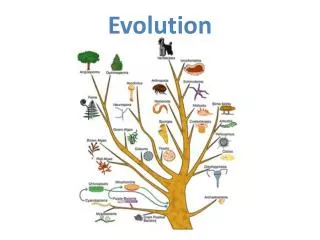
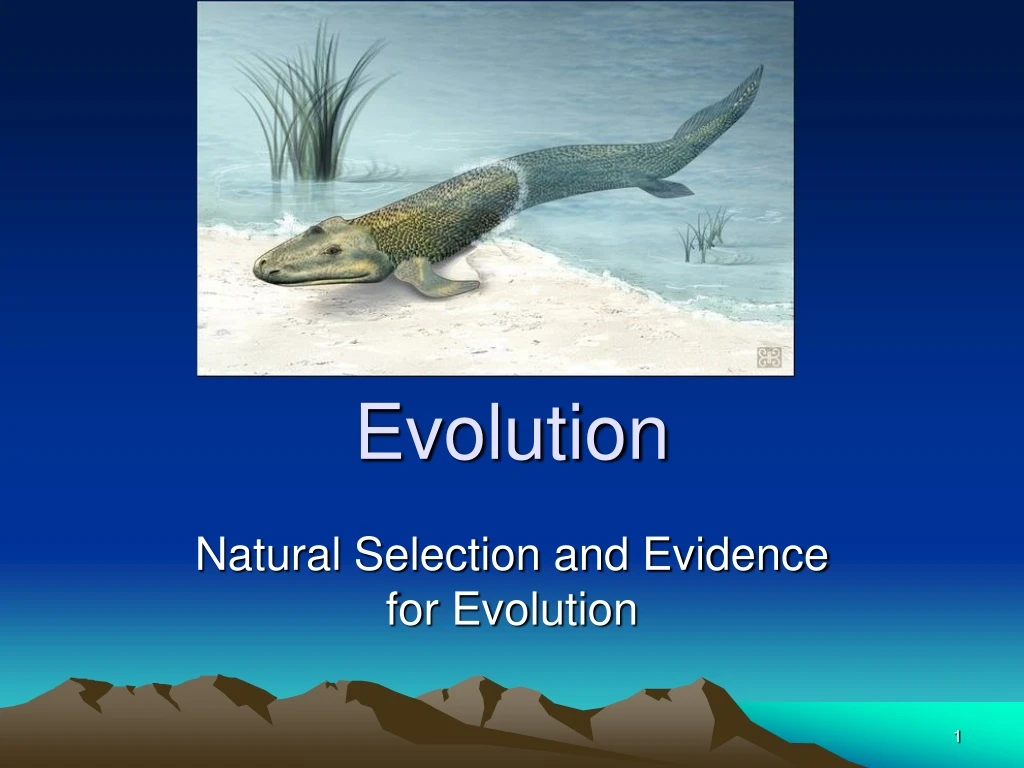
Evolution Natural Selection and Evidence for Evolution
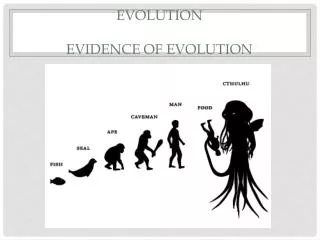
Life • How did we come from this? • To this.
Change in a population over a long time or MANY generations A population is a group of a single species Humans…or Lions Evolution occurs through Natural Selection (“That is the Key!”) What is Evolution?
What is a Species? • A Species is defined as a group of organisms that share similar characteristics and that are capable of interbreeding and producing fertile offspring
Lamarck • French scientist Jean Baptiste de Lamarck (1744 – 1829) • First to propose a unifying hypothesis of species modification • Acquired Traits – trait that is not determined by genes • Lamarck – these were passed on to offspring
Darwin – individuals struggle to survive (competing for food and space, escaping predators, finding mates, locating shelter). Only some individuals survive the struggle and produce offspring Charles Darwin
Darwin – Descent with Modification Modification by Natural Selection Charles Darwin
Darwin and Natural Selection • Four things that drive N.S. • Fitness • Ability to survive and reproduce • Variation • Differences among species • Adaptation • Variation that improves chances of survival • Adaptations develop over many generations • Competition • Fight for survival (food, shelter)
Selection • Artificial Selection • Breeding organisms with specific traits • Natural Selection • Mechanism for change in population • Organisms with certain variations survive, reproduce and pass their traits to offspring • Survival of the Fittest!
Variation A variation is an inherited trait that makes an individual different from other members of the species. Some traits are “better” or more favorable than others
Adaptation • Adaptation: any variation that aids an organism’s chances of survival in its environment
1. Structural Adaptation: allow a species to defend against predation. Mimicry: The ability species to resemble another species; two types. Camouflage: The ability of species to blend in with their surroundings Evidence of Evolution Monarch • Viceroy
Structural Adaptations cont • Mimicry
Other Evidence 2. Physiological Adaptations: • Develop rapidly…(antibiotic resistance; pesticide resistance) • This is Direct Evidence • 3 – 6. Indirect Evidence
3. Fossils • Fossils show evolutionary history
Homologous Structures Common ancestry Analogous Structures No Common ancestry Vestigial Structures No visible function or use any longer 4. Anatomy
Anatomy Revisited • Homologous Structures • Common Ancestor • Can have similar arrangement and function • Analogous Structures • No common ancestor • Similar function; different anatomy
Vestigial Structures • Flightless Cormorant
Vestigial Structures • Human Ear Muscles • Baleen Whale Pelvic Bone • Vestigial Video
5. Embryology • Similarities in Embryos • Suggest a common ancestor
6. Biochemistry • Comparison of DNA and RNA • Determine evolutionary relationship
Evolution and History How Evolution Happens - YouTube
Industrial Melanism • Peppered moths – • Before the Industrial Revolution • After the Industrial Revolution
Disruption of Equilibrium shows Evolution • Mutation – change in the DNA of an organism • Genetic Drift • Alleles frequency changes by random events or chance • Non-Random Mating • Assortative Mating – Selection of mate based on similar characteristics • Migration • into or out of population • Gene Flow: genes moving from one pop to another • Natural Selection – See Below
Review Natural Selection • Natural Selection – • The idea that organisms with traits best suited to their environment are more likely to survive and reproduce
Types of Natural Selection • Stabilizing Selection • Favors average individuals • Disruptive Selection • Favors both extremes of a variation • Directional Selection • Favors a single extreme variation
Speciation • What is Speciation? • The evolution of new species • Geographic Isolation • Occurs when a small part of the population becomes separated; over generations, different variations become more common • Reproductive Isolation • Members of a species change from one another over time so much that they can no longer reproduce fertile offspring
How long does speciation take? • Gradualism • The model that describes evolution as a slow ongoing process • Punctuated Equilibrium • States that rapid evolution comes about when the mutations of a few genes results in the appearance of a new species over a relatively short period of time
Patterns of Evolution • Divergent Evolution • Adaptive Radiation • Single species evolves into an array • Convergent Evolution • The acquisition of the same biological trait in unrelated lineages