Download
1 / 29
290 likes | 408 Vues
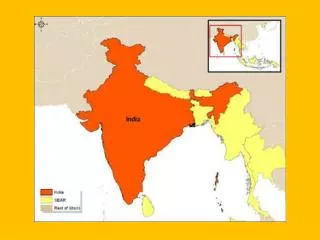
India's population as of 2011 is over 1.21 billion, with a rising life expectancy projected. However, challenges persist, including high infant mortality rates and significant morbidity from both communicable and non-communicable diseases. The government has implemented health policies since 1983 aimed at improving primary healthcare access and standards. Safety concerns regarding traditional medicine usage highlight the need for quality control. Efforts continue towards health equity and enhanced public health infrastructure amidst these demographic changes.

E N D
Demographics • Population (2011): 1,210,193,422 or over 1.21 billion! • Population is increasing. • Life expectancy (2010): 62.6 years (male), 64.2 (female). Projected to increase. • Therefore, have an ageing population. • Infant mortality rate (2010): 50 per 1000 live births.
Main causes of morbidity and mortality(2010): • Communicable diseases e.g. infectious and parasitic diseases e.g. malaria, acute respiratory diseases e.g. pneumonia, TB, and acute diarrhoeal diseases. • Non-communicable diseases e.g. CHD, DM, cancer, neuropsychiatric disorders, blindness. • 357021 deaths due to accident in 2009. • No. 1 cause of death = diseases of the circulatory system.
Health Policy • First national health policy (1983) – aimed to achieve health for all through provision of primary healthcare services. Also, involvement of voluntary organisations, provision of drugs and vaccines, family planning, medical research, nutrition, drinking water and sanitation (inter-departmental cooperation).
Revised national health policy (2002) – aim for acceptable standard of good health among general population. Goals set to be met by 2015 e.g. Increase in public expenditure, decentralisation of health programmes to local governing bodies, increased access to traditional medicine, eradicate leprosy by 2005. http://www.searo.who.int/en/Section313/Section1519.htm
70% of people living in India use some form of traditional medicine for primary healthcare (WHO). • Safety concerns – US studies 20% of Ayurvedic treatments contained toxic levels of heavy metals such as lead, mercury and arsenic. Also herbs containing toxic compounds and the lack of quality control in Ayurvedic facilities (Saper, R. B.; Phillips, R. S. et al. (2008) Lead, Mercury, and Arsenic in US- and Indian-manufactured ayurvedic Medicines Sold via the Internet, Journal of the American Medical Association300 (8): 915–923).