Muscular System 1
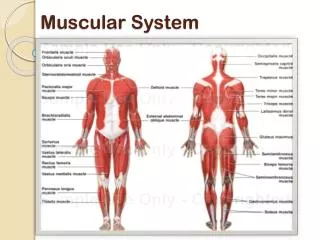
Explore the three primary types of muscle tissue: skeletal (striated & voluntary), cardiac (striated & involuntary), and smooth (smooth & involuntary). Learn about their unique characteristics, functions in the body, and properties such as contractility, extensibility, and elasticity. Delve into the histological aspects, including fascial components, muscle fibers, and the contraction cycle. Additionally, understand the role of neuromuscular junctions in muscle contraction. This guide provides a comprehensive overview of muscular systems essential for human movement and stability.

Muscular System 1
E N D
Presentation Transcript
Muscular System 1 To be copied
Types of Muscle Tissue • 3 types: • Skeletal • striated & voluntary • Cardiac • striated & involuntary • Smooth • Smooth & involuntary
Skeletal Muscle Tissue • most attached to bone • striations: • see light & dark bands under microscope
Cardiac Muscle Tissue • found only in walls of heart chambers • heart has a pacemaker that initiates each contraction • called autorhymicity • controlled by hormones & neurotransmitters
Smooth Muscle Tissue • in walls of hollow organs • attached to hair follicles • some autorhythmic (wall of intestines) • regulated by ANS motor neuron& hormones
Functions of Muscular Tissue (#4) • 1. producing body movements • moving whole body or parts of body
Functions • 2. stabilizing body position • skeletal muscles stabilize joints & halp maintain body positions • postural muscles hold sustained contractions (holding head up all day)
Functions • 3. storing & moving substances w/in body • storing: accompanied by sustained contractions of ringlike bands of smooth muscle called sphincters (hold material in organ) • contraction/relaxation of smooth & cardiac muscle moves material thru bld vessels heart bld vessels
Functions • 4. generating heat • process called thermogenesis • most of heat generated by muscle contraction maintains normal body temp of 37°C • shivering: involuntary contraction of skeletal muscle increases heat production
Properties of Muscle Tissue (#4) • 1. electrical excitability • ability to respond to certain stimuli by producing electrical signals called action potentials • 2 main types stimuli: • autorhythmic electrical signals • chemical stimuli (neurotransmitters) released by neurons
Properties • 2. contractility • ability of muscle fibers to contract forcefully when stimulated by an action potential • muscle fiber shortens & pulls on whatever it is attached to • if force > resistance of object, movement occurs
Properties • 3. extensibility • ability of muscle tissue to stretch w/out being damaged • smooth muscle fibers are stretched every time your stomach or bladder is really full
Properties • 4. elasticity • ability of muscle tissue to return to original length & shape after contraction or extension
CT Components • fascia: sheet or broad band of fibrous CT that supports & surrounds muscles or other organs • 2 layers: superficial & deep
CT Components • 2. 3 layers of CT extend from deep fascia deeper into muscle tissue • epimysium: outermost layer, encircles entire muscle • perimysium: surrounds groups of 10 – 100 muscle fibers = a fascicle • endomysium: surrounds individual muscle fibers
CT Components • 3. tendon: extension of epimysium, perimysium, & endomysium beyond muscle that attaches the skeletal muscle to another structure (bone or another muscle)
Muscle Histology Terms • hypertrophy: enlargement of existing muscle fibers • ex: muscle growth in newborn • hyperplasia: increase in # of muscle fibers • ex: growth hormone causes increase in #s from childhood adult • fibrosis: replacement of muscle by fibrous scar tissue • satellite cells: stem cells in muscle tissue; limited capacity
Terms for Muscle Fiber Organelles • sarcolemma: plasma membrane • sarcoplasm: cytoplasm • myofibril: contractile organelles; thread-like structures; each extends length of muscle fiber
Terms for Muscle Fiber Organelles • T tubules: (transverse) invaginations of sarcolemma into sarcoplasma; increasing surface area • filled with interstitial fluid • ensures action potentials excites all parts of muscle fiber
Terms for Muscle Fiber Organelles • sarcoplasmic reticulum: (SR) endoplasmic reticulum that encircles individual myofibrils • dilated end sacs called terminal cistern • T tubule + 2 terminal cisterns = triad • in relaxed muscle fiber SR stores Ca++ • release of Ca++ triggers contraction
Muscle Proteins • 3 kinds proteins in myofibrils: • contractile proteins • myosin make up thick filaments, golf-club shape (myosin head) • actin thin filaments • regulatory proteins • tropomyosin &troponin: both in thin filaments • structural proteins • ~12 different ones function in alignment, stability, elasticity, & extensibility of myofibrils
Contraction Cycle Steps • ATP hydrolysis • ATP attached to myosin head • attachment of myosin head to actin to form cross bridges • power stroke • cross bridges rotate center slides thin filament past thick filament • detachment of myosin from actin • ATP binds to myosin head & cross bridges released
Neuromuscular Junction (NMJ) • somatic motor neurons innervate muscle fibers to contract
NMJ • synapse: functional junction between 2 neurons or between a neuron & an effector (muscle or gland); may be electrical or chemical • 1st side of synapse: end of axon of motor neuron called synaptic end bulb • then synaptic cleft (the space) • lastly, motor end plate: part of sarcolemma that has receptors for neurotransmitter acetylcholine (ACh)
Steps in Nerve Action Potential Muscle Action Potential • 1. release of ACh • 2. activation of ACh receptors • 3. production of muscle action potential • 4. termination of ACh activity
Release of ACh • ACh stored in vesicles in synaptic end bulb • action potential travels down axon reaches synaptic end bulb induces exocytosis of neurotransmitter from synaptic vesicles • ACh diffuses across synaptic cleft toward motor end plate
Activation of ACh receptors • 2 molecules of ACh bind to ACh receptors embedded in sarcolemma opens ion channel allows Na+ diffuse across membrane
Production of Muscle Action Potential • inflow Na+ makes inside of muscle fiber more + charged • this change in membrane potential triggers a muscle action potential propagates along sarcolemma T tubules • this causes SR to release Ca++ sarcoplasm contraction
NMJ • @ midpoint of muscle fiber: • muscle action potential propagate both ends of fiber • allows simultaneous activation & so contraction of all parts of muscle fiber
Curare • South American plant derivative • causes paralysis by binding to & blocking ACh receptors on motor end plates • curare-like drugs used in general anesthesia to relax skeletal muscles
Botulism • disease caused by Clostridium botulinum toxin that blocks exocytosis of synaptic vesicles so no ACh released so no muscle contraction • toxin one of most lethal chemicals known • causes death by paralyzing skeletal muscles: breathing stops when diaphragm & intercostal muscles stop contracting
Isotonic Contractions • “equal tension” • force of contraction developed by muscle remains almost constant while muscle changes its length • used for body movements & for moving objects • 2 types: • concentric isotonic contraction • eccentric isotonic contraction
Concentric Isotonic Contraction • when tension generated is enough to overcome resistance of object being moved …muscle shortens & pulls on another structure (tendon) ….producing movement that reduces angle at a joint
Eccentric Isotonic Contraction • tension exerted by the muscle resists movement of the load (whatever was lifted up) slowing the lengthening process
Isometric Contraction • tension generated by the muscle is < tension needed to overcome resistance of the object • muscle does not change its length
Cardiac Muscle Tissue • same arrangement actin/myosin: striations • muscle fibers branched • *intercalated discs: unique to cardiac muscle • autorhymicity alone: 75 bpm • remains contracted 10-15 x’s longer than skeletal muscle after 1 action potential • due to prolonged delivery of Ca++ (SR + interstitial fluid • larger & more #s of mitochondria
Smooth Muscle Tissue • +thick & thin filaments but no T tubules & less SR so no striations
Development of Muscle • from mesoderm • starts ~4 wks • cardiac muscle forms tubes bends & folds to form heart
Medical Terminology • spasm: sudden involuntary contraction of a single muscle is a large group of muscles
Medical Terminology • tic: an involuntary twitching by muscles that are normally under voluntary control
Medical Terminology • tremor: rhythmic, involuntary, purposeless contraction that produces a quivering or shaking movement
Medical Terminology • fasiculation: involuntary, brief twitch that is visible under the skin; occurring irregularly & not ass’c with movement • seen in MS or ALS
Medical Terminology • fibrillation: spontaneous contraction of single muscle fiber that is not visible under skin but can be recorded by EMG (electromyograph) • signals destruction of motor neurons
Medical Terminology • muscle strain: tearing of muscle due to forceful impact + bleeding +pain • most often affect quadracepsfemoris • tx‘d RICE (rest, ice, compression ie a wrap, elevation)