
Global Location Impact on Climate Zones and Weather Patterns
E N D
Presentation Transcript
Location, location, location How global location affects weather patterns
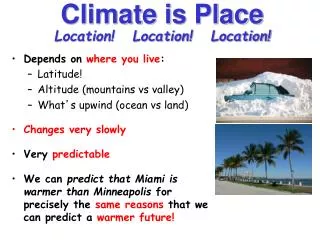
GLOBAL Location affects weather • The equator is an imaginary line that divides the earth in half horizontally. • Latitude is the distance north and south of the equator. • Aplace’s latitude helps determine its weather.
CLIMATE ZONES • Climate is the average weather of a place over a long period of time. • There are 3 types of climate zones: • POLAR- farthest from the equator • TEMPERATE- mid latitudes • TROPICAL- closest to equator
Polar climate zones • POLAR- stays cold all year long. • Where most continental polar and maritime polar air masses form.
Temperate climate zones • Temperate- temperatures change throughout the year, cold in the winter, warm/hot in the summer. • Most noticeable seasonal changes of all the climate zones. • North Carolina is in the temperate climate zones.
Tropical climate zones • Tropical – temperature stays consistently hot to warm all year long. • Receives the same amount of sunlight throughout the year, and the most sunlight of any of the climate zones.
The equator • Since the equator has the warmer conditions and more sunlight, this leads to more evaporation. • More evaporation leads to more water in the atmosphere, more water in the air leads to more condensation, which leads to more precipitation. • Increased evaporation leads to a decrease in pressure.
THE EQUATOR • This is why more LOW pressure systems form near the equator. • This is also why hurricanes form over the Atlantic ocean, near the equator.
Hemispheres • Each half of the earth is a hemisphere. • Northern hemisphere is north of (above) the equator. • Southern hemisphere is south of (below) the equator.
Hemispheres • The seasons are opposites in each hemisphere. • When it is fall in NC in the northern hemisphere it is spring in the southern hemisphere.