
Skeletal System: Bones, Joints, and Movement
E N D
Presentation Transcript
Goformative • http://goformative.com/join • Enter this code MXYJ996 • Password MEDTERMS123 • If you are relatively new to class I may not have created an account for you. To get in the class you will need to do the following: goformative.com/#signup.Students sign up and enter Class Code QXMC237
Websites • http://www.bbc.co.uk/science/humanbody/body/interactives/3djigsaw_02/index.shtml?skeleton • http://www.3d4medical.com/ • http://askabiologist.asu.edu/bone-anatomy • http://anatomy.uams.edu/AnatomyHTML/bones.html • http://www.globalrph.com/medterm5c.htm
Learning Outcomes • List the primary functions of bones. • Identify skeleton bones/types • Explain various types of body movement that occur at the freely movable joints. • Define fracture and state the various types.
Combining Forms • Bone oste/o, oss/i, osse/o • Bone Marrow myel/o • Cartilage chondr/o, cartilag/o • Elbow olecran/o • Joints arthr/o, articul/o • Ligaments ligament/o, syndesm/o • Muscles my/o, myos/o, muscul/o • Sinus sin/o, sinus/o • Tendons tendin/o, ten/o, tend/o
Combining Forms • Bone oste/o, oss/i, osse/o • Bone Marrow myel/o • Cartilage chondr/o, cartilag/o • Elbow olecran/o • Joints arthr/o, articul/o • Ligaments ligament/o, syndesm/o • Muscles my/o, myos/o, muscul/o • Sinus sin/o, sinus/o • Tendons tendin/o, ten/o, tend/o
Prefixes Match Through, between, Around Upon, over, above Within Between Beyond, over, between Within, inner dia- endo-, end- epi- inter- intra- meta- peri-
Suffix Popcorn • Germ cell • Surgical puncture • Cell • Binding • Soft • Growth • Surgical Repair • Formation • To view/examine • Tissue • -blast • -centesis • -cyte • -desis • -malacia • -physis • -plasty • -poiesis • -scopy • - um
Functions of the Skeletal System • Bones- oste/o • Act as a framework for the organ systems • Protect many of the body’s organs • Provide the organism with the ability to move • Storage of minerals • Hematopoiesis (formation of blood)
Bone marrow contains two types of stem cells: hempoietic (which can produce blood cells) and stromal (which can produce fat, cartilage and bone). • There are two types of bone marrow: red marrow (also known as myeloid tissue) and yellow marrow. • The color of yellow marrow is due to the much higher number of fat cells.
What is Oste/o mean? What is Oste/o mean? a) Bone b) Cell c) Formation d) Cartilage
What does cartil mean in cartilage? What does cartil mean? a) Gristle b) Smooth c) Hard d) Pain
Cartilage- Chondr/0 • Cartilage – chondr/o • Forms major portion of embryonic skeleton and part of adult skeleton. • Cartilage is an important structural component of the body. It is a firm tissue but is softer and much more flexible than bone.
Functions of the Musculoskeletal System • Tendons- Attach muscles to bones • Ligaments – ligament/o Bands of connective tissue that connect bones, cartilages and other structures
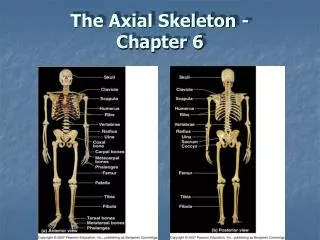
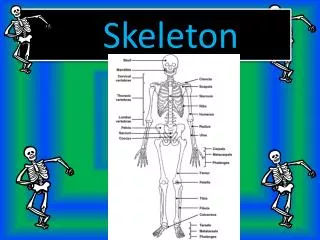
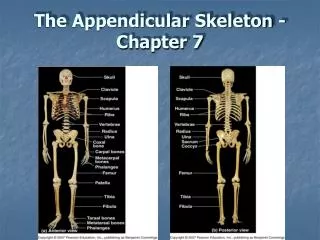
Anatomy and Physiology Overview • The human adult skeletal system is composed of 206 bones that, with cartilage, tendons, and ligaments, make up the framework or skeleton of the body.
Anatomy and Physiology Overview • Axial skeleton • 80 bones, the principal bones being the skull, spine, ribs, and sternum. • Appendicular skeleton • 126 bones, the primary bones being the shoulder girdle, arms, hands, pelvic girdle, legs, and feet.
Figure 6.4Epiphyseal plate (arrows). (Courtesy of Teresa Resch)Note: Epiphyseal plate later turns into an epiphyseal line
Joints and Movement • Classification of Joints • Synarthrosis (Fibrous)- cranial structure • Amphiarthrosis (Cartilaginous) - vertebra • Diarthrosis (Synovial) – knee, hip, elbow What do the prefixes – Syn, Ampi and Dia
Figure 6.6A Flexion and ExtensionFlexion–Bending a limb. Extension–Straightening a flexed limb.
Figure 6.6B CircumductionCircumduction–Moving a body part in a circular motion.
Figure 6.6C Abduction and AdductionAbduction–Moving a body part away from the middle. Adduction–Moving a body part toward the middle.
Figure 6.6D Protraction and RetractionProtraction–Moving a body part forward. Retraction–Moving a body part backward.
Figure 6.6E RotationRotation–Moving a body part around a central axis.
Figure 6.6F DorsiflexionDorsiflexion–Bending a body part backward.
Figure 6.6G Pronation and Supination Pronation–Lying prone (face downward); also turning the palm downward. Supination–Lying supine (face upward); also turning the palm or foot upward.
Figure 6.6 H Eversion and Inversion Eversion–Turning outward. Inversion–Turning inward.
Vertebral Column • These curves are the: • Cervical • The first 7 vertebrae. • Thoracic • The next 12 vertebrae. • Lumbar • The next 5 vertebrae. • Sacral • Consists of the sacrum and coccyx (tailbone).
Bone Pathology • Terms related to bone disease Osteomalacia Osteomyelitis Osteoporosis osteoporosis
Joint Pathology • Osteoarthritis • Degenerative joint disease (DJD) • Rheumatoid arthritis RA joints affected by osteoarthritis
Fractures • A fracture is classified according to its external appearance, the site of the fracture, and the nature of the crack or break in the bone. • Short video on factures • https://youtu.be/qVougiCEgH8
Fractures • Types of fractures:
Fractures • Types of fractures: • Colles • Pott • Compression • Vertebral compression • Epiphyseal (Greek root-phyein) • Stress • Hip
Figure 6.10AClosed, or simple–A completely internal break that does not involve a break in the skin (x-ray of the tibia and fibula). Note the break in the fibula (smaller bone).
Figure 6.10BOpen, or compound–The fracture projects through the skin and there is a possibility of infection or hemorrhage; more dangerous than a closed fracture
Figure 6.10EGreenstick–Only one side of the shaft is broken, and the other is bent (like a green stick); usually occurs in children whose long bones have not fully ossified
Figure 6.10ICompression–Due to the collapse of a vertebra. It may be caused by trauma or due to a weakening of the vertebra due to osteoporosis, tumors, or infection