Download
1 / 18
180 likes | 286 Vues
This document outlines the essential techniques and methodologies for characterizing cells, emphasizing species confirmation, correlation with tissue origin, and transformation status. Key characterization methods are detailed, including chromosomal analysis, tissue markers, and surface markers, as well as the importance of flow cytometry in detecting intracellular and secreted factors. The limitations of light scattering techniques are discussed, alongside the role of fluorescent dyes and antibodies in enhancing detection capabilities. Understanding these methods is crucial for advancing research in cell biology and medicine.

E N D
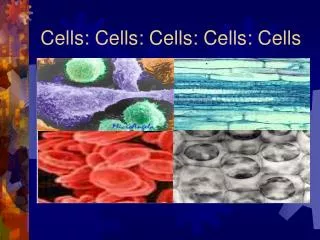
What To Characterize • Confirmation Of Species Of Origin • Correlation With The Tissue Of Origin • Transformation Status • Finite Or Continuous • Cross-Contamination • Stability (ex. susceptibility to transformation)
How Is Characterization Done • Species Identification • Chromosomal analysis • Tissue Markers • Cell surface markers • Ex. CD11c if DC • Intermediate filament proteins • Ex. 1 Glial fibrillary acidic protein (GFAP) for astrocytes. Ex. 2 Desmin for muscle cells. Ex. 3 Cytokeratin for epithelial cells • Differentiated products • Ex. Melanin for melanocytes, hemoglogin for erythroid cells, serum albumin for hepatocytes • Unique Markers • Ex. HLA highly polymorphic, unique to an individual • Morphology • Easy and fast but has variability depending on culturing conditions and site
Flow Cytometry Is A Powerful Technique For Characterizing Cells • Allows For Detection Of Surface Markers Of Cells • Allows For Detection Of Intracellular Factors • Allows Detection Of Secreted Factors By Cells • Allows For Detection Of DNA Content
How Is It Done: http://biology.berkeley.edu/crl/flow_cytometry_basic.html
Limitations With Light Scattering • Some Information Can Be Obtained • FSC Correlates With Cell Size • SSC Correlates With Internal Complexity • To Distinguish Between 2 Cell types • A. Size Has To Be Different OR • B. Internal Complexity i.e amount of granules • If These Two Parameters Are The Same, Then No Distinction Can Be Made • See The Following Figure
Fluorescent Dyes And Antibodies • Fluorochromes Are Molecules That Emit Fluorescence Upon Excitation With Light • Ex. FITC (Fluorescein Isothiocyanate) • PE (Phycoerythrin) • PerCP (Peridinin Chlorophyll Protein) • APC (Allophycocyanin) • Some Fluorochromes Are Proteins, Some Are Small Organic Compounds • Ex. PE (Phycoerythrin)-Protein • Ex. FITC (Fluorescein Isothiocyanate)
Principles Of Fluorescence E= h f = f
GM-CSF+IL-4 GM-CSF+IL-4+PGE2 Fig. 2 GMF: 1.85 GMF: 168.92 25 75 99 1 GMF: 11.82 GMF: 391.83 99 80 1 20
Unstained ISOTYPES
GM-CSF + IL-4 (6 Days Old) GM-CSF