Download
1 / 14
140 likes | 255 Vues
This text explores the complex social, economic, and political landscape of Antebellum Mississippi, focusing on the institution of slavery and the treatment of Native Americans. Key points include the introduction of slavery by the French in the 1700s, the rise of cotton as a cash crop driven by slave labor, and the harsh realities of slave society, including lack of rights and family separations. Additionally, it addresses the challenges faced by Native Americans, treaties that forced relocation, and the legacy of the "Trail of Tears."

E N D
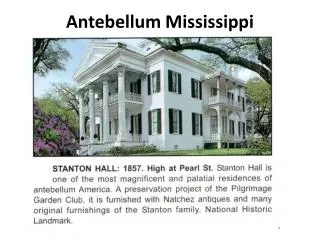
Antebellum Mississippi Mississippi Studies Coach Marbury (cdt Mrs. Bailey)
Slavery in MS I. • Brought by the French in 1700s • From W. Africa or Caribbean • Gov. Bienville & the Black Codes 1724 • Included rights, marriage, property, gatherings, and punishments
Slave Contributions • Natchez District prospered due to slave labor throughout the 1700s • Agriculture was the main occupation for slaves • Tobacco & indigo (Spanish), later cotton
“King Cotton” II. • Cotton gin- 1793 • In 1795, it was introduced to Natchez • Who built the first cotton gin in MS?? • Soon, cotton became the primary cash crop in the South! • Earned the nickname “King Cotton”-it’s importance to MS
Where was it grown? • Improved cotton= more production! • Produced all over the state • Cotton was grown by everyone, but MOSTLY by farmers on __________ • Labor used??
Slave Society III. Jobs: • Cooked, cleaned, tended animals, made clothes, took care of small children • Some were able to become blacksmiths, carpenters, & brick masons
Slave Society IV. Community: • No rights • Considered property • Families separated • Couldn’t testify in court • Ate meals together • Owners provided medical care • Lived in log cabins on plantations • Practiced Christianity
Slave Society V. Freedom & Resistance: • “free blacks” • Natchez & Vicksburg • Restrictions:
Slave Society V. Freedom & Resistance: • Punishment was met with resistance • Run-aways • Nat Turner-1831, VA • Fears of whites in MS • No rebellions in MS
MS Economy • VI. • Prosperous period • “easy credit” • “specie” • Andrew Jackson’s policies led to depression in MS • Planters Bank- Natchez “pet bank” • More $ in circulation=? • Used to buy federal land • 1. land must be paid for in “specie”, 2. banks couldn’t provide the “specie”, 3. banks failed!= Panic of 1837 • Resulted in the depression of 1837-1841 :Gov’t took back land, cotton prices fell, • Banks disappeared
MS Transportation • VII • Economy depended on adequate transportation! • Steamboats • Railroads
Native Americans in Antebellum MS • Assimilation?? • Native Americans were mostly against assimilation • Reason: • After the war of 1812, the gov’t gave up assimilation • Treaties- got the Native Americans to go west of the MS River & give land to the US gov’t • 1.Treaty of Ft. Adams-1801 Cherokee • 2. Treaty of Mt. Dexter-1805 Choctaw/ 4 mil acres • 3. Treaty of Doak’s Stand-1820 Choctaw/ 5 mil acres • 4. Treaty of Dancing Rabbit-1830 Choctaw/ 10 mil acres • 4. Treaty of Pontotoc Creek-1832 Chickasaw/ north MS • “Trail of Tears”-path of the Native Americans to OK • -because of the large number that died on the way to OK • -died of disease, starvation, weather conditions