Download
1 / 23
230 likes | 273 Vues
Learn the fundamentals of series and parallel circuits, applying Kirchhoff's rules to determine voltage drops and equivalent resistance. Discover how brightness of bulbs varies in circuit configurations.

E N D
Physics Mrs. Coyle Series and Parallel Circuits
Kirchhoff’s Rules • Series Circuits • Equivalent Resistance • Voltage Drop Across Resistors • Brightness of Bulbs in a Series Circuit Part I
Series Circuit • There is one current path. • All resistors have the same current.
Remember: Conventional Current • Positive charges are “pumped” by the battery from low to high potential. V>0 • When traversing a resistor with the current, there is a decrease in potential. V<0
1st Rule: (Junction Theorem): At a junction (node), current in= current out 2nd Rule: (Loop Theorem): In a closed loop the sum of the voltages is zero. Kirchhoff’s Rules
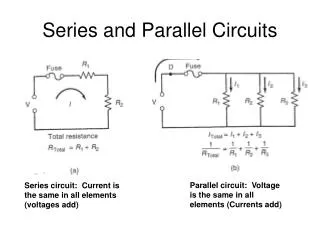
In a series circuit the total voltage drop across the resistors equals the sum of the individual voltages. V = V1 + V2 + V3 Voltage Drop in a Series Circuit
Example 1 • If the battery’s voltage is 12V and the voltage across R1 is 5 V, and across R2 is 4V, find the voltage across R3 . • Answer: 3V
V = V1 + V2 + V3 Using Ohm’s Law: IReq = IR1+IR2 +IR3 Equivalent resistance Req = R1 + R2 + R3 Equivalent ResistanceSeries Circuits
Example 2 • If the battery’s voltage is 12V and R1 = 1Ω R2 = 2Ω R3 = 3Ω • Find the equivalent resistance. • Find the current. • Find the voltage across each resistor. • Answer: 6Ω, 2A, 2V, 4V, 6V
The greater the power actually used by a light bulb, the greater the brightness. Note: the power rating of a light bulb is indicated for a given voltage, at room temperature and the bulb may be in a circuit that does not have that voltage. Remember: Brightness of a Light bulb and Power
P= I V P=I2 R P=V2 / R Remember: POwer
Find the total resistance. • Find the current. • Find the power dissipated in each lamp. • Which light bulb will be the brightest and why? • Find the totalpower. • How does the total power compare to the powers of the individual bulbs. • Ans: 450Ω, 0.027A, 0.18W, 0.036W, 0.109W, 250 Ω, 0.324W Example 3 250Ω 50Ω 12 V 150Ω
Parallel Circuits • Equivalent Resistance • Brightness of Light Bulb • Combination Circuits Part II
There is more than one current path. The voltage across the resistors is the same. Parallel Circuits http://www1.curriculum.edu.au/sciencepd/energy/images/energy_ill112.gif
I = I1 + I2 + I3 V=V1=V2=V3 Using Ohm’s Law: V/Req= V/R1 +V/R2 + V/R3 Equivalent Resistance: 1/Req= 1/R1 +1/R2 + 1/R3 Parallel Circuits
Find the Req , I’s. How does Req compare with each R?Ans: 0.55Ω, I= 22A, (12A, 6A, 4A) Example 1 =2Ω 12V =1Ω =3Ω
Why should you not plug in too many appliances in the same outlet in a home? Question
Ans: 11 Ω, 1.8A, V1=9V, V2=11V, I2=1.1A, I3=0.7A Example 2: Find the Req, all I’s and V’s =10Ω =5Ω =20V =15Ω
Example 3: Find the Req, Total I and All V’s http://www.eng.cam.ac.uk/DesignOffice/mdp/electric_web/DC/00123.png
Req 1 = 71.4Ω Req 2 = 127.3Ω Req = 198.7Ω I=0.12A V1 = 8.6V V2 = 15.3V Answers: