Download
1 / 26
260 likes | 403 Vues
This exploration of Ancient Greece traverses the evolution of its civilizations, starting from the Neolithic settlers around 3000 BC, through the flourishing Minoan and Mycenaean cultures, to the emergence of city-states. The dramatic shifts during the Dark Age culminated in the rise of the Polis and Athenian democracy, showcasing the impact of the Persian Wars. We delve into the contrasting societies of Athens and Sparta, the transformative Peloponnesian War, and the unifying yet devastating conquest by Macedonia. Finally, we examine Alexander the Great's vast empire and its fragmentation post his death in 323 BC.

E N D
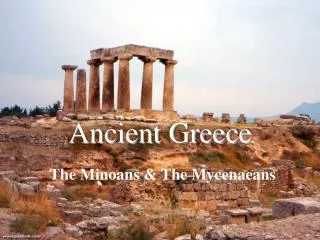
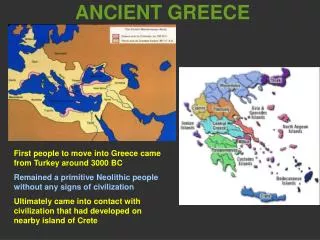
ANCIENT GREECE First people to move into Greece came from Turkey around 3000 BC Remained a primitive Neolithic people without any signs of civilization Ultimately came into contact with civilization that had developed on nearby island of Crete
MINOAN CIVILIZATION • Located on Crete • Developed civilization in response to contact with Egypt • Merchants • Established trade contacts with Mycenaeans • Destroyed in 1500 BC (combination of manmade and natural disasters)
MYCENAEAN CIVILIZATION • Mainland Greece • Small city-states in southern and central Greece • Ruled by chieftains • Stone fortifications • Main economic activity was piracy • Warriors • Incessant fighting among themselves • Destroyed by invasions of Dorians, Ionians, and others • Plunge Greece into “Dark Age” • 1100-800 BC
END OF THE DARK AGE I • Population Pressure • Many Greeks left the mainland and settled elsewhere • Islands in Aegean Sea • Coast of Turkey and Black Sea • Southern Italy and France • Eastern and southern coasts of Spain • Coast of North Africa • Greek colonists always retained ties to the Greek mainland and kept their Greek identity • Remained “Greek” in a cultural sense no matter where they lived
END OF DARK AGE II • With the establishment of worldwide network of colonies, Dark Age came to an end • Greeks rediscovered trade • Also rediscovered writing • Adopted Phoenician alphabet and modified it to fit their spoken language • Also evolved new form of political organization • The Polis
THE POLIS • Product of a long and complicated process of evolution that had occurred during the Dark Age • Based on the city-state • No kings • Governed by assemblies made up of men who were eligible for military service • Greek soldiers had to arm and equip themselves so assemblies were made up of men wealthy enough to do this • Also governed by spokesmen selected from and by these assemblies
ATHENIAN “DEMOCRACY” • Athens: only 30,000 out of a total population of approx. 200,000 were “free citizens” • WHO WAS EXCLUDED FROM CITIZENSHIP? • Women • Slaves • Residents not born in Athens • Lower classes who could not afford military service
GREAT PERSIAN WAR • Response to Athenian aid to rebellion in Ionia in 499 BC • Started by Darius I in 490 BC and continued by his son, Xerxes (until 479 BC) • Three invasion attempts of mainland Greece • Greece won • More familiar with terrain • Fighting for their homes • City-states united together to face Persian threat
ANCIENT ATHENS • Delian League (former military alliance transformed into an empire) • Pericles • Drew on resources of empire to transform city into the most beautiful city of the ancient world • Golden Age • Trade boomed • Work was plentiful • City was an exciting place to live
SPARTAN SOCIETY • All Life Devoted to the Military • Babies inspected for defects • Boys taken from mothers at age 7 for 14 years military training • Spend entire adult life in army • All civilian worked performed by helots • Created Peloponnesian League
PELOPONNESIAN WAR • Between Athens and Sparta • Lasted 25 years (431-404 BC) • Caused massive destruction and loss of life throughout Greek world • Sparta technically won but it was an empty victory—both Athens and Sparta exhausted • Did the Greeks learn anything from this horrible experience? • No !!!!
MACEDONIAN CONQUEST • Philip II, “King and Warrior Lord” of Macedonia, invades Greece in 338 BC and conquers entire peninsula • Murdered two years later • In the middle of planning “war of revenge” against the Persian Empire • Succeeded by his 21-year old son, Alexander (the Great) • Not only continued his father’s plan but also went beyond Philip’s wildest dreams to create the largest empire the world had ever seen • Encompassed all the land between Greece and the middle of India
ALEXANDER THE GREAT • Enormous intellectual and military talents • Enormous ego and powerful vindictive streak • Intelligence and talent plus insatiable desire for glory and cutthroat ruthlessness = conquest of known world
ALEXANDER’S CONQUESTS • 334 BC—invaded and conquered Persian Empire • Then invaded and conquered Central Asia • Then invaded India • Met fierce resistance • Retaliated with slaughter of civilians and destruction of property • Established new cities along route of conquest to protect supply and communications lines
THE END • Troops mutiny in central India • Alexander punishes them by marching them back home through a desert • Stops temporarily at Babylon in 324 BC • Dies suddenly in 323 BC at age 32
THE SUCCESSOR KINGDOMS • Civil war erupts after Alexander’s death • Empire is ultimately split into three parts among his former generals • Ptolemy (Egypt) • Selecus (most of old Persian Empire) • Antigonus Gonatus (Macedonia and Greece) • Known as the “successor kingdoms” • Period known as the Hellenistic Age
GREEK LITERATURE • ILLIAD AND ODYSSEY • Composed by Homer • Deal with the wars of the Mycenaneans and their attack on Troy • Include many famous characters: Achilles, Odysseus, Agamenon and many gods • Characters not portrayed in black and white terms—even heroes have personality flaws. Sophisticated portrayal of characters
GREEK POETS • SAPPHO(female poet from Lesbos) • Only fragments of her poetry survive • Great descriptive beauty and insight into human relationships • PINDAR • Developed the eulogy—long poems praising the lives and exploits of famous individuals
GREEK THEATER • Invented tragedy and comedy • Wore masks and used chorus • Plots derived from mythology • Sophocles---Oedipus the King • Euripides—The Trojan Women • Aristophanes—The Clouds
SOCRATES AND PLATO • Philosopher: “lover of wisdom” • Interested in fundamental questions about the human condition– what is justice; what is good; what is beauty • Used rigorous logic and demanding question-and-answer form of inquiry • Attempted to find absolute answers (universally valid answers that apply to all people, at all times, and in all places
ARISTOTLE • Interested in same questions as Socrates and Plato • Differed in method • Argued that a person should gather evidence on a topic, analyze that evidence, and then base conclusions on that analysis • Example: Politics
GREEK SCIENCE • PYTHAGORAS • Mathematician • Formula for the square of a right angle triangle • HIPPOCRATES • Father of modern medicine • Rejected supernatural explanations for illness • Theory of “bodily humours” (blood, water, black bile, yellow bile) • Hippocratic Oath
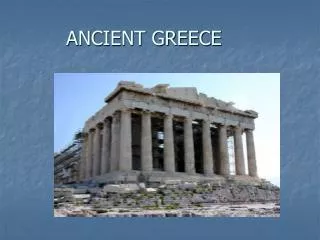
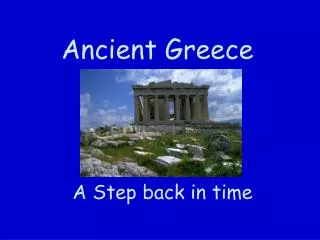
PARTHENON Acropolis
HELLENISTIC CIVILIZATION • Realistic Sculpture • Individualistic philosophies (Skepticism, Stoicism, Cynicism, Epicureanism) • Advances in science
AN IMPORTANT SHIFT • Center of intellectual/cultural achievement moved to cities of successor kingdoms (Alexandria) • Fusion of Greek and Middle Eastern civilization =Hellenism