The Geography and Culture of Ancient Greece: City-States, Myths, and the Olympic Games
Ancient Greece was a diverse collection of lands and islands, characterized by expansive coastlines and mountainous terrain. This geographical fragmentation led to the rise of independent city-states, known as Poleis. The history spans from the Minoans on Crete to the Mycenaean civilization, which flourished before the Dark Ages. Notable literary contributions, like Homer's "The Iliad" and "The Odyssey," emerged during this time. Religion played a significant role, with a polytheistic belief system and gods residing on Mt. Olympus. The Olympics began in 776 BC, uniting Greeks in competition and civic pride.
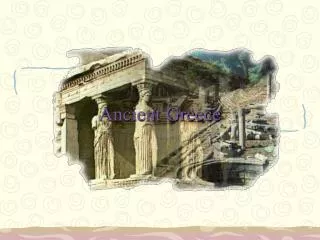

The Geography and Culture of Ancient Greece: City-States, Myths, and the Olympic Games
E N D
Presentation Transcript
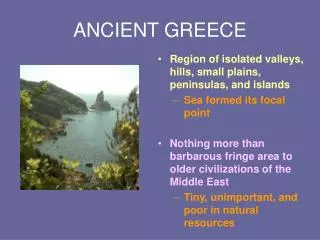
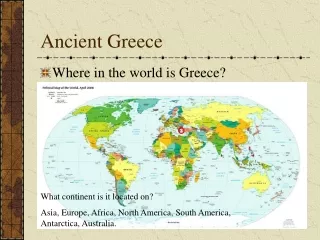
Geography • not a country, but a collection of lands and islands, many miles of coastline; inlets and bays • Sea: Aegean, Ionian, and Black seas united them • Poor resources on land meant increased sea travel, trade and imports • Land: ¾ mountains; highest Mt. Olympus • Difficult to unite under one government; divided by mountains • Broken into different city-states, called Polis (Poleis, pl.) • Climate: moderate temps. Men led outdoor life, most activity – shopping, civic meetings, athletic activities
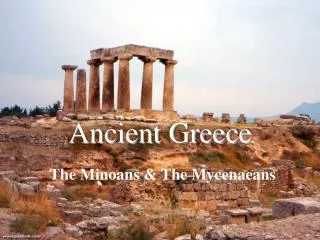
Early Greeks • Crete (2000-1400 BCE) • Minoans (after their king Minos) • Wealthy traders; built large homes, had fancy clothes, etc… • Ended by volcano, undersea earthquake, tidal waves, invasion, evidence exists for all these theories • Bronze Age (2000 BCE) • Mycenae – mainland Greek city of Mycenae built on steep ridge • Fortified their cities with stone walls • Wealthy from piracy • Trojan War: 1200 BC • Greek kings attack Troy, a trading city on the coast of Asia Minor • Greek king’s (Menelaus) wife (Helen) stolen by a Trojan youth (Paris); archaeological evidence shows some proof of this, prolonged wars
The Dark Ages 1200 BC (early iron age) • Dorians • Greek speaking people from the north come in with iron weapons • Little skill, less advances • Trade at a standstill • Skill of writing is lost for about 400 years (1150-750 BC) • Homer • The blind poet • Depended on spoken words (bards) • Wrote long epic poems, ideals of heroism, Arête: heroic ideal: strive for excellence, courage, fame and honor • Interested in individuals, heroes compete for glory • The Iliad and The Odyssey around 750 BC Carving of Trojan Horse; 7th C. BCE
Bonds Uniting Greeks • Language and Literature • Religion: Polytheistic • Gods Lived on Mt. Olympus, immortal • The were very “human” – fought a lot, had human weaknesses • Religion linked to government and civic pride
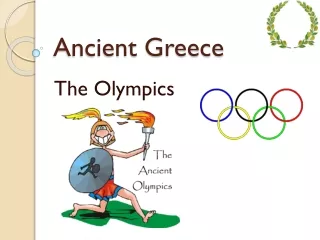
More Bonds • Olympics • Began in 776 BC every 4 years • All athletes from Aegean area traveled to Mt. Olympus, home of the gods, to honor Zeus • Pentathlon most important event (racing, jumping, discus, javelin, wrestling) • Prize= honor and fame (arête) • Fear of Persia • to the east, Greeks felt the Persians were Barbarians