Australia Review
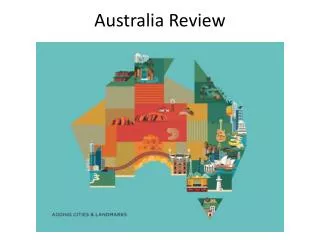
Discover the extraordinary landscapes and natural wonders of Australia, from the dry expanses of Lake Eyre—often filled only three to four times a century—to the vibrant ecosystem of the Great Barrier Reef, the world's largest living structure. Uncover Ayers Rock, or Uluru, a sacred site for Aboriginal people, and learn about the rich history of Australia's indigenous cultures. Experience the unique wildlife, including kangaroos, koalas, and the fascinating Tasmanian devil, while gaining insights into Australia's parliamentary democracy and economy.

Australia Review
E N D
Presentation Transcript
Land &Climate: Lake Eyre • In central Australia • Fills only 3 or 4 times every century • Flat & dry
Lake Eyre 2010 • 99m above sea level, this large, flat lake is usually dry • About every 25 years, the rare event of heavy rainfall will fill rivers and Lake Eyre in the Australian Outback • Queensland's summer floods of 2009 have transformed parts of the outback landscape
When full, it Lake Eyre is the largest pelican breeding area in Australia.
Great Barrier Reef • Off Northeastern coast of Queensland, Australia • Made up of tiny animal skeletons less than an inch long • Has taken hundreds of years to form
Ayers Rock • In central Australia • Can change colors from blue to red • World’s largest monolith (stand-alone rock formation) • Also called Uluru • Sacred site for Aborigines
Outback • 2/3 of central Australia • 15% of Australians live in the Outback • Flat plains, desert, & unusual rock formations
History • Aborigines: native people • Weapons: boomerang, spear • Had many languages • No written language • Migrated from Asia • Have been marginalized
Britain Colonizes Australia • British settled the land and took it over from the Aborigines • Prisoners arrived from Great Britain to establish penal colonies • farmed land, built roads, & constructed buildings • Received free land after they served their sentence • incentive to remain in Australia
Government • Parliamentary Democracy • Prime Minister is head of government • Tony Abbot • Federal system of government • National government • State government • All Australians required to vote! • Australia gained independence from Britain in 1901.
Economy • Mineral & energy resources • World’s top producer of wool • Tourism
Major Cities • Sydney • Melbourne • Canberra – national capital
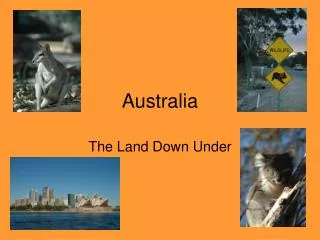
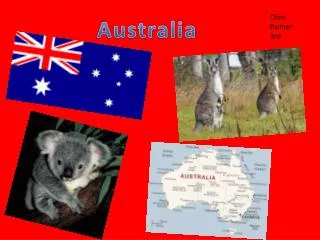
Australian Animals • Kangaroos & koalas • are marsupials • call their young “joeys” • Emu • 2nd largest bird • it cannot fly • Platypus & Echidna • Monotreme: Mammal that lays eggs • Wombat • Tasmanian Devil
Tasmanian Devil • Cantankerous disposition • Will fly into a maniacal rage when threatened by a predator, fighting for a mate, or defending a meal. • Early European settlers dubbed it a "devil" after witnessing such displays, which include teeth-baring, lunging, and spine-chilling guttural growls. • Coat of coarse brown or black fur and a stocky profile gives them the appearance of a baby bear. • Most have a white stripe or patch on their chest They have long front legs and shorter rear legs, giving them a lumbering, pig-like gait. • The Tasmanian devil is the world's largest carnivorous marsupial, reaching 30 inches in length and weighing up to 26 pounds • Its oversize head houses sharp teeth and strong, muscular jaws that can deliver, pound for pound, one of the most powerful bites of any mammal.