Understanding Plate Tectonics: From Mountains to Volcanoes
This informative overview explores key concepts of plate tectonics, including divergent and convergent boundaries. Learn how oceanic plates form mid-ocean ridges, how folded mountains arise from colliding continental plates, and the processes behind subduction that creates trenches and volcanic arcs. Discover the significance of convection in the mantle and how geological features like the Ring of Fire and the Himalayas develop. This resource is essential for anyone interested in earth sciences and geology.

Understanding Plate Tectonics: From Mountains to Volcanoes
E N D
Presentation Transcript
Plate Tectonics A Path To Victory!
Answer 1 Divergent boundary, 2 oceanic plates, mid-ocean ridge forming!
Answer 2 • Folded mountains form when 2 continental plates converge—collide.
Answer 3 Fault block mountains form when continental plates diverge.
Answer 4 • Rift valley forms when continental plates diverge.
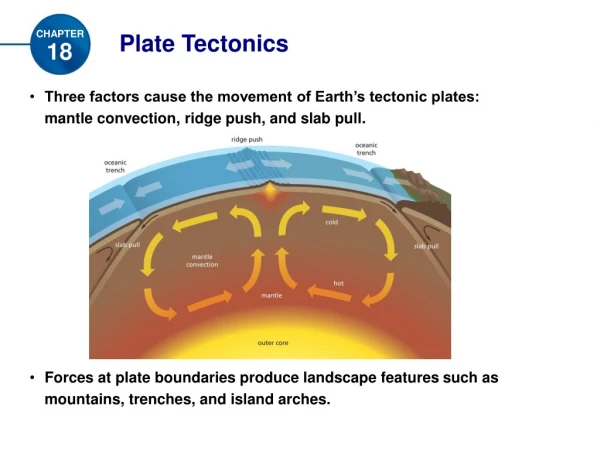
Answer 5 Subduction: When heavier plate dives beneath less dense plate.
Answer 6 • Oceanic plates subduct beneath continental plates or other oceanic (less dense) plates.
Answer 7 • Trench, volcanic mountain
Answer 8 • Mid-ocean ridge volcano!
Answer 9 • Divergent: 2 oceanic plates pulling apart.
10. Where do trenches form? • ??????
Answer 10 • At subduction zones.
Answer 11 • Mid-ocean ridge Subduction
Answer 12 • Convection in the mantle!
14. How does subduction form volcanoes? • ???????
Answer 14. • Subducting plate melts then “bubbles up” to form volcano.
Answer 15 • Aleutian Islands
Answer 16. • Two oceanic plates diverging-mid ocean ridge.
Answer 17. • Iceland! Part of mid-ocean ridge (Atlantic)
Answer 18 • Ring of fire! Subduction zones around the world form this ring.
Answer 19. They get older…they move closer to subduction/trench.
Answer 20. • Rocks formed at ridge record earth’s magnetic field reversal.
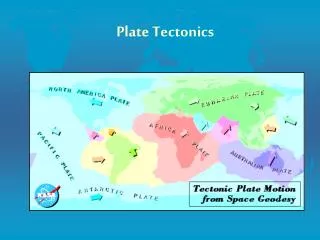
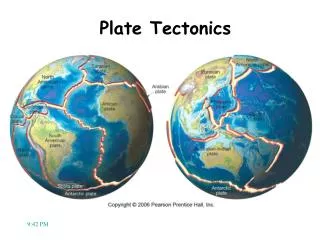
21. What will most likely form at boundary of Antarctic plate and Cocos plate?
Answer 21. It’s 2 oceanics diverging, so mid-ocean ridge.
Answer 22. 2 continental plates converging.
Answer 23 • Subduction zones!
Answer 24. • New ocean floor/rock
25. Where in the U.S. would we find a transform boudary? • ?????