Download
1 / 43
440 likes | 566 Vues
This overview explores the intricate structure and vital function of mitochondria, the powerhouse of the cell. Mitochondria possess a unique double membrane, featuring an inner matrix with extensive folds to maximize surface area and an outer compartment rich in protons (H+). They have their own DNA, allowing them to reproduce independently within cells, hinting at their evolutionary origin. Key processes like the breakdown of pyruvate into acetyl-CoA, the Krebs cycle, and electron transport are essential for ATP production. Explore the fascinating mechanisms that fuel cellular energy!

E N D
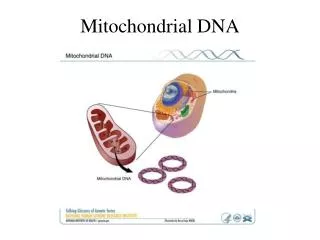
Mitochondrial structure • Two compartments inner and outer • Inner=MATRIX • Lotsa folds=…why? • Outer=acid…why?
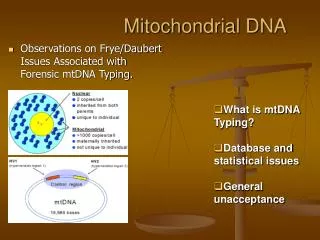
The Mitochondria • Double membrane • Has it’s own DNA!! • Can reproduce in cell…! • Endosymbiont?? • Possible evolution?
The Fate of PYRUVATE • Taken into mitochondria • Broken down to ACETATE • CO2produced • Binds to large protein Coenzyme A toproduce acetyl Coenzyme A
The TCA or KREBS CYCLE • CO2 • NADH & FADH • 2 more ATP
Alternative pathway… • Mitochondria and • O2 needed • Uses NADH and FADH produced in previous reactions • To make more ATP • Lots more!!
NADH FAHD
What is NADH?? FADH?? • ENERGY CARRIER! • Same forFADH • Carrier to…?
Electron Transport System • ETS (cytochrome chain) is a series of reduction/oxidation reactions • Enzymes embedded in mitochondrial membranes
ETS • RedOx reactions pump H+ out of matrix to the outer compartment • H+ = acid…aha!
Summation of Reactions • H+ can only “fall” back into matrix thru • A special enzyme/protein complex • ATP SYNTHASE…guess what that makes?? • But…how much ATP??
ETS makes how much ATP??
cytoplasm mitochondria