Balancing Chemical Equations and Understanding Reaction Types
This document provides a comprehensive understanding of balancing chemical equations and identifying reaction types. It explores various reactions, such as BiCl5 with Zn and Mg(NO3)2 with Na2SO4, detailing coefficients needed for balance, reaction types (decomposition, synthesis, combustion, single replacement, double replacement, neutralization), and the examination of redox processes. Additionally, it guides through oxidation number assignments, determining if reactions can occur based on the activity series, and recognizing reducing and oxidizing agents.

Balancing Chemical Equations and Understanding Reaction Types
E N D
Presentation Transcript
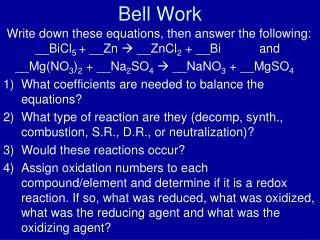
Bell Work Write down these equations, then answer the following: __BiCl5 + __Zn __ZnCl2 + __Bi and __Mg(NO3)2 + __Na2SO4 __NaNO3 + __MgSO4 • What coefficients are needed to balance the equations? • What type of reaction are they (decomp, synth., combustion, S.R., D.R., or neutralization)? • Would these reactions occur? • Assign oxidation numbers to each compound/element and determine if it is a redox reaction. If so, what was reduced, what was oxidized, what was the reducing agent and what was the oxidizing agent?
Reality Check • Determine the Oxidation number for each atom in the following: Fe2O3 H2 Zn+2 Na2O CO3-2 H2Cr2O7 • Prove that the following is a redox reaction by determining the oxidation numbers of each atom. Then identify the reducing agent and oxidizing agent. Cu + 2Ag+ Cu+2 + 2Ag
Choose Your Category Final Question
Random Points 400 points
Will It Happen - 100 This can be used to determine if a single replacement reaction can occur. The Answer is an activity series Back
Will It Happen - 200 • Will the following reaction occur? AlO + Fe The Answer is no because Fe is lower than Al Back
Will It Happen - 300 • Will the following reaction occur? Zn + CuSO4 The Answer is yes because Zn is higher than Cu Back
Random Points 200 points
Will It Happen - 400 • Will the following reaction occur? AgNO3 + (NH4)2SO4 Back The Answer is no Because product would be Ag2SO4 (aq) and NH4NO3 (aq)
Will It Happen - 500 Will the following reaction occur? • Na2CO3 + BaCl2 The Answer is yes because BaCO3 would be a solid. Back
Oxidation Numbers - 100 • The oxidation number of a monatomic ion is equal to _____________________ The Answer is the charge of the ion. Back
Oxidation Numbers - 200 • What is the oxidation number of Cu. The Answer is 0. Back
Random Points 200 points
Oxidation Numbers - 300 • The most electronegative element on the periodic table has an oxidation number of ______________ when in a compound. The Answer is -1. Back
Oxidation Numbers - 400 • Assign oxidation numbers to all the atoms in the following: • HOCl The Answer is +1/-2/+1. Back
Oxidation Numbers - 500 • Assign oxidation numbers to all the atoms in the following: • AlNO3 The Answer is +3/+3/-2. Back
Redox Reactions – 100 • Any chemical change in which one species loses electrons and another species gains electrons is known as this. The Answer is a reduction – oxidation reaction or a redox reaction. Back
Random Points 300 points
Redox Reactions– 200 • This is defined as a chemical change in which electrons are gained, either by the removal of oxygen, the addition of hydrogen, or the addition of electrons. The Answer is reduction. Back
Redox Reactions – 300 • What element was reduced in the following reaction? • 2 HCl + Mg MgCl2 + H2 The Answer is H (it went from a +1 to a 0). Back
Redox Reactions – 400 (peroxide) -1 +1-1 +1-2 0 +1 -2 • 2Br -1 + H2O2 + 2H3O+ --> Br2 + 4H2O • What element was reduced? • What element was oxidized? • What is the Reducing Agent? • What is the Oxidizing Agent? Oxygen Bromine Br -1 H2O2 Back
Redox Reactions – 500 What is the reducing agent in the following reaction? HNO3 + HBr NO + Br2 + H2O +1+5-2 +1-1 +2-2 0 +1-2 The Answer is HBr Back
Balancing Chemical Reactions - 100 • These are the only thing that can be used to balance chemical equations. The Answer is coefficients Back
Balancing Chemical Reactions - 200 • Balance the following equation: ___ CaCO3(s) ___ CaO(s) + ___ CO2(g) The Answer is 1,1,1 Back
Random Points 500 points
Balancing Chemical Reactions - 300 • Balance the following equation: __ CaH2 + __ H2O __ Ca(OH)2 + __ H2 The Answer is 1,2,1,2 Back
Balancing Chemical Reactions - 400 AlCl3(aq) + Ba(OH)2(aq) --> Al(OH)3(s) + BaCl2(aq) When this equation is correctly balanced, the coefficient of the AlCl3 will be — The Answer is 2 Back
Balancing Chemical Reactions - 500 • Balance the following equation: __ C6H14 + __ O2 __ CO2 + __ H2O The Answer is 2, 19, 12, 14 Back
Reaction Types - 100 • This type of reaction involves a hydrocarbon and oxygen making water and carbon dioxide. The Answer is combustion Back
Reaction Types - 200 • Which reaction type best describes the reaction above? The Answer is single replacement. Back
Random Points 100 points
Reaction Types - 300 2 Fe + 3 Cl2 2 FeCl3 • Which reaction type best describes the reaction above? The Answer is synthesis. Back
Reaction Types - 400 • This type of reaction is shown in the following graphic: The Answer is decomposition Back
Reaction Types - 500 H2SO4 + 2 NaOH Na2SO4 + 2 H2O • Which reaction type best describes the reaction above? The Answer is neutralization. Back
Random Points 400 points
Note Type Questions - 100 • This type of reaction involves a hydrocarbon and oxygen making water and carbon dioxide. The Answer is combustion Back
Note Type Questions - 200 • If an atom is reduced in a redox reaction, what must happen to another atom in the system? The Answer is it must be oxidized. Back
Note Type Questions - 300 • Chemical equations must be balanced to satisfy ___________________________ (multiple words). The Answer is the law of conservation of mass Back
Note Type Questions - 400 • An element in the activity series can replace any element The Answer is below it on the list. Back
Note Type Questions - 500 • An insoluble solid produced by a chemical reaction in solution is called The Answer is a precipitate. Back
The Final Question • The final question has to deal with: • Balancing Chemical Reactions and Classifying Reactions from words Make your wager
Balance the following equation and classify the type of reaction. • Tetracarbon decahydride and oxygen react together to make carbon dioxide and water.
The Answer • 2 C4H10 + 13 O2 8 CO2 + 10 H2O • combustion