Download
1 / 7
80 likes | 402 Vues
This guide explores the fundamental concepts of moles and equivalents in chemistry. It clarifies that 1 mole of any substance corresponds to its atomic or molecular weight in grams. For example, 1 mole of Na+ equals 23 grams, and 1 mole of CaCl2 equals 111 grams. We delve into the definitions of milliequivalents (mEq) and millimoles (mmol), explaining how to calculate them based on valence. Additionally, example problems illustrate how to determine mEq in multiple scenarios, enhancing your grasp of these essential chemical calculations.

E N D
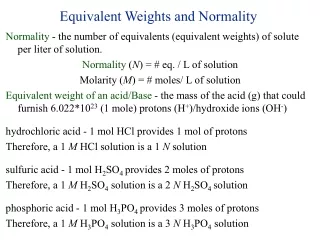
Basics • 1 mole of anything = atomic, formula, or molecular weight in grams • 1 mole of Na+ (atomic weight 23) = 23 grams • 1 mole of CaCl2 (Ca=40, Cl=35.5 X 2) = 111 grams • 1 milliequivalent (mEq)= 1/1000 Eq • 1 millimole (mmol) = 1/1000 mol • 1 mEq = 1 mmol/valence
Basics • Equivalent (Eq) weight = molecular weight/valence • Equivalents = # moles X valence • Valence = charge • K+, Na+, PO4-, or Cl- = 1 • Ca2+ = 2 • Eq weight of Na+ =23/1 = 23 grams • 1 Eq of Na+ = 1 mole of Na+ • Eq weight of Ca2+ = 40/2 = 20 grams • 2 Eq of Ca2+ = 1 mole of Ca2+
Example • How many mEq are in 117 mg of NaCl Cl = 35.5, Na = 23 = 2 mEq of Na+, 2 mEq of Cl-, 2 mEq of NaCl.
Example • How many mEq of potassium are in 1500 mg of KCl? K+ = 39.1 g, Cl- = 35.5 g
Same problem different way to calculate We have 1500 mg KCl FW = 74.6 g
How many mEq of NaCl needs to be added to 250 mL of water to make half normal saline?