Download
1 / 21
210 likes | 382 Vues
Cells maintain a resting membrane potential, characterized by a polarized state where the interior is negatively charged compared to the exterior. This electrical potential, expressed in millivolts (mV), varies among different cell types. Key factors determining this potential include concentration gradients of ions and the permeability of the membrane. The Nernst Equation allows for the calculation of equilibrium potential for specific ions, guiding our understanding of membrane dynamics. The K+ gradient influences the resting potential, with the Na-K pump sustaining these ionic distributions.

E N D
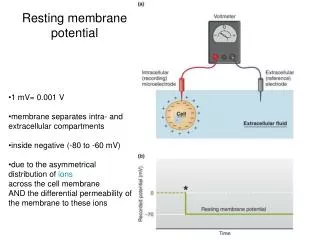
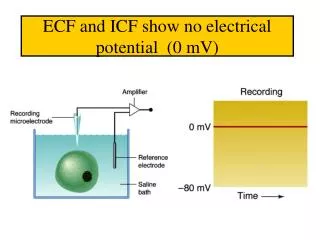
All cells are polarized. • The value of the potential varies from cell to cell but they are all polarized. • Negative inside, positive outside. • The sign of the potential is referred by convention to that of the inside.
What determines the value of the electrical potential? • Concentration gradients of ions. • Permeability characteristics of the membrane.
Electrical potential: potential difference or potential. Units: Volt, in biology mV. • Separated charges (+) and (-) have the potential for work if they come together. • Current: movement of charges. Unit Ampere. • Resistance: hindrance to movement of charges. Unit: Ohm
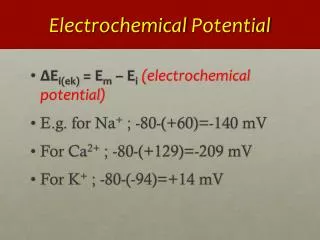
Equilibrium Potential • Equilibrium potential: Electrical potential (mV) that balances the concentration (chemical) gradient. • Nernst Equation.
Nernst Equation • Given a chemical gradient of ion X, the equilibrium potential Ex, can be calculated as • Ex = (RT/Fz) ln [X]out / [X]in • z is the charge of the ion. • R and F are constants. • T is temperature in K.
Nernst Equation Simplified • Ex in millivolts = + or – 60 log [Xinside]/[Xoutside] • This works for univalent ions such as Na+ or K+ • This applies the constants (R,F) and works at normal body temperature (K) • The sign will be + for negative ions and – for positive ions • The answer is for the potential INSIDE the membrane
K potentials • Resting membrane potential (Vm) = -90mV. • K+ chemical gradient pulling Vm to –101 mV. • The resting membrane is more permeable to K+ and the Vmis closer to EK.
Membrane Permeability • Two main factors determine Vm • Chemical gradient. • Membrane permeablity
Membrane Permeability and Concentrations • Goldman-Hodgkin-Katz equation
Anion and Cation distribution [K+] 4mEq/l [K+] 155 mEq/l Fixed Anions [Na+] 12 mEq/l [Na+] 145 mEq/l