Phonological Categories and Laryngographic Closed Quotient Interaction in Language
This study examines the interaction between laryngographic closed quotient values and articulation manners in phonological categories across different languages. Conducted by researchers from the University of Leeds, University of Salford, Dammam University, and CNRS Paris, the research highlights how language-specific phonological characteristics manifest in speech. The findings aim to deepen understanding of the acoustic properties associated with various articulatory configurations, contributing to the broader field of phonetics and phonology.

Phonological Categories and Laryngographic Closed Quotient Interaction in Language
E N D
Presentation Transcript
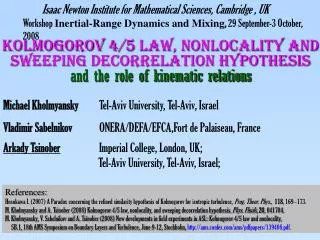
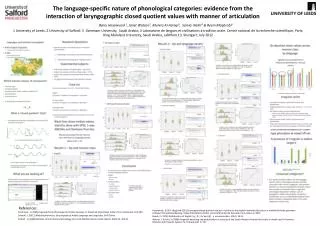
The language-specific nature of phonological categories: evidence from the interaction of laryngographic closed quotient values with manner of articulation Barry Heselwood 1, Janet Watson2, Munira Al-Azraqi3, Samia Naïm4 & Reem Maghrabi5 1 University of Leeds; 2 University of Salford; 3 Dammam University, Saudi Arabia; 4 Laboratoire de langues et civilisations à tradition orale, Centre national de la recherchescientifique, Paris; King Abdulaziz University, Saudi Arabia, LabPhon 13, Stuttgart, July 2012 References • Heselwood , B. & R. Maghrabi (2012) Laryngeal closed quotient vlaues in relation to the majhūr-mahmūsdistinction in traditional Arabic grammar. Colloque International Backing / Base ArticulatoireArrière, Université Sorbonne Nouvelle, Paris, May 2-4, 2012. • Roach, P. (1973) Glottalization of English /p/, /t/, /k/ and /ʧ/ - a re-examination. JIPA 3, 10-21. • Watson, J. & Asiri, Y. (2008) Prepausal devoicing and glottalization in varieties of the South-Western Arabian Peninsula. In Arabic and Its Varieties: Phonetic and Prosodic Aspects. M. Embarki (ed). 17-38. • Cantineau , J. (1946) Esquissed’unephonologie de l’arabeclassique. In Etudes de linguistiquearabe. Paris: Klincksieck, 165-204. • Danecki, J. (2012) Majhūra/mahmūsa. Encyclopedia of Arabic Language and Linguistics. Brill Online. • Garbell , I. (1958) Remarks on the historical phonology of an East Mediterranean Arabic dialect. Word 14, 303-37.