Understanding the Metric System: A Comprehensive Overview
The Metric System, developed in France in the 1790s and formalized by the Treaty of Meter in 1875, is a decimal-based measurement system widely used across the globe. With consistent units for length (meter), volume (liter), and mass (kilogram), it simplifies calculations by using powers of ten. While it is the standard for scientists and governments worldwide, the United States remains an exception. This guide covers the essential units, prefixes, and practical applications of the Metric System, including temperature in degrees Celsius and measurements in seconds and liters.

Understanding the Metric System: A Comprehensive Overview
E N D
Presentation Transcript
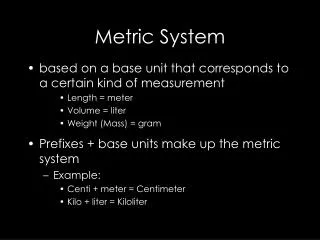
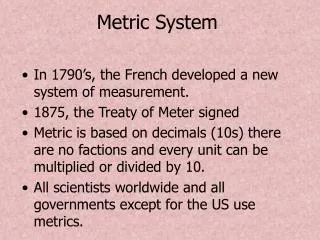
Metric System • In 1790’s, the French developed a new system of measurement. • 1875, the Treaty of Meter signed • Metric is based on decimals (10s) there are no factions and every unit can be multiplied or divided by 10. • All scientists worldwide and all governments except for the US use metrics.
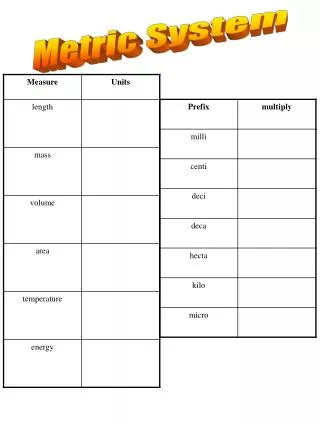
Units • Length • Meter - the meridian running through Paris from North Pole to Equator was divided into 10 million parts or meters. • Volume of liquid • Liter - 1 cubic decimeter. • Mass • Kilogram - weight of 1 liter of pure water which is approximately 1000 paper clips.
Other Measurements • Temperature is measured in degree Celsius the difference between water freezing and boiling is divided into 100parts or degrees with freezing at 0o and boiling at 100o C • Time is measured in seconds, minutes, hours, days and years
Prefixes • The prefixes most commonly used are: • Kilo (K) = 1000 • Hecto (H) = 100 • Deca (Da) = 10 • deci (d) = .1 or 1/10 • centi ( c) = .01 or 1/100 • milli (m) = .001 or 1/1000
Using metrics • To measure the length of the room • meters (m) • To weigh a person • kilograms (kg) • To give medications • milliliters (ml)