
SlideServe
Menu
Préférences
© SlideServe · v2026

Nutrients

keiki avatar
12 diapositives · 324 Views · Jul 30, 2014

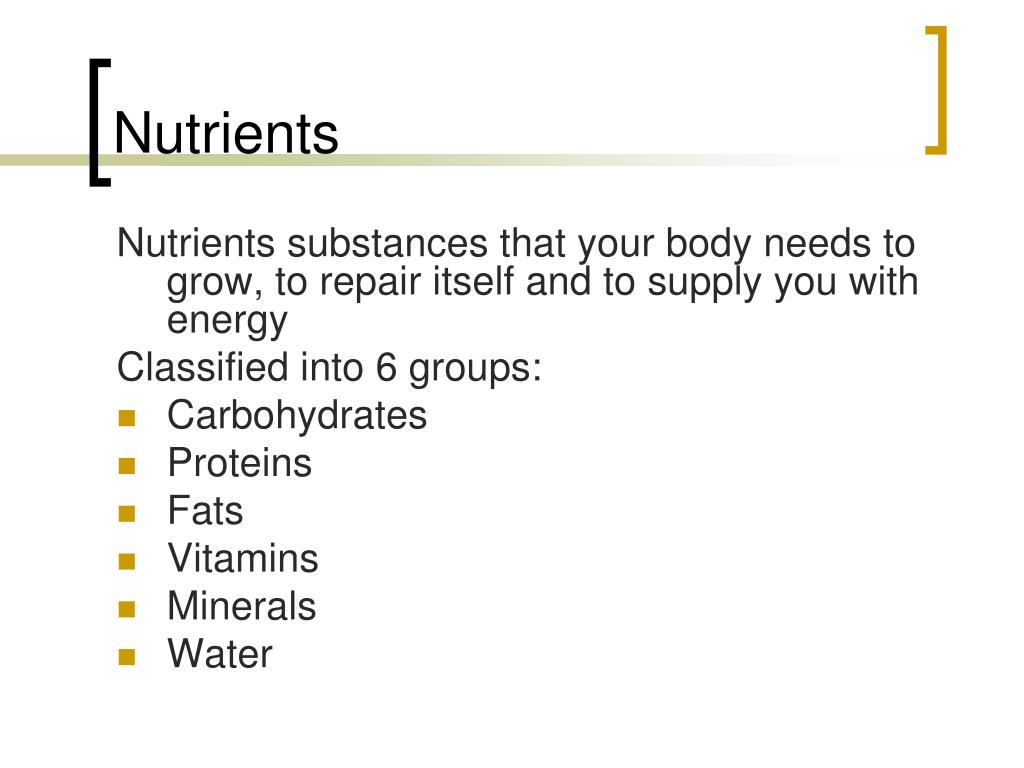
Nutrients. Nutrients substances that your body needs to grow, to repair itself and to supply you with energy Classified into 6 groups: Carbohydrates Proteins Fats Vitamins Minerals Water. Carbohydrates. The starches and sugars present in foods Body’s main source of energy
Nutrients - slide 1
01 / 12Nutrients
1 / 17

Télécharger la présentation

Nutrients
Une image / un lien ci-dessous est fourni (tel quel) pour télécharger la présentation

Politique de téléchargement : le contenu du site vous est fourni TEL QUEL pour votre information et votre usage personnel ; il ne peut être vendu, concédé sous licence ni partagé sur d’autres sites sans l’accord de son auteur.Le contenu vous est fourni TEL QUEL, pour votre information et votre usage personnel uniquement. Téléchargez la présentation en cliquant sur ce lien. Lors du téléchargement, si vous ne parvenez pas à télécharger une présentation, l’éditeur a peut-être supprimé le fichier de son serveur.Pendant le téléchargement, si vous ne parvenez pas à obtenir une présentation, le fichier a peut-être été supprimé par l’éditeur.

F I N

Plus de contenu associé

Transcription de la présentation
  1. Nutrients Nutrients substances that your body needs to grow, to repair itself and to supply you with energy Classified into 6 groups: • Carbohydrates • Proteins • Fats • Vitamins • Minerals • Water

  2. Carbohydrates • The starches and sugars present in foods • Body’s main source of energy • Simple – sugars • Complex – starches • Fiber

  3. Proteins • Nutrients that help build and maintain body cells and tissues • Made of long chains of amino acids • Used to make enzymes, hormones and antibodies • Supply body with energy

  4. Fats • Lipid – fatty substance that does not dissolve in water • Some fat is necessary for good health • Types: • Saturated – solid at room temperature • Unsaturated – liquid at room temperature

  5. Role of Fats • Provide a concentrated form of energy • Transport vitamins in blood stream • Needed for growth and healthy skin • Add flavor and texture to foods • Help satisfy hunger longer • Consuming excess can result in weight gain and obesity

  6. Vitamins • Compounds that help regulate many vital body processes, including digestion, absorption and metabolism of other nutrients • Water-soluble and fat-soluble

  7. Common Vitamins • C – protects against infection • A – keeps eyes moist and adjusts to darkness • D – bone and tooth development • Folic Acid – needed for cell replication and growth

  8. Minerals • Substances that the body cannot manufacture but that are needed for forming healthy bones and teeth and for regulating many vital body processes

  9. Common Minerals • Calcium – building bones and teeth • Iron – important for red blood cell function • Phosphorous – gives rigidity to bones, maintains pH balance in blood and essential in cell metabolism • Magnesium – aids in bone growth and muscle contraction

  10. Which is healthier?

  11. Water • Vital to every body function • Transports nutrients • Carries wastes • Important to drink at least 8 glasses of water a day

  12. Questions • Compare the energy provided to the body by carbohydrates, proteins and fats. • What is the difference between vitamins and minerals? • What are the benefits of eating a variety of fruits and vegetables?