Effective Project Planning for Robotics Development
This project focuses on the planning and execution of significant robotics development activities. It encompasses non-routine tasks with distinct start and end dates, ensuring that the use of resources—time, money, and personnel—is efficiently managed. Key activities include creating technical drawings, building prototypes, and developing transmission systems. The project outline also incorporates milestones to track progress and motivate the team, utilizing tools like Work Breakdown Structure (WBS) and Gantt charts to visually represent tasks, durations, and dependencies effectively.

Effective Project Planning for Robotics Development
E N D
Presentation Transcript
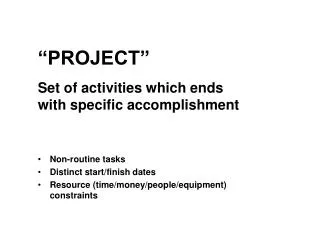
“PROJECT” Set of activities which ends with specific accomplishment • Non-routine tasks • Distinct start/finish dates • Resource (time/money/people/equipment) constraints
Project Plan • What • Tasks, activities • When • Schedule • How • People, equipment, $’s
Tasks • Short relative to project • Significant • Defined start/end points • Assign (1) duration, (2) resources • “verb-noun” name • "create drawings” • "build prototype” • “develop transmission”
Your Task Think of three tasks for the robot project, and describe to the person sitting next to you, who will record them. • Short relative to project • Significant • “verb-noun” name • "create drawings” • "build prototype” • “develop transmission”
Your Task For each task, assign a duration in days
Milestones • Tasks with 0 duration • Mark significant project checkpoints • Use to motivate • Use to check progress • Name by “noun-verb” • “report due” • “parts ordered” • “concept selected”
Your Task Think of three milestones for the robot project, and describe to the person sitting next to you, who will record them. Milestones should be spread out • Mark significant project checkpoints • Use to motivate • Use to check progress • Name by “noun-verb” • “report due” • “parts ordered” • “concept selected”
WBS and Gantt charts • Work-breakdown schedule (WBS) • A “to-do” list, sorted by category • Gantt chart • A bar chart • Tasks • Durations • Dependencies
WBS Task Time Concept generation Patent search 5 d Brainstorm 2 d Concept selection Develop criteria 1 d QFD process 3 d Pick concept 1 d
Closing Thoughts • Do early! • Plan will evolve ==> be flexible • Identify risk areas • Have a plan!