Advanced Techniques in Multi-View Stereo Reconstruction: A Review of Algorithms and Applications
This paper presents a comprehensive comparison and evaluation of multi-view stereo reconstruction algorithms, as discussed by Seitz et al. (2006). By analyzing calibrated images from multiple viewpoints, various techniques for generating 3D object models are explored. The evaluation covers merging depth maps, addressing artifacts, and optimizing surface extraction using least squares solutions. Significant insights are provided into advancements from sparse to dense reconstructions, exemplified by models like the Temple and Venice. This work aids in understanding the evolution and practical implementation of multi-view stereo methods.

Advanced Techniques in Multi-View Stereo Reconstruction: A Review of Algorithms and Applications
E N D
Presentation Transcript
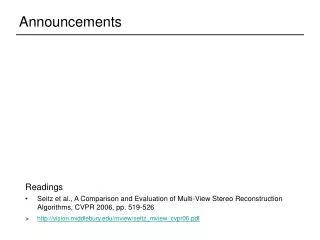
Announcements • Readings • Seitz et al., A Comparison and Evaluation of Multi-View Stereo Reconstruction Algorithms, CVPR 2006, pp. 519-526 • http://vision.middlebury.edu/mview/seitz_mview_cvpr06.pdf
Multi-view Stereo Apple Maps
CMU’s 3D Room Point Grey’s ProFusion 25 Multi-view Stereo Point Grey’s Bumblebee XB3
Multi-view Stereo Input: calibrated images from several viewpoints Output: 3D object model Figure by Carlos Hernandez
Fua Seitz, Dyer Narayanan, Rander, Kanade Faugeras, Keriven 1995 1997 1998 1998 Goesele et al. Hernandez, Schmitt Pons, Keriven, Faugeras Furukawa, Ponce 2004 2005 2006 2007
error depth Stereo: basic idea
merged surface mesh set of depth maps (one per view) Merging Depth Maps vrip [Curless and Levoy 1996] • compute weighted average of depth maps
Merging depth maps Naïve combination (union) produces artifacts Better solution: find “average” surface • Surface that minimizes sum (of squared) distances to the depth maps depth map 1 Union depth map 2
E ( ∫ N x ( 2 , f f ) ) = dx d ∑ i i = 1 Least squares solution
VRIP [Curless & Levoy 1996] depth map 1 combination depth map 2 isosurface extraction signed distance function
Merging Depth Maps: Temple Model 16 images (ring) 317 images (hemisphere) input image 47 images (ring) ground truth model Goesele, Curless, Seitz, 2006 Michael Goesele from [Seitz et al., 2006] temple: 159.6 mm tall
From Sparse to Dense Sparse output from the SfM system
From Sparse to Dense Furukawa, Curless, Seitz, Szeliski, CVPR 2010