Comparing Energy Storage Technologies: Pumped Storage and Compressed Air Solutions
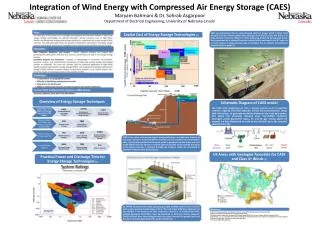
This overview discusses key energy storage technologies, focusing on pumped-storage hydroelectricity and compressed air energy storage (CAES) systems. It highlights the advantages and challenges associated with each technology, such as efficiency, capacity, and integration with renewable energy sources like wind. The analysis references various studies and laboratory findings, including modeling competition between gas turbines and CAES for supplemental generation. Understanding these technologies is crucial as we transition towards more sustainable energy systems.

Comparing Energy Storage Technologies: Pumped Storage and Compressed Air Solutions
E N D
Presentation Transcript
[1] Electric Storage Association, Technology Comparison, www.electricitystorage.org/technology, April 2009. • [2] http://en.wikipedia.org/wiki/Pumped‐storage_hydroelectricity. • [3] Argonne National Laboratory. Compressed Air Energy Storage (CAES) in Salt Caverns. Argonne National Laboratory, 2009. • [4] Greenblatt, J. B. et. al. Baseload wind energy: Modeling the competition between gas turbines and compressed air energy storage for supplemental generation. Energy Policy, 35(3), 1474-1492, 2007. • [5] US Census 2000, NREL, 2001/2/6 • References: Integration of Wind Energy with Compressed Air Energy Storage (CAES)Maryam Bahmani & Dr. Sohrab AsgarpoorDepartment of Electrical Engineering, University of Nebraska-Lincoln