
Understanding Biological Macromolecules: Carbohydrates, Lipids, Proteins, and Nucleic Acids
This text provides an overview of the four major classes of biological macromolecules: carbohydrates, lipids, proteins, and nucleic acids. It explains the structure and functions of each category, detailing how carbohydrates are made of monosaccharides and form rings, how lipids consist of glycerol and fatty acids, the complex structure of proteins from amino acids and their various structural levels, and the composition of nucleic acids from nucleotides. Each macromolecule plays a crucial role in the biology of living organisms.

Understanding Biological Macromolecules: Carbohydrates, Lipids, Proteins, and Nucleic Acids
E N D
Presentation Transcript
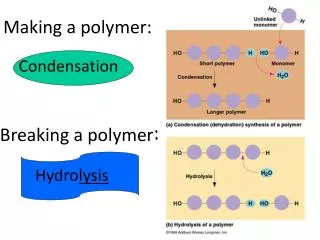
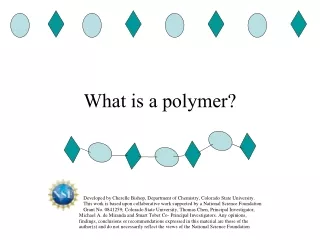
Breaking a polymer: Hydrolysis Making a polymer: Condensation
In solution, most simple sugars form RINGS.
Polysaccharides Starch: Cellulose:
2. Lipids—Contain large nonpolar regions Glycerol + 3 Fatty Acids = Triglyceride (fat)
Fats can be saturated or unsaturated Solid at room temperature Liquid at room temperature
CHOLESTEROL Steroids have 4 rings and a tail
3. Proteins—Made of amino acids Peptide bonds form between amino acids Primary structure– sequence of amino acids
Secondary Structure Alpha Helix And Beta Pleated Sheet Held together by H-bonds
Tertiary Structure—held together by hydrogen bonds, disulfide bridges, hydrophobic interactions, van der Waals forces, and ionic (electrostatic) interactions
Quaternary Structure—held together by hydrogen bonds, disulfide bridges, hydrophobic interactions, van der Waals forces, and ionic (electrostatic) interactions











![READ [PDF] FaeMaker: Making Fantasy Characters in Polymer Clay](https://cdn7.slideserve.com/12458581/slide1-dt.jpg)
