Chapter 10 Washington and Adams
560 likes | 687 Vues
Chapter 10 explores the rapid population growth in the U.S. post-1789, the development of the first presidential cabinet, and the emergence of political parties. With a population of 4 million people, 90% of whom were rural, the nation faced challenges in governance and economic management. Key figures like Washington and Hamilton championed strong governance, while Jefferson supported agrarian values. The chapter details critical events such as the Whiskey Rebellion and the formation of the Federalist and Republican parties, shaping the early political landscape of the United States.


Chapter 10 Washington and Adams
E N D
Presentation Transcript
Chapter 10 Washington and Adams
Rapid Growth • Population doubling every 25 years - 4 million people - 1790 • 90% rural - only 5% lived west of the Appalachian Mountains • Largest city - Philadelphia • World was watching: feared both failure and success of US
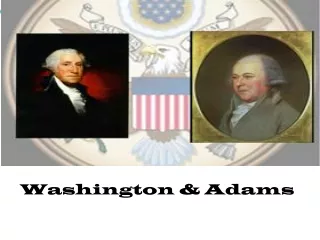
Washington - 1789 • Unanimous vote - no political party • Good character, not necessarily a good politician! • Inauguration - NYC, April 30, cannons, flowers, singing • Couldn’t blame others, set standards for presidency
Creation of the Cabinet • Not mentioned in Constitution • “May require” written opinions of the heads of the executive departments (supply advice) • At first only 3 Departments - all headed by a Secretary
Secretary of State - Thomas Jefferson - deals with foreign affairs • Secretary of Treasury - Alexander Hamilton • Secretary of War - Henry Knox - head of army and navy • Attorney General - Edmund Randolph - comes in later
Hamilton • Federalist, wanted active government - to help economic growth • Powerful commercial nation with high tariffs to pay for education, growth, promote immigration • Anti-Slavery, financial wizard • “Loves country more than countrymen”
Jefferson • Republican Party (Democratic-Republicans) • Laissez-faire government - “Government that governs least governs best” • Quiet agrarian nation, low tariffs, for the common people • Slaveholders and landowners
Judiciary Act of 1789 • Created the federal courts • Organized Supreme Court - hear appeals from Circuits Courts • Chief Justice - John Jay - and 5 Associate Justices • 13 District Courts and 3 Circuit Courts
Bill of Rights • 1791 - First 10 amendments • Major criticism of Constitution by the Anti-Federalists • Protect individual rights from the strong central government • 2 Ways to propose amendments - 2/3 of Congress or Conventions
James Madison feared a new convention would lessen Federalist victory - drafted amendments himself • Adopted 1791 • Amendments 9 and 10 very important - other rights and states rights
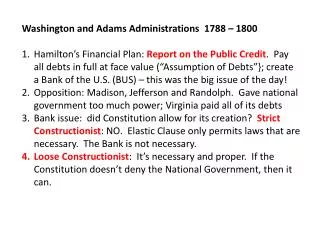
Four Major Programs • Alexander Hamilton • Payment of the National Debt • Payment of State Debts • The Bank of the United States • Customs Duties and Excise Taxes
1. Payment of the National Debt • During Revolution - gov’t sold bonds (promised payment with interest) and issued paper money • Hamilton wants government to fund national debt “at par” - face value with interest ($54 million) • Thought debt would ensure longevity?!
People had lost faith in bonds and sold them to rich speculators • Hamilton criticized - rich are getting richer - mostly Northerners • Plan passed by Congress - called the “funding fathers”
2. Assumption of State Debts • Hamilton wants gov’t to assume state debts ($21 million +) • South opposes - little debt - had already paid them off - angry - South would once again help pay debt of North
Jefferson returns from France and argues against • Hamilton pleads for his support • Compromise - Jefferson will support and sway votes if Hamilton agrees that the nations new capital will be located in Virginia on banks of Potomac
3. The Bank of the US • Hamilton wants federal bank in which Nat’l gov’t would be major stockholder - 1/5 of share to gov’t, 4/5 private investors • Tax $ and private $, could make huge loans if necessary • Washington asks for opinions!
Jefferson cries out against the bank - fights for states rights - state banks would die • Strict Constructionist • Hamilton argues for the bank - Elastic Clause “necessary and proper” • Loose Constructionist • Washington signs into law
4. Customs Duties and Excise Taxes • Money to pay debts from customs duties derived from high tariffs • Tariff on foreign trade (first one - 8% on imports) • Also wants to protect US manufacturers - wants industrial revolution to spread to the US • Agrarian Congress - little increases
Whiskey Tax • Levied an excise tax on making and selling of whiskey 7 cents/gallon • Mainly affected backcountry distillers - easier to transport whiskey than grain • Also a form of currency for many • Angry farmers get together and rebel
Washington summons militia to put down rebellion in western Pennsylvania (13,000) • No real battle, most had fled (3 killed) Whiskey Rebellion - 1794 • Few captured and pardoned by Washington • New respect for Washington’s new government
Political Parties • Develop out of Hamilton/Jefferson feud • Only factions before Washington era - No parties • 2 Distinct parties by 1792/93 - Hamiltonian Federalists, Jeffersonian Republicans
Hamiltonian Federalists • Believed in rule by the “best people” - upper classes • Those who own the country ought to govern it - common man -dumb • Supported strong central gov’t - should foster business not interfere with it
Pro-British - wanted friendly ties with G.B. - needed them to trade with - some mild Loyalists still sentimental to mother country • Made up mostly of merchants, shippers, and manufacturers
Jeffersonian Republicans • Also party of James Madison • Wanted weak central gov’t - “government that governs least governs best” • Bulk of power should be retained by the states - people remain in closer contact
Rule for the people, but not all of the people - only people who were literate and could make informed decisions • Freedom of Speech necessary to voice against the government • Pro-French - ideals of revolution • Made up mostly of agrarians from the South and Southwest
French Revolution • Began in 1789 (26 years) • Affected American political and social life - saw is as continuation of own Revolution • France proclaims itself a republic - excited Americans • England later sucked into the conflict - Americans mixed
Washington's Second Term • Both France and G.B. want US on their side • US had an alliance with France to help defend West Indies • Republicans want to honor Alliance obligation • Federalists want to avoid war altogether
Neutrality Proclamation - 1793 • Washington wants to avoid war at all costs - weak military, shaky economy, political disunity • Best for the country - need time to grow - both parties agree • Issued Proclamation - warned people to be impartial to both countries
Citizen Edmond Genet - French Representative in US - tried to bring US into the war - underhanded - replaced later • France would actually gain more if US remained neutral - could be a provider • G.B. upset with the proclamation
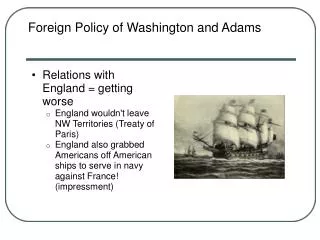
Seizing US ships, taking supplies, impressing Americans into service, threw some in dungeons, people very upset • Federalists stay calm - need British for the economy • Republicans want war - defend liberties - at least an embargo
Jay's Treaty • Washington sends John Jay to England in 1794 - upset Republicans - thought he would sell out • British promised to evacuate posts on US • Promised to pay damages for the seizures - no promise to stop
Bound US to pay pre-war debts • Outraged Jeffersonians - Southern farmers would foot the bill again, Northern shippers being paid for damages • Washington backs treaty - avoid war - narrowly passes Senate • Created deep split between Federalists and Republicans
Jay’s Treaty • John Jay (Chief Justice) sent to London for agreement • England leave all forts in Northwest Territory • Expand trade • Treaty didn’t end English stopping US ships searching for British subjects
Pinckney's Treaty • Spain fears Anglo-American alliance - 1795 • Granted free navigation of the Mississippi River • Yielded large area north of Florida to the United States
Washington's Farewell • Begins tradition by deciding not to run for a 3rd term - exhausted and tired of verbal abuse • Great accomplishment - he kept us out of war • Farewell Address - not delivered orally, but published in newspapers
Warns of the dangers of three things! Peace out!
Rise of political parties - need cooperation to run government • Sectionalism - political divisions based on geography • Involvement in foreign wars - avoid permanent alliances - alright in emergencies - isolationism
Election of 1796 • Federalists - John Adams (71) • Republicans - Thomas Jefferson (68) - becomes vice-president • Campaign focuses on personalities • Issue also becomes Jay’s Treaty
Adams Faces Many Problems • Washington’s successor • Hated by Hamilton - resigns from Treasury • Cabinet was against him • Inherited quarrel with France • Vice-President from different party
Adams as President • Didn’t have prestige as Washington • Known as very honest, devoted to public service • Cooled relations with France • Failed to silence critics (decreased popularity)
Quasi-War with France • Undeclared war with France • French upset w/Jay’s Treaty - saw it as alliance w/England - violated Franco-American Treaty of 1778 • French warships begin to seize defenseless American vessels (about 300
French regime refused American diplomats to Paris • American people are outraged and want respect - Adams wants to stay out of any kind of war • Leads to deteriorating relationship with France in the 1790’s • Adams tries a final time to negotiate
XYZ Affair • Cause of the undeclared war • Adams sent 3 men headed by John Marshall to meet with Tallyrand (Foreign Minister) • Secretly approached by 3 go betweens known as X,Y,Z • Want loan and bribe to meet • Intolerable - return home
X Y Z Show us the Money!
War Preparations - 1798 • Created Navy Dept., expanded Navy • Established Marine Corps • New Army of 10,000 led by Washington/Hamilton • Undeclared battles, sea warfare • Navy captured 80 vessels, lost hundreds of merchantmen
France doesn’t want war - no new enemies, spread out the fight, didn’t want GB and US close again, Napoleon wants power in Europe • Tallyrand invites America to send a new Minister • Adams also wants to avoid full scale war - nations too weak and young - would have increased his popularity
Convention of 1800 • Sent 3 envoys to Paris • Welcomed by Gov’t - Napoleon • Granted break from Treaty of 1778 • Americans had to pay damages to American shippers • Impact on future (Louisiana)
Alien and Sedition Acts Measures passed by the Federalists designed to muffle or minimize their foes (Republicans) and Silence their critics