Download

1 / 20
200 likes | 313 Vues
This overview explores the rise in global population, from 6 billion in 1999 to an estimated 7 billion in 2020, highlighting the challenges faced, including shortages in resources, environmental degradation, and economic strains. Demography is crucial for analyzing population changes and helping governments make informed decisions. The complexity of census data, particularly in developing countries, reflects the challenges in accurate population tracking. The document also discusses migration trends, emphasizing the reasons behind immigration to Canada, including economic opportunities and asylum seeking.

E N D
Ch. 13 – Population: Canada and the World Social Studies 11 Ms. Shrieves
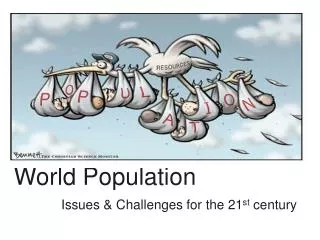
Introduction • 1999 – The world had 6 Billion People (UN) • 2020: Estimated 7 Billion • What are the consequences of a rise in population? • Question being asked by these people? • Other side of the argument: • - Shortages in energy, housing and food, an increase in pollution, unemployment and the destruction of the environment. • At what point will the world’s resources fail to support it’s population • Technology will find ways to provide for increased # of people
World Population Growth • Why would there have been a rapid growth in population in the twentieth century? Hans Rosling on Global Population Growth Video
Demography • Demography: The statistical study of human populations • Why is demography important? • Helps to understand the causes and consequences of population change • Gives local, provincial and federal governments accurate statistics of population shifts Business like information about family size, incomes and consumer habits as they plan their marketing strategies
Census • Census:. • Canada conducts a detailed census The formal counting of people every ten years
Limitations of the Census • Difficult to keep track of people with no fixed address. • People may fear the authorities so not put down truthful information. • Illiteracy and poor communication networks undermine a nations ability to maintain accurate records. • In developing countries – data is much less accurate due to incomplete registration of births and deaths.
Developed Countries • Have highly developed economy • Citizens have the highest standard of living in the world • High levels of literacy, health services, and food supplies
Developing Countries • An economy that depends more on primary industries. • Citizens have lower standard of living than those in developed countries • Usually highly indebted.
Least Developed Countries • Given to those who have exhibited the lowest levels of socio-economic development • Very much indebted to developed countries. • Political unrest.
Population Rates • Three components of population change • 1. How many people are born • 2. How many people die, and • 3. How many people move in or out of an area (immigration or emigration)
Population Rates • Crude Birth Rate = Number of births in one year Population X 1000 • Crude Death Rate = Number of deaths in one year Population X 1000 • Rate of Natural increase = Deaths – Births
The Rule of Seventy -Exponential rate of increase: a rapid rate of increase as each generation doubles in size. - Doubling Time: The number of years it takes a country to double its population at its current birth rate. - “Rule of Seventy” states that doubling time is approximately equal to 70 divided by the growth rate (%) per year.
The effect of Migrations • Population increase in some countries (esp. Canada) depends on immigrants • Emigrants leave every year as well, which will affect the demography. • Immigration Rates: Rates at which people immigrate to a country usually based at the number of people per thousand who enter a country. • Emigration Rates: The rate at which people emigrate, usually based on the number of people per thousand who leave a country • Net Migration rate: Difference between immigration and emigration rates.
Why do people migrate to Canada? • Most immigrants to Canada come as economic migrants from developing nations, wanting to better their standard of living. • Others come as refugees seeking to escape persecution in their home country.
Homework: • Textbook Page 322: #2 (a and b) and #3 • Read Page 322 – 328