Final Exam Preparation and Review Session Details for Programming Course
Attention students! Check your grades posted on the door of room 5141 Upson and prepare for the upcoming final exam. Join the review session with Alan on Sunday night to clarify any last-minute doubts. Final Exam is scheduled for Tuesday, August 10, at 8 AM in Olin 155. A review sheet has been distributed, so ensure you're familiar with the material. Don’t forget to bring pictures and a note if you seek a letter of recommendation. Review all quizzes and assignments thoroughly to maximize your performance!

Final Exam Preparation and Review Session Details for Programming Course
E N D
Presentation Transcript
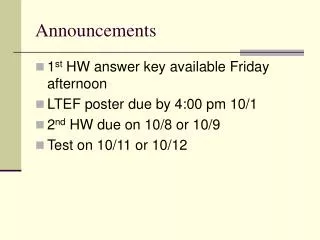
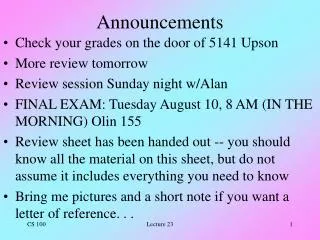
Announcements • Check your grades on the door of 5141 Upson • More review tomorrow • Review session Sunday night w/Alan • FINAL EXAM: Tuesday August 10, 8 AM (IN THE MORNING) Olin 155 • Review sheet has been handed out -- you should know all the material on this sheet, but do not assume it includes everything you need to know • Bring me pictures and a short note if you want a letter of reference. . . Lecture 23
Review. . . • Know the prelim! • Know the material on the quizzes! • Go over your assignments and make sure you understand where you made mistakes and how you’d fix them. Lecture 23
Control structures • if • if/else • while • for Lecture 23
Classes and subclasses • What’s a class? • What’s an object? • What’s a class hierarchy? • What’s inheritance? How does it work? • What are constructors? What’s super? Lecture 23
More on classes • public vs. private fields and methods • What does it mean to override a method? • Give an example • What does it mean to overload a method? • Give an example Lecture 23
Scope of variables? public class Coordinate { public int x; public int y; public Coordinate(int xx, int yy) { x = xx; y = yy; } public void swapFields() { int tmp; tmp = x; x = y; y = tmp; } • What’s scope? • What’s the scope of a parameter? • A local variable? • A field of a class? Lecture 23
Static • Static variables in a class • Static methods -- give an example? • Why use static variables and methods? Lecture 23
Methods • What are the infamous FOUR STEPS? • What’s a frame? How/when is a frame created? • Know how to draw and label a frame correctly • Call-by-value • Parameter passing (primitive types vs. object references) • return Lecture 23
Operators and statements • The ternary operator in Java • ++, --, -=, += • break; • continue Lecture 23
Arrays • How to declare an array? • How to initialize an array? • Arrays as parameters in C? • Arrays of objects Lecture 23
Search algorithms • Binary vs. linear search • Write linear search • Sketch binary search Lecture 23
Sorting algorithms • Describe each, including bubble sort • Be able to read and debug search algorithms • Understand the partition algorithm Lecture 23
Efficiency • How is the efficiency of an algorithm measured? • What’s linear -- O(n)? • What’s logarithmic -- O(log n)? • What’s the n refer to here? Lecture 23
Matlab • What’s the fundamental data structure in Matlab? • Linspace? What’s that? • Know the colon/semicolon notation • How do you access the row of a matrix? • How do you access the column of a matrix? Lecture 23
More Matlab • What’s the transpose of a matrix? • What does f(x) do in Matlab if x is an array? • What do the control structures look like in Matlab? • Be able to read Matlab code and generate some yourself. Lecture 23
Recursion • What’s recursion? • Give examples of recursive algorithms • Be able to write a small recursive algorithm (something like factorial, for example) Lecture 23
Advanced Topics • What are threads? • What’s the abstract modifier all about? • What are interfaces? When would you use one? • What are exceptions? Lecture 23
C • What are the advantages and disadvantages of C vs. Java? • What are pointers? • Be able to read C code (small examples as presented in class) and understand it Lecture 23
Final thoughts • In 1995, One of the inventors of Java, Bill Joy, said: “Java is just a small, simple, safe, object-oriented, interpreted or dynamically optimized, byte-coded, architecture-neutral, garbage-collected, multithreaded programming language with a strongly typed exception-handling mechanism for writing distributed, dynamically extensible programs.” • Remember: You never finish a program, you just stop working on it. . . • Fun book: Snow Crash by Neal Stephenson Lecture 23