Understanding the Four Groups of Carbon Compounds in Living Organisms
This overview highlights the four essential groups of carbon compounds found in living things: Carbohydrates, Lipids, Proteins, and Nucleic Acids. Carbohydrates, such as glucose, provide energy and consist of carbon, hydrogen, and oxygen. Lipids, including fats and oils, serve for energy storage and cell membrane formation. Proteins, made up of amino acids, are vital for structural support and biochemical reactions. Finally, Nucleic Acids, like DNA, hold the genetic blueprint required for protein synthesis. Understanding these macromolecules is crucial for biology and life sciences.

Understanding the Four Groups of Carbon Compounds in Living Organisms
E N D
Presentation Transcript
MACROmolecules BIG molecules
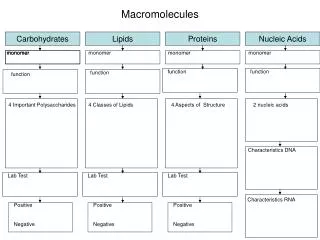
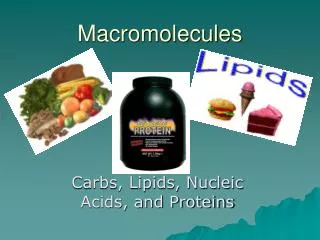
What are the four groups of carbon compounds found in living things? • Carbohydrates • Lipids • Proteins • Nucleic Acids
1. Carbohydrates Glucose Molecule Made of… Carbon Hydrogen Oxygen Examples: glucose fructose lactose Function: Provides Energy Monomer: Monosaccharide Mono = one Saccharide = sugar
2. Lipids Made of… Carbon Hydrogen Oxygen Examples: Fats Oils Waxes Cholestrol Function: energy storage, cell membrane, hormone Monomer: Triglyceride (three fatty acids, 1 glycerol)
3. Proteins Large molecule made of… Carbon Hydrogen Oxygen Nitrogen Sulfur Examples: hemoglobin (in blood) Actin & myosin (muscles) Keratin (hair, nails) Monomer: Amino acids (20 total) Function: structure, aid in chemical reaction, immune response
4. Nucleic Acids Monomer made of… Carbon Hydrogen Oxygen Nitrogen Phosphorous Examples: DNA (deoxyribo-nucleic acid) Function: contains the info cells need to make proteins (“blueprint” for life) Monomer: Nucleotide (contains sugar molecule, phosphate molecule, & base molecule)