Download
1 / 20
210 likes | 395 Vues
This article explores the concepts of hybridization in carbon compounds, focusing on sp3, sp2, and sp hybridization. It provides insights into the formation of single, double, and triple bonds in various carbon compounds, using examples like methane (CH4), ethylene (C2H4), and acetylene (C2H2). The text includes details on bond lengths, energies, and the significance of molecular orbitals in determining chemical behavior. Additionally, it highlights the behavior of electron delocalization in polyenes and benzene, crucial for understanding organic chemistry.

E N D
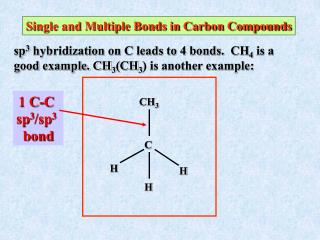
Single and Multiple Bonds in Carbon Compounds sp3 hybridization on C leads to 4 bonds. CH4 is a good example. CH3(CH3) is another example: 1 C-C sp3/sp3 bond CH3 C H H H
sp2 sp2 C sp2 sp2 C sp2 sp2 Carbon can also exhibit sp2 hybridization: C2H4 (ethylene) H H H H
C C 2 of sp2 orbitals on each C form C-H bonds ( total of 4 ) Remaining sp2 on each c overlap each other gives C-C bond This uses 3 valence e - from each C to form 5 sp2 bonds ( bonds) H H 120˚ 120˚ H H (EachC contributes 1 valence e - to C-C bond.)
+ C C – Up to this point, need not be planar because bond symmetric under rotation. 2p + + C C – – bond
C C bond H H + + sp2 sp2 120˚ - - H H
C C H H sp2 sp2 H H Planar Ethylene
C C H H – + + – H H Nodal Line * transitions in ethylene occur around 1700 Å (58,500 cm-1) Corresponds to an energy of about 600 kJoules/mole
States in Ethylene * E 2py 2py C (Atom) C (Atom) Molecule E = h = hc/ 1700 Å * Photon E = h
H H + H C C H H H Saturated carbons form only bonds, and * higher in energy than π* (start to absorb ~ 1600 Å) bond formed from two sp3 hybridized orbitals Cylindrically symmetrical about C-C bond.
C sp sp sp sp C Carbon sp hybrids: Acetylene and the Triple bond C2H2 is H-CC-H + H - + - H
H-C-C-H 2py 2py 2px sp H H C C 2px
Short Comparison of Bond Order, Bond Length, Bond Energy C-C C-C C-C Molecule Bond Order Bond Length Bond E, kcal/mole Ethane, C2H6 1 (1 ) 1.54Å 83 Ethylene, C2H4 2 (1, 1π) 1.35Å 125 Acetylene, C2H2 3 (1, 2π) 1.21Å 230
Although energy of π* in ethylene < *, conjugated polylenes have even lower energy π* levels. These absorb light at longer wavelength- sometimes even in visible (human eye’s light perception). Conjugated polyenes: C=C-C=C-C=C polyene
C C C C C C C C C C C C MO = (Const)[2py(1) + 2py(2) + 2py(3) + 2py(4) +2py(5) + 2py(6) +………]. Add 2py Atomic Orbitals on each C This gives delocalized structure
C C C C Energy H2C=CH-HC=CH2 * antibonding levels E=h (photon) 2p orbitals (one each on 4 carbons) bonding levels E=h for butadiene << E=h for ethylene Molecular Orbital Energies
C C C C C C H H Electron Delocalization in Carbon Ring Compounds 120˚ sp2 H H H H
or This islocalized picture!
+ + + + + + – – – – – – Delocalized Picture H H H H Can form bonds with these p orbitals. H H MO = (Const)[2py(1) + 2py(2) + 2py(3) + 2py(4) +2py(5) + 2py(6)] Add 6 2py Atomic Orbitals on each C There are 6 such combinations!
MO = (Const)[2py(1) + 2py(2) + 2py(3) + 2py(4) +2py(5) + 2py(6)] Add 6 2py Atomic Orbitals on each C
Can actually form a total of 6 delocalized M.O.’s for benzene (6 2p Atomic Orbital’s 6 M.O.’s). Energy + Antibonding orbitals 0 (isolated C 2p) π2b π3b Bonding orbitals _ π1b