Download
1 / 8
80 likes | 191 Vues
This document provides an in-depth analysis of the freight data related to Washington's potato production and diesel distribution. It uses USDA and state commission data to map supply chains and identify key processors. Additionally, it examines the regulatory landscape involving diesel distribution, encompassing multiple agencies such as WA DOA and WA Department of Ecology. The study aims to identify high-volume and high-value commodities, outline problematic areas in commodity disaggregation, and propose five supply chain examples to illustrate the complex interactions in local freight movement.

E N D
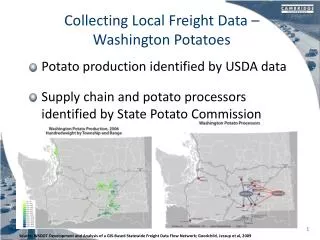
Collecting Local Freight Data – Washington Potatoes • Potato production identified by USDA data • Supply chain and potato processors identified by State Potato Commission Source: WSDOT Development and Analysis of a GIS-Based Statewide Freight Data Flow Network; Goodchild, Jessup et al, 2009
Collecting Local Freight Data – Diesel Distribution • Sources of diesel data • WA DOA – regulates fuel at gas stations • WA Department of Ecology – regulates active underground storage tanks • U.S. EPA – regulates above-ground storage tanks • WA DOR – responsible for assessing and collecting fuel taxes at terminal locations • Other agencies monitor mode-specific activity (e.g., pipeline, waterborne activity, railroads) Source: WSDOT Development and Analysis of a GIS-Based Statewide Freight Data Flow Network; Goodchild, Jessup et al, 2009
Collecting Local Freight Data – Diesel Distribution (continued) Source: WSDOT Development and Analysis of a GIS-Based Statewide Freight Data Flow Network; Goodchild, Jessup et al, 2009
Development of Generic Supply Chain Descriptions • Identify commodities that represent high volume and high value • Identify industries and commodities where disaggregation have been problematic • Based on literature review • Identify industries and commodities where CFS data are weak
Development of Generic Supply Chain Descriptions (continued) • Propose to identify five supply chains total • Potential candidates include • Containerized imports of retail consumer products • Bulk domestic products (e.g. agricultural products) • LTL shipments of mixed manufactured products • Domestic plastics and rubber manufacturing • Building and/or road construction • Parcel and mail shipped commodities
Transportation and shipment size: to D/C is rail carload and truckload; to stores are truckload; local vendors are small local peddle trucks Distribution: Demand pull from point of sale data. Finished goods are nationwide; regional D/Cs are local Food Processors’Plants and D/Cs Supermarket’s Facilities FinishedGoods RegionalD/C Stores Consumers LocalVendors Supply Chain Example: Supermarket
Transportation and shipment size: to site and yards are truck of various sizes Distribution: Timely sequencing/staging is key. Materials to be installed are national; supplies and equipment for use in erection of facility are regional/local Distributors Construction Site Short-Term Inventory;Materials To Be Erected Inventoryfor Site ErectedFacility Equipment,Forms, Trucks,etc. ConstructionSupplies, Tools Contractor’s Yard TemporaryYard; Near Site Example: Construction
Transportation and shipment size: to warehouse, distributor, D/Cs, supermarkets’ D/Cs is rail carload and truckload Distribution: Slow, predictable. Finished goods are nationwide; D/Cs are regional Growers Processing Plant Distributor HarvestSlaughterShip Can, Dress, Freeze, Protect,Inventory Inventory Supermarkets’Regional D/C Flow Thru;Consolidations Inventory Inventory Warehouseat Origin Regional D/Cs Example: Food Processing and Distribution