IAB-RC Inverted Autonomous Balancer Remote Controlled
300 likes | 447 Vues
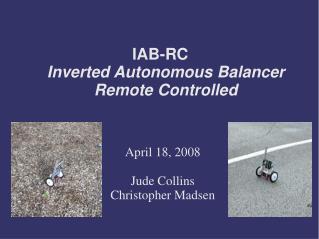
This final presentation details the development of an inverted pendulum robot, showcasing its autonomous balancing capabilities and remote control features. The presentation covers the robot's system overview, hardware components, and technical aspects, including sensors like the gyroscope and accelerometer, which help maintain balance. A comparison with prior art, such as Segway and nBot, highlights innovation in robot design. Key financial data and project scheduling are also reviewed, offering insights into the project's feasibility and execution.


IAB-RC Inverted Autonomous Balancer Remote Controlled
E N D
Presentation Transcript
April 18, 2008 Jude Collins Christopher Madsen IAB-RCInverted Autonomous BalancerRemote Controlled
Final Presentation • Technical aspects of the robot • Prior art • Schedule • Finances
Overview • Robot system overview—Chris • Capabilities • How it works • Robot hardware • Remote control—Jude • Controller hardware • PC • N64 Controller • PDA
Overview • Literature/product search—Chris • “Trajectory Tracking Control for Navigation of Self-contained Mobile Inverse Pendulum” (1994). • Segway (2002). • David P. Anderson's “nBot” (2003). • Schedule and finances—Jude • Questions
Capabilities • Balance • Stand up • Lay down • Slide • Jump curbs • Crash • ?????
How does it work? • Hardware calculates “lean” of the robot • Wheels turn to prevent “lean” • Forcing the robot to lean causes the robot to drive • The robot learns to lean into external forces to keep balanced • Spinning one wheel faster than the other causes the robot to turn • Kicking the robot may make the robot angry
Microcontroller • MSP430F1611 • Running 4 MHz • 12 bit A/D with 8 pin-accessible inputs • Two 16 bit timers • 1.8-3.6v • Programmed in C
Inertial Measurement Unit • IDG-300Gyroscope • ADXL-330Accelerometer
IDG-300 Gyroscope • Dual-Axis rate gyroscope • Operates by oscillating masses and capacitively measuring vibration caused by Coriolis effect. • Sensitivity: 2 mV/deg/s • Max rate: 500 deg/s • Operating voltage: 3.0-3.3v
ADXL-330 Accelerometer • Triple-axis accelerometer • Micro-machined structure suspended over silicon by polysilicon springs. Plates mounted on moving structure and a fixed structure act as a variable capacitor in a filter circuit to measure acceleration. • Sensitivity: ~300mV/g • Max acceleration: ±3.0g • Operating voltage: 2.0-3.6v (sensitivity is ratiometric)
Estimating pendulum orientation • Integrating rate gyros is subject to drift errors. • Accelerometers only work to determine orientation when not accelerating. • Using both estimates together gives better estimate of orientation.
Bluetooth Radio • Basically a breakout board for NXP's BGB203. • Class 1 so has a 100m range • 100 mW max transmitted power • 3.3 volts • 1 Mbps max UART
Computer • Communicates via Bluetooth dongle • Used for early verification of control law • Jitter in transmission limited stability
The Remote Control • Needed Peripherals • Joystick • A few buttons • Modify old N64 controller. • Exceeds requirements • Cheap ($5-$15 on Amazon.com)
The microcontroller • Needed peripherals • UART • High clock frequency • Low Vcc • ATMEGA8515L • UART • 20 MHz • 2.7 – 5.5 V • Low Cost ($3.06-$5.27 Digikey.com)
PDA • Can also be used to remotely control robot. • And ?????
Prior art • First appearance of similar two-wheeled inverted pendulum that can navigate in 2 dimensions on a plane: “Trajectory Tracking Control for Navigation of Self-contained Mobile Inverse Pendulum” by Yunsu Ha and Shin'ichi Yuta of Japan in 1994. • Position encoders on wheels (2000 step) • Sensors to detect obstacles • No remote-control
Prior art • Segway • Most popular inverted-pendulum type product. • Patented just about everything imaginable concerning inverted pendulum human transportation. • Have several Robotic Mobility Platform (RMP) models
Prior art • David P. Anderson's nBot • Received NASA's Cool Robot of the Week award and subsequently became well-known in the minds of robotics enthusiasts (2003). • Launched a revolution of inverted-pendulum robot building. • Homebrew shaft encoders.
How are we different? • Back EMF encoders rather than mechanical encoders. • Bluetooth radios enabling hardware-in-the-loop simulation. • Stands up autonomously. • Lays itself down gently. • And ?????
Finances • Allotted budget: $1000 • Expenditures: ~$500 • Main expenses: • 1 IMU -- $110 • 2 Bluetooth radios -- $120 • 1 MSP430 on breakout board -- $50 • 2 Motors and H-Bridges -- $80