Download
1 / 10
100 likes | 218 Vues
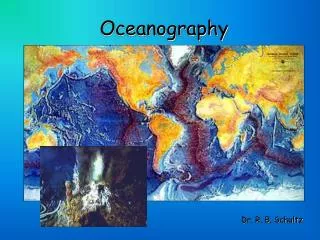
Oceanography is the scientific study of the oceans and their ecosystems, focusing on marine biology and the diverse organisms that inhabit these vast waters. Covering approximately 71% of the Earth's surface, the ocean's maximum depth reaches around 11,022 meters, compared to land's Everest peak at 8,848 meters. Despite contributing only 2% of human food, oceans provide 20% of high-quality protein. Remarkably, NASA scientists emphasize our limited knowledge of ocean depths compared to celestial bodies. This field reveals essential insights into the unique life forms and nutrient cycling of aquatic environments.

E N D
What is Oceanography? The scientific study of the ocean and its inhabitants
Marine Biology – biological discipline; focused on the biology and physiology of marine organisms
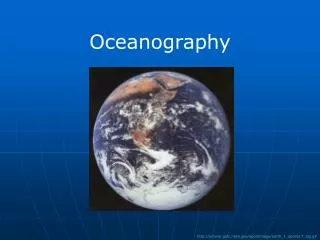
~71% of the earth’s surface are oceans Maximum depth: ca. 11,022 m (Trieste) (Land: Mt Everest 8,848 m) Average depth: ca. 3800 m Total volume: 1370 x 106 km3 Presents 300 times space for life than land and freshwater combined.
Only 2% of human food originates from the oceans but present 20% of high quality protein nutrition Still recent NASA scientist said: “We now know more about the backside of the moon than about the depths of our oceans.”
Marine vs. Terrestrial Life Organisms – similar density as environment (salt water) less energy to float/swim… small effect of gravity Organisms – much higher density than air.High gravity impact (fall down)
Water supports bodies, no need to put energy in skeletons Plenty of water for life Temperature variation low Need strong skeletal material (animals: bones; trees: trunks) May become water limited Temperature varies strongly
Light limited: reflection of light at sea surface and rapid light absorption with water depth Nutrient limited: nitrate, phosphate, silicate, iron Light energy substantially higher than in aquatic systems, low absorption by air High nutrient concentrations in natural soils
Major part of nutrient cycling in the dark deep-sea Physically unstable habitats Nutrient cycling in soil close to plant uptake Physically stable environment